
A walk-in cooler that repeatedly starts and stops when the weather turns cold needs a documented control and refrigeration diagnosis. Cold weather does not, by itself, prove that the system needs more refrigerant. Ask the technician to identify what is actually stopping the compressor, verify the installed low-ambient provisions against the exact equipment instructions, and demonstrate stable operation under the conditions that produced the complaint before closing the repair.
For a manager, the immediate priorities are protecting the stored product, preserving useful observations and arranging qualified service. Do not repeatedly reset the equipment, block the condenser with cardboard, disconnect a fan, turn pressure-control adjustments or order a different refrigerant as a shortcut. Those actions can hide the initiating fault and create additional risks. If there is a suspected refrigerant leak, electrical damage or another immediate hazard, follow the site’s emergency procedures and keep people away from the affected area.
This guide concerns commercial walk-in coolers served by an air-cooled condensing unit in an outdoor or otherwise unheated location. The operating question is how to approve the service scope and verify the result. It is not a universal winter charging procedure. A packaged reach-in, a water-cooled unit and a remotely controlled rack can have different sequences, so the exact model and installed controls must lead the diagnosis.
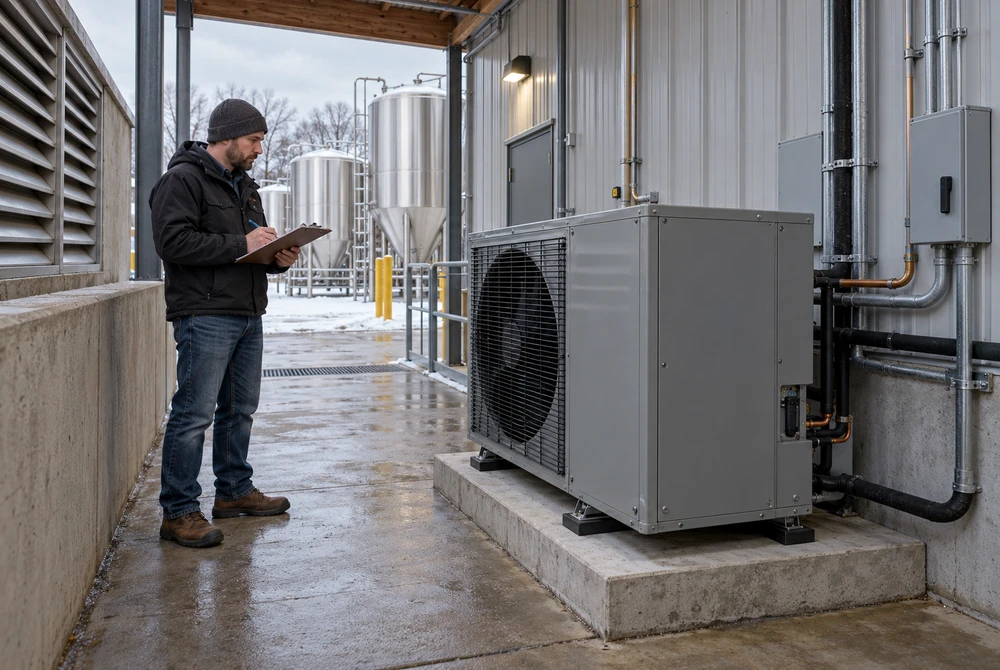
What does short cycling mean in this particular installation?
Short cycling describes repeated compressor starts and stops that are inconsistent with the intended operating sequence. It does not identify the cause. Before calling a repair successful, establish whether the compressor is stopping, only a condenser fan is cycling, or the display is changing while the machinery continues running. These are different events. A person standing outside the service area may hear a fan change speed and reasonably describe the whole unit as switching off.
Record what you can observe without opening equipment. Note the time, the cooler display, the independent monitoring reading if one is available, whether the room is recovering toward its normal target, and the sounds or visible fan behavior. State uncertainty plainly. “The outdoor sound stopped while the display remained on” is more useful than “the compressor definitely tripped” when nobody has verified the compressor status.
A normal control sequence can include stopping after the thermostat is satisfied, scheduled defrost-related operation, a pumpdown sequence, capacity control or a protective delay. Those explanations must fit the installed system and its actual temperature history. A cycling pattern accompanied by warming product space, repeat alarms or failed recovery deserves investigation even if somebody says that cycling is normal in winter. The service report should connect each relevant stop to a specific control event.
Do not adopt another operator’s reported cycle duration as a pass or fail limit. A public brewery discussion describes a cooler that worked in summer but repeatedly cycled in cold conditions. That question shows why managers need an explanation beyond “add refrigerant”; it is not a source of acceptable cycle times or charging settings. Your equipment manufacturer’s sequence and the conditions of your installation govern the assessment.
Which records should the manager collect before service arrives?
Start a simple incident record with one responsible person maintaining it. Include the first observed symptom, the last known normal period, the weather change and any work performed immediately beforehand. Describe whether the problem occurs at opening, overnight, after a delivery, during a quiet period or after a scheduled defrost. A pattern across several events is often more useful than an isolated photograph of a temperature display.
Photograph accessible equipment labels without entering restricted areas or removing covers. The technician needs the condensing-unit model, unit-cooler identification, refrigerant designation and any visible controller information. If a previous retrofit changed the refrigerant, provide the service documentation rather than assuming that the original plate remains the whole story. A room called “the beer cooler” may contain equipment from different manufacturers with an installation-specific control arrangement.
Provide the last repair invoice, commissioning report and maintenance records that are already available. Highlight a recent controller replacement, fan repair, refrigerant addition, leak repair, equipment relocation or electrical interruption. Do not rewrite the records to fit a suspected cause. If an invoice simply says “topped up,” mark the amount, refrigerant identity and reason as unknown where they were not recorded. Missing information is itself a useful question for the next service visit.
Keep product decisions separate from the refrigeration diagnosis. Use the site’s established monitoring, hold and escalation procedures for the actual goods being stored. A room-air display cannot establish that every item is acceptable, and a successful restart cannot retrospectively establish that a temperature excursion was harmless. The responsible food-safety or quality person should decide what evidence is required for disposition under the applicable requirements.
Preserve the original time basis. A building alarm system, a stand-alone logger and a technician’s phone may use different time zones or have clocks that are not synchronized. Identify those differences before combining their records. Otherwise, a defrost event can appear to happen after an alarm when it actually preceded it. A useful event log records both the displayed time and any known offset instead of silently correcting selected entries.
Why can a cooler that worked all summer struggle in cold weather?
An air-cooled condenser rejects heat to surrounding air. The installation must remain within the manufacturer’s intended operating envelope as ambient conditions change. Some systems use specific controls and components to maintain appropriate operation at low ambient. The fact that the room needs cooling all year does not prove that an arbitrary outdoor condensing unit has the correct provisions for that duty.
Ask for a clear distinction between an installation that lacks the required low-ambient arrangement and an arrangement that is present but malfunctioning. The first may require an approved equipment-specific change. The second calls for diagnosis of the existing components and their inputs. Ordering a generic “winter kit” before checking the model, control strategy and existing equipment can duplicate parts or produce a configuration the manufacturer has not approved.
Heatcraft’s condensing-unit installation and operations manual, H-IM-CU-0725, July 2025, Version 010, discusses cold-weather starting and low-pressure short cycling. Its troubleshooting distinguishes pressure-control adjustment, refrigerant shortage and absent low-ambient provisions. That list supports a model-specific investigation, not a universal diagnosis. The instructions and values apply only where the installed equipment and configuration are covered.
For the service visit, request the applicable manual revision and the page or section used. A technician may properly use a newer document or a model-specific supplement instead. The important point is to establish why that document governs your unit. A table copied from an unrelated model, or a screenshot with the refrigerant column missing, is not adequate support for a change to operating controls.
Cold-weather correlation also leaves room for other causes. A failing electrical component, changing room load, a sensor issue or an existing refrigeration fault may become apparent during colder operation. The diagnosis should explain the observed evidence rather than assuming that everything beginning in winter is a low-ambient design problem. Record the conditions, but leave the causal conclusion to verified measurements and the correct sequence.
What must the technician identify before changing any settings?
The central question is: what command or protective function stops the compressor at the troublesome moment? Ask the technician to trace that event using the equipment’s intended control sequence. An operating thermostat, a pumpdown pressure control, a safety function and an internal compressor protection event are not interchangeable explanations. The repair should address the cause of the actual event while preserving required protections.
A useful report names the control or circuit, states the observed event and identifies the evidence used to verify it. “Low pressure” is incomplete if it is only a displayed value. “The low-pressure control opened during a cooling demand, confirmed against the installed control sequence and instrument readings” is a materially better description. If the evidence is still inconclusive, the report should say so and outline the next safe diagnostic step.
Clarify whether the room thermostat was calling for cooling when the stop occurred. Then clarify whether that call was actually reaching the relevant control. A satisfied thermostat and an interrupted demand signal can look similar from the operator’s desk. A controller display is valuable, but the technician may need to verify its inputs and outputs rather than treating every displayed status as proof of what the equipment received.
Request verification of the control’s function against the model-specific documentation, including the correct refrigerant and installed components. Do not ask the manager to make an adjustment using an online pressure chart. Any settings recorded on the service ticket should include their purpose and applicable reference. A numerical setting without its control identity or units is easy to misread on the next visit.
Where a protective function is opening, closing the job requires more than making it stop opening. The technician must establish why it was acting and verify that the corrected system operates with the required protection intact. A bypass that produces continuous operation is not evidence of a completed repair. If temporary supervised diagnostic measures are necessary, the technician should restore the intended final configuration and document that restoration.
How should a manager compare the possible repair scopes?
Ask for the smallest verified scope that resolves the demonstrated fault and supports the required operating conditions. This is different from choosing the cheapest description on an estimate. Two proposals may use similar words but include different diagnosis, approved components, leak work, control verification and follow-up. Compare those deliverables before comparing the total cost.
| Proposed scope | Evidence to request | Closure requirement |
|---|---|---|
| Control repair | Verified input and stop event | Correct sequence restored |
| Low-ambient upgrade | Model-specific approval | Installed configuration verified |
| Refrigerant work | Confirmed charge issue and cause | Repair and charge records |
| Monitoring visit | Unreproduced conditions | Defined follow-up and response |
These categories can overlap. For example, a verified control fault and a separate leak may both require work. The estimate should distinguish the evidence and work associated with each problem. The table does not prescribe the technical solution, and it should not be used to reject a justified combined repair simply because more than one category is present.
If an upgrade is proposed, ask whether it changes only an approved control arrangement or requires additional components, wiring, receiver considerations or commissioning work. The technician should explain the exact approved configuration and any operating limits. A promise that “this works on every cooler” leaves the most important compatibility question unanswered. Include the component identification in the final records so future technicians know what was installed.
If only a refrigerant addition is proposed, ask how a shortage was established and how the underlying reason was addressed. A recurring need for material requires an explanation. Conversely, do not demand a leak repair when the technician has established a different cause and no supporting leak evidence. The manager’s role is to ask for the reasoning and complete records, not to force every winter complaint into one preferred diagnosis.
What should a refrigerant-related diagnosis actually document?
Record the refrigerant presently specified for the equipment, including a documented retrofit where relevant. Product names do not establish interchangeability. R404A, R407A, R407F, R448A and R449A are examples that may appear in commercial refrigeration discussions, but their availability from a supplier does not authorize substitution in your system. The compressor, oil, valves, controls and approved service procedure must be considered together.
A technician’s charge assessment should follow the applicable manufacturer’s method and operating conditions. The required evidence may include pressures, temperatures, equipment status, a weighed quantity or other model-specific checks. The service ticket should state the method and its limitations. A single pressure reading or a sight-glass observation without the installation context should not be presented as a complete explanation of the cycling problem.
For charge work, retain the amount removed or added where the procedure requires it, the material identity and the reason for the change. Where a leak was found, identify the repair location and the verification performed afterward. Where no leak was demonstrated, state what investigation was completed and what remains uncertain. The next technician needs facts that can be checked, rather than a generic invoice line that becomes another assumption.
Keep the purchasing decision downstream of that diagnosis. A facility should not buy a larger cylinder or a different blend merely because the cooler struggles on a cold night. Once the correct material and authorized service need have been established, the buyer can evaluate package size, handling arrangements and supplier documentation. The purchase quantity and system charge are different quantities; an available package is not a recommended amount to install.
For example, the site lists R448A and R449A products. Review the actual product page and obtain the matching supplier SDS and technical documentation for the specific product supplied before ordering. Neither link asserts suitability for an unidentified walk-in or establishes current stock, price or a retrofit approval.
What evidence is needed when the fault appears only overnight?
A midday visit can miss the combination that produces the complaint. The room load, ambient conditions, scheduled control events and recent deliveries may all differ from the overnight period. Ask the technician which conditions were reproduced and which were not. A successful warm-afternoon run should be recorded as evidence for that run, without being expanded into proof of cold-night performance.
If immediate reproduction is not possible, agree on a monitored follow-up. Define what records will be collected, who will review them and what event triggers a return visit. Keep the site’s existing alarm response active. Remote monitoring should supplement a defined service plan rather than leaving operators to watch an unstable system indefinitely with no decision about escalation or product protection.
The record should connect room temperature, cooling demand, compressor status, relevant controller alarms and local ambient conditions on a common timeline. Do not assume that a remote weather report represents the air entering a condensing unit in a sheltered loading area. The technician can decide where an appropriate ambient measurement belongs. The manager can help by documenting the location and the site’s normal operating schedule.
Ask how observations will be distinguished from conclusions. A graph showing a rising room temperature and repeated controller messages is evidence of a problem, but it may not identify the failing component. The follow-up plan should state which additional measurements or inspections would resolve the remaining uncertainty. Otherwise, the monitoring record can grow while the same unsupported diagnosis is repeated.
A conditional service closeout can be appropriate when the repair was completed but the triggering conditions have not yet returned. It should say what was corrected, what testing passed, what was not reproduced and how confirmation will occur. That is more defensible than an unconditional “all fixed” after a single restart. It also gives the manager a clear action if the next cold period produces another alarm.
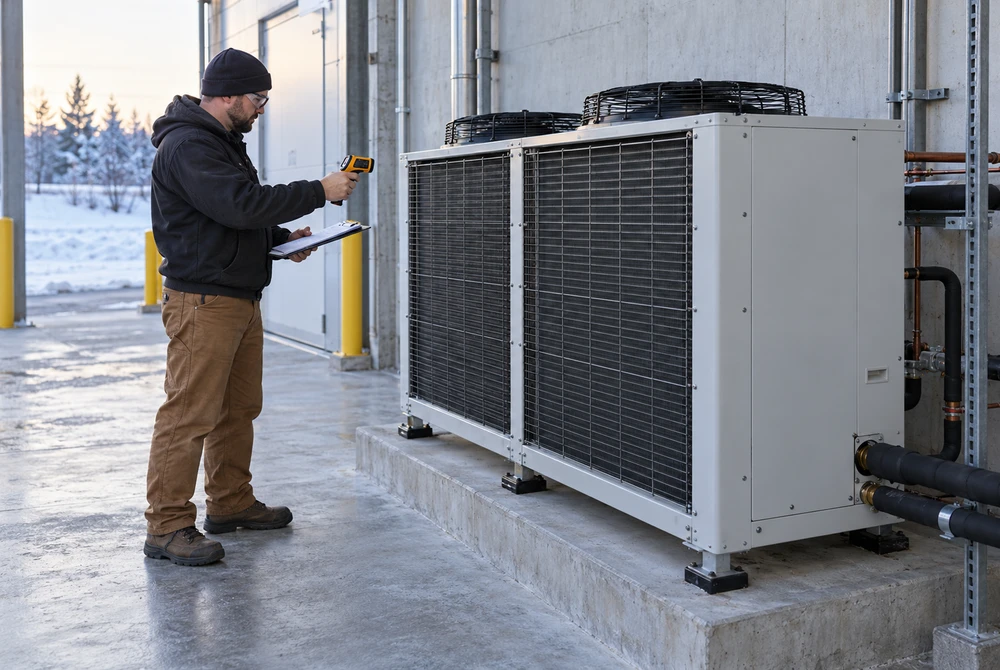
How do you verify that the repair is complete?
Agree on the acceptance checks before the work begins. The service provider should verify the corrected configuration, required protections, control sequence and refrigeration performance using the manufacturer’s procedures. The manager should receive an explanation of the result in language that connects to the original complaint. A replacement part number alone does not establish that the room now recovers properly in the conditions that caused the problem.
Ask the technician to demonstrate the relevant sequence rather than only a running unit. If the diagnosed issue involved a low-pressure control during a cooling demand, the closeout should address that behavior. If an approved low-ambient arrangement was added, the closeout should identify its configuration and commissioning checks. The exact test belongs to the equipment instructions; the manager’s question is whether the test resolves the initiating symptom.
Record the room condition and load during verification. A nearly empty room with the door closed after a long recovery period may behave differently from normal operation after a delivery. That does not make the test useless, but it defines what it establishes. If the service company cannot test every relevant condition at once, the final report should separate completed checks from the planned observations that remain.
Confirm that the operating configuration is fully restored. Panels and guards should be secured, required protective functions should be active, and temporary diagnostic arrangements should be removed. Where controller values were legitimately changed, record the final values with their identity and applicable reference. Where a sensor or control was replaced, note the installed part and the verification of its input. These details prevent the next visit from beginning with uncertainty about what changed.
Close the refrigeration work and the product incident separately. A cooler returning toward its normal target does not automatically close a product hold or erase earlier alarms. The manager should route the refrigeration service record to the responsible quality person, retain the relevant monitoring history and document the product decision through the site’s existing process. The service provider can establish equipment performance without being asked to make unsupported declarations about every stored item.
What should remain in the maintenance file?
Keep a concise record that another technician can use. Include the equipment identities, refrigerant, relevant control arrangement, applicable manual, initiating symptom, verified cause, completed repair and test conditions. Attach detailed instrument records or commissioning sheets where appropriate. An invoice can serve a financial purpose while a separate service report carries the technical information; the two documents should refer to the same job.
Preserve the distinction between the original equipment configuration and later authorized changes. If the system has a documented refrigerant retrofit or an added low-ambient arrangement, file the approvals and commissioning information alongside the equipment identification. Do not rely on a label that is difficult to read as the only surviving record. Conversely, do not infer an undocumented retrofit from a cylinder seen near the unit.
Add the result to the seasonal maintenance plan. The next pre-winter inspection should verify the relevant components and controls under the manufacturer’s guidance. It should also review the prior cold-weather complaint and any unresolved follow-up. A generic cleaning checklist can miss the exact issue that produced repeated stoppages. Use the walk-in cooler maintenance checklist as an organizational reference, with the installed equipment instructions governing technical tasks.
Review alarm handling with the staff who work overnight or at opening. They need to know whom to contact, what observations to preserve and what actions are authorized. They should not be expected to adjust pressure controls, diagnose a blend from pressure or repeatedly reset equipment to keep the business running. Clear responsibilities are particularly useful when the symptom disappears before the daytime manager arrives.
Where monitoring limitations affected the incident, record a specific improvement for review. It may concern clock alignment, sensor identification, alarm routing or access to a reliable historical trend. Do not change a control setting solely to make the chart look smoother. The related temperature-monitoring guide explains why sensor location and response responsibilities deserve attention alongside the refrigeration repair.
Questions managers ask about winter short cycling
Should I keep resetting the unit if it temporarily starts working?
No. A temporary recovery does not establish the cause or show that continued operation is safe. Follow the equipment instructions and the site’s escalation process, document the behavior and arrange qualified service. Tell the technician about resets already performed and whether they changed the pattern. Do not erase alarm histories or present the latest successful restart as proof that the underlying problem has disappeared.
Can an unheated indoor location create the same concern as an outdoor installation?
It can expose the condensing unit to low ambient even without rain or snow. The important conditions are those experienced by the equipment, together with the manufacturer’s approved installation and operating envelope. A sheltered loading area is not automatically a controlled mechanical room. Ask the technician to assess the actual location rather than using the building’s indoor designation as a substitute for measured conditions.
Does a condenser fan stopping mean the compressor is short cycling?
Not necessarily. Some installed systems intentionally control fan operation as part of their strategy. The technician should distinguish fan behavior from compressor behavior and verify both against the correct sequence. Record only what you can actually observe. A room that is warming while fans change state still needs investigation, but the fan observation alone does not identify which control or component needs repair.
Should I buy more refrigerant before booking the repair?
Wait for the technician to establish the required material and service scope. Low ambient, low pressure and repeated cycling do not specify a purchase quantity. If material is needed, match the actual refrigerant and supplier documentation to the authorized work. Confirm who is responsible for supplying and handling it. A supplier’s available package size must not become a substitute for the equipment’s charging procedure.
Can a different refrigerant solve the cold-weather problem?
A change of refrigerant is not a shortcut for an unverified control or installation fault. A retrofit requires its own equipment approval, component and lubricant review, service procedure and documentation. It may not address the reason the compressor stops. Ask for a diagnosis of the existing system first, and keep any proposed retrofit as a separately justified decision with the required compatibility evidence.
Is the repair unfinished if the weather is warmer during the visit?
The technician can complete many inspections and repairs in warmer conditions, but the report should identify which cold-weather behavior was actually confirmed. Where the original operating conditions were not reproduced, request a specific verification plan and clear alarm response. A conditional closeout is useful when it transparently describes the remaining check. It should not become an indefinite instruction to tolerate unexplained repeated stoppages.
What should I ask if two service companies propose different solutions?
Ask each company to state the verified stop event, equipment reference, supporting observations, proposed change and acceptance test. Those answers reveal whether the proposals address the same demonstrated fault. A control repair and a low-ambient upgrade may both be reasonable in different installations; the words alone cannot decide between them. Compare the reasoning, approved configuration and complete deliverables rather than assuming the larger or smaller estimate is automatically correct.
Can I use someone else’s pressure settings from a forum?
No. A reported setting may belong to a different refrigerant, compressor, control purpose or equipment revision. Even an accurate example is not an instruction for your unit. Preserve the question for the service provider, who should verify the relevant settings against the actual installation. Online discussions are useful for identifying unanswered operator questions; they are not authority to alter refrigeration controls.
What should the next service authorization say?
Describe the complaint, the conditions and the deliverables: identify the control event responsible for the repeated stops; verify the model-specific low-ambient configuration; establish whether refrigerant work is justified; document the completed correction; and confirm the relevant operating sequence and temperature recovery. Include a follow-up plan if the triggering weather cannot be reproduced. That request gives the technician room to diagnose correctly while giving the manager a practical basis for accepting the work.
The strongest closeout is a traceable explanation from observed symptom to verified cause to completed correction. Keep that record with the equipment history and preserve any separate product-safety decision. When the next cold period arrives, staff should know what normal operation looks like, what evidence was verified and which remaining condition would require another call. That is a more useful outcome than an unexplained reset or a cylinder purchase made before the fault was established.











