
Walk-in cooler temperature monitoring works when a meaningful measurement reaches someone who can act on it. Sensor placement, the type of reading, alarm timing and staff response belong in the same plan. A dashboard cannot protect stock by itself if it measures the wrong area, conceals a communication gap, or sends an alert to someone who is unavailable.
Start by separating the control sensor from independent monitoring, air temperature from food temperature, and alarm acknowledgement from incident resolution. Those distinctions determine what a reading can tell you and which follow-up check is appropriate. They also prevent a common mistake: selecting whichever display looks reassuring when different instruments disagree.
This guide helps restaurant managers organize sensor placement, interpret air and buffered readings, review delays and assign responders. It is not a universal alarm-setting recipe or a comparison of monitoring products. Equipment instructions, stored foods, locally adopted requirements, approved procedures and the time needed for an actual response must shape the final monitoring program.
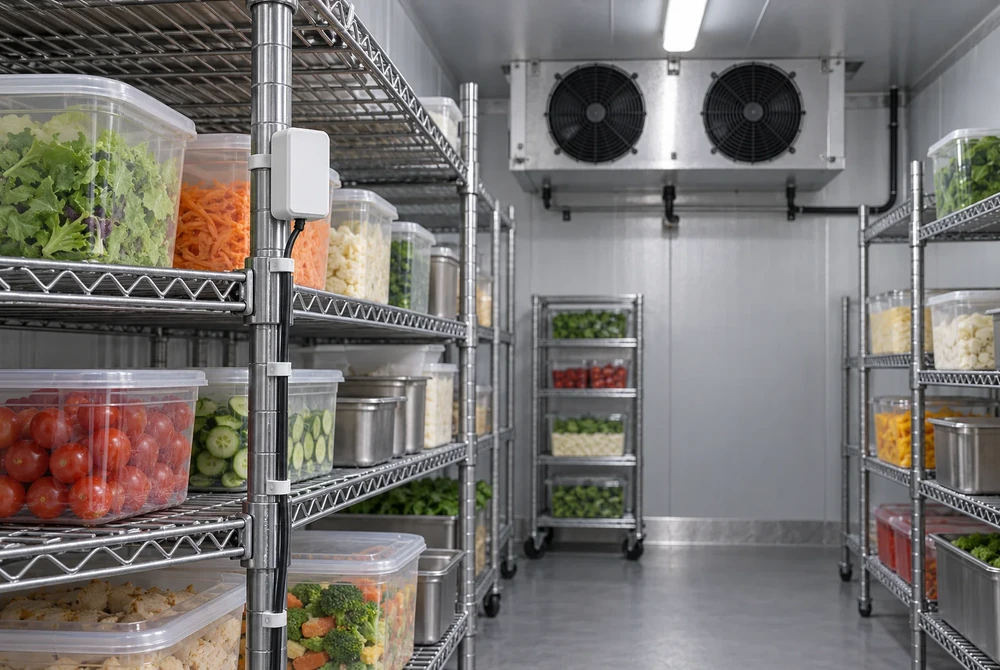
Choose what each cooler temperature measurement is meant to verify
Begin by asking what a reading is intended to tell you. A refrigeration controller needs information suitable for operating the equipment. An independent monitoring device may be positioned to detect a warm storage area. A food probe measures the condition of a selected product using a defined technique. These functions can support each other, but substituting one for another without review can undermine the monitoring plan.
Create a simple inventory of instruments before adding more devices. Give each sensor a durable identifier and record its location, measurement medium, units, normal reporting interval, alarm owner, and calibration or verification information. Include any built-in display that staff routinely read. A label such as Cooler 1 is insufficient if that room has a controller probe, an air logger, and a buffered probe that produce different traces.
Describe each channel in plain language in the log. For example, identify it as room air at the monitored shelf, simulated product in an approved buffer, or a direct food check performed by trained staff. Avoid calling every channel product temperature. The extra words prevent a later reviewer from assuming that a smooth buffered trace proves the temperature history of every container in the room.
Use the current Food Code as a model, then verify local adoption
FDA’s website identifies the 2026 Food Code as the current full edition when checked on October 1, 2026. The Food Code is offered as a model for adoption by jurisdictions. Your restaurant may be governed by a different adopted edition, amendments, or specific regulatory instructions. Check the actual authority responsible for your establishment rather than assuming a newly published federal model immediately replaces local rules.
In the 2026 model text, section 4-204.112 addresses the location of temperature-measuring devices: for mechanically refrigerated storage, the measurement is of air or simulated product in the warmest part of the unit. Section 3-501.16 generally specifies 41°F or below for cold holding of time/temperature control for safety food, subject to its stated exceptions. That food requirement is not a universal setting for every room-air alarm.
Ask the food-safety lead to document the applicable rule, the foods covered, any relevant exceptions, and the approved corrective-action procedure. FDA’s state and territorial code directory can help locate the starting authority. A restaurant with multiple locations should maintain the applicable reference for each jurisdiction rather than copying one location’s procedure to every other site.
Sensor placement: identify the warm storage area
The most convenient place to mount a logger is not automatically the right monitoring location. A device close to a cold discharge stream may report reassuring air while food elsewhere is warmer. A device attached to an unsuitable surface may respond to that surface rather than the intended air. A location subject to direct door drafts may show frequent transients that require interpretation. Start with the storage layout and actual operating conditions.
Arrange a temperature survey with qualified support where needed. Compare candidate storage locations during representative operation, including ordinary stocking and door activity. Record the temporary sensor positions, measurement intervals, and load arrangement so the results can be understood later. The purpose is to identify meaningful warm areas and variations, not to prove that one empty-room reading meets a target.
Do not deliberately create an unsafe food condition to test monitoring. Use an approved commissioning or verification plan that protects inventory. An empty cooler test can help evaluate equipment, but its results should not automatically be treated as a complete picture of a stocked restaurant cooler. The food-safety and refrigeration teams should agree on what observations are needed and what conditions the results actually represent.
Heatcraft’s technical FAQ notes that product-temperature problems can occur despite a satisfactory box-temperature log, with air distribution and restrictions among the considerations. That is a reason to examine the storage environment rather than treating a single sensor as proof about the whole room. It is not a reason to move a manufacturer’s control probe without authorization.
Keep monitoring placement separate from control placement
Ask the contractor which sensors belong to the refrigeration system and which are independent monitors. Their positions may have different engineering purposes. A controller sensor can be essential to the intended control sequence, and moving it to improve the appearance of a log can change equipment behavior. Record its location and leave changes to authorized personnel using the correct equipment documentation.
For an independent monitor, use the approved location and mounting method. Keep the sensing element exposed to its intended medium and protected from impacts, cleaning damage, and accidental movement. Avoid pinching a cable in a door or placing it where shelving will pull it loose. Select equipment suitable for the environment, and follow the manufacturer’s instructions for immersion, moisture exposure, and mounting orientation.
Include the sensor in the room’s storage rules. Staff should know not to bury it behind cartons, hang packaging over it, relocate it during cleaning, or use its cable as a convenient tie. If the sensor must be temporarily moved, document the start and end of that period and arrange the approved alternative check. An unexplained relocation can make an apparently continuous record misleading.
Review placement after a meaningful layout change. Moving shelves, adding dense containers, changing the product mix, or altering delivery routines can change the relevance of the original monitoring point. A logger still reporting from the same wall has not necessarily retained the same relationship to the food. Reassessment should be proportionate to the change and documented rather than triggered only after a complaint.
Air temperature, buffered readings and direct food checks
An exposed air sensor can respond quickly when a door opens or refrigeration operation changes. That responsiveness can provide an early indication of an equipment or operating problem. It also means the trace may contain short excursions that do not describe the internal temperature of stored food. Interpret the trace using location, event duration, and the approved response process; do not erase the excursions merely because they are inconvenient.
A buffered sensor responds through the thermal behavior of its buffer. It can reduce the effect of brief air changes, but its response depends on the probe, medium, amount, container, and placement. It represents that arrangement, not every food package. A small shallow pan and a large dense container do not have identical thermal behavior. Use only the monitoring arrangement approved for the intended purpose.
A direct food measurement answers a more specific question about the item and location tested at that time. The probe, technique, stabilization, and hygiene procedure matter. Record the product, location within it where relevant, time, units, instrument, and result. A single satisfactory measurement does not establish the full history of an affected batch, and an unsatisfactory measurement needs the approved corrective action rather than repeated testing until a better number appears.
| Measurement | Useful information | Important limitation |
|---|---|---|
| Independent room air | Conditions at a monitored location and their changes over time | Does not directly measure every food item |
| Buffered or simulated product | Behavior of a defined probe and buffer arrangement | Cannot represent all package sizes and food histories |
| Direct food probe | Selected food condition using an approved measurement method | A snapshot is not the complete exposure history |
| Controller display | Equipment information according to its configured display logic | May not represent the independent monitoring location |
| Door or communication status | Context for access events or missing data | Does not establish a safe food temperature |
Make instrument confidence part of the program
A precise-looking digital value can still be wrong. Keep instruments in suitable condition and maintain the required accuracy checks or calibration records. The 2026 Food Code, section 4-502.11, addresses calibration of food temperature devices according to manufacturer specifications and the accuracy and repair of ambient-air measuring devices. Apply the requirements in your adopted code and the instrument manufacturer’s procedure.
Distinguish a quick comparison from a formal calibration. Two sensors placed together may disagree because of accuracy, response time, positioning, or different measurement media. A comparison can reveal a concern, but it does not automatically identify which device is correct. Have a documented reference and acceptance method appropriate to the instruments. Do not simply adjust the inconvenient sensor until both displays match.
Keep a replacement plan. If a probe is damaged, wet beyond its rating, unstable, or outside its accepted accuracy, identify it as unreliable and use the approved alternate measurement process. Record when confidence in that channel was lost and restored. Replacing a sensor does not retroactively validate earlier readings, so the food-safety lead may need to assess the affected period separately.
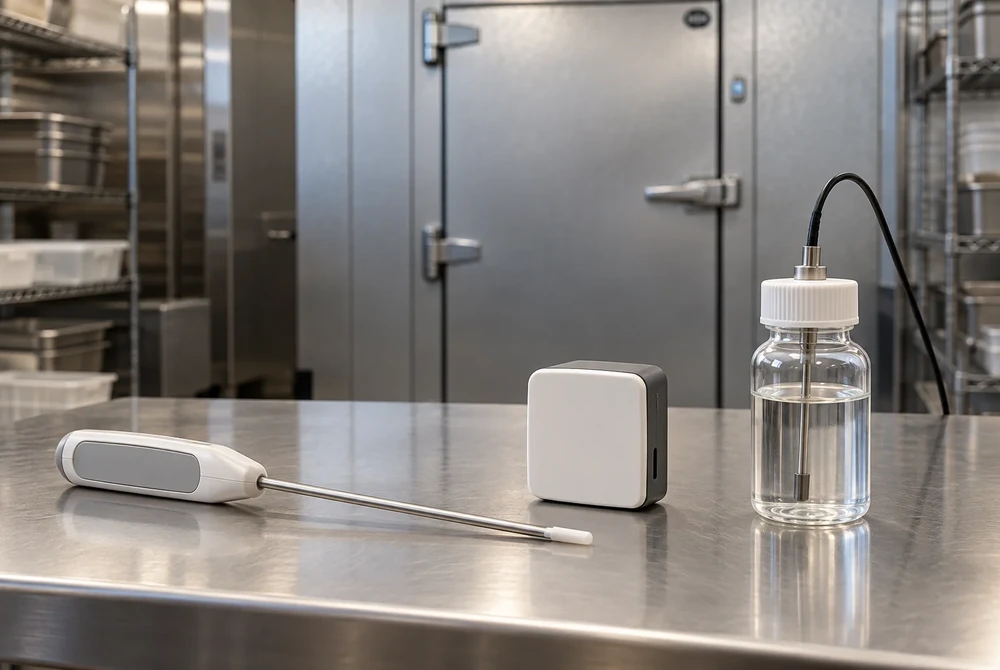
Cooler alarm thresholds and delays are separate decisions
The threshold describes the condition that starts an alarm evaluation. The delay determines how long a qualifying condition must persist before a notification or alarm becomes active, according to the device’s logic. A monitoring system may also have reset behavior, escalation timing, or separate rules for sensor faults. Document the whole rule rather than recording only one temperature value.
Model-specific differences matter. The Danfoss ERC 21X guide distinguishes a normal temperature-alarm delay from a delay associated with startup, pull-down, and defrost. It also describes separate digital-input delay settings. This demonstrates why a technician must identify the active operating mode when interpreting a delayed alert. It does not establish an appropriate delay for a particular restaurant’s independent monitoring plan.
Never choose a delay solely by how often employees complain about notifications. First determine whether the events are expected operating transients, a poor sensor location, an overloaded room, a failing component, or an unsuitable alert rule. The response should address the actual cause. Increasing the delay can make all of these situations quieter while making an important event slower to detect.
Evaluate the complete time to action
The configured alarm delay is only one part of the time between a problem beginning and somebody protecting the food. Consider the sensor’s response, the sampling interval, communication timing, alarm evaluation, message delivery, acknowledgment, travel, assessment, and any transfer arrangements. Those stages may overlap in some systems, but none should be assumed instantaneous without evidence. A short delay displayed in an app does not prove a short operational response.
Write the stages out as a response budget using the actual system design. Ask the monitoring provider which timestamps are stored and which actions happen locally versus through an online service. Ask the manager who will be available during closed hours and how long access realistically takes. The food-safety lead must judge whether the complete arrangement supports the required corrective action for the products and operation.
Do not treat a response budget as a new food-safety allowance. It is a planning tool for identifying avoidable delay, not permission to hold food outside the applicable requirements. Where the arrangement cannot support a timely response, change the staffing, notification path, available backup storage, or monitoring design. Extending the written allowance on the form does not change what is happening to the food.
Review normal-event handling separately from persistent deterioration. A brief documented door event may call for a different operational response from a room that keeps warming after the door closes. The rules should preserve visibility of recurring events and failure to recover. Avoid a design in which repeated short interruptions continually restart a timer and prevent an important pattern from ever reaching a person.
Assign an alarm responder, backup and escalation route
Assign responsibility by role and shift, then maintain the current people and contact methods behind those roles. The first responder needs authority to start the approved checks and contact the food-safety lead or service provider. The backup needs to know when responsibility transfers. A list of phone numbers without an escalation rule is a contact directory, not an alarm response plan.
Define acknowledgment as acceptance of a task. The person acknowledging should state that they are handling the incident and identify the next action or update. They should not acknowledge merely to clear their phone when another person is expected to investigate. If they cannot respond, they should transfer responsibility explicitly and verify that the next person accepted it.
Separate three decisions: who checks the room, who decides what happens to affected food, and who authorizes technical service. In a small restaurant one manager may fill several roles, but the responsibilities still exist. The contractor can repair refrigeration equipment without being the person authorized to release held inventory. Conversely, the food-safety lead should not need to diagnose the refrigeration circuit before arranging protection for stock.
Build the overnight and holiday path into the same system. Keep access arrangements, service contacts, and receiving-storage options current. Do not depend on a person who is off duty noticing an informal message. If no one can safely attend, the plan must say how the incident is escalated and how opening staff will prevent potentially affected stock from being used without review.
Use a response record that distinguishes evidence from assumptions
At notification, record the sensor identity, first event time reported by the system, receipt time, acknowledgment time, and responsible person. Include the units and whether the reading is air, buffered, or direct food. Preserve the original trace. A screenshot of the latest value may omit the beginning of the event or the missing-data period that is most important to the food assessment.
During the check, record the actual observations: door position, apparent operating status, stock arrangement, other instrument readings, and any known delivery or cleaning activity. If a fact is unknown, leave it unknown. Avoid writing that the cooler was only warm briefly unless the record supports that conclusion. The time since notification is not necessarily the duration of the temperature event.
Record each action and its result separately. Closing a door, contacting a technician, checking food, and transferring inventory are distinct actions with distinct times. A falling air temperature after the door closes is evidence of a change, but it does not alone establish the cause or resolve the earlier food history. Keep the incident open until the appropriate people have completed both equipment and food decisions.
Treat missing data as its own event
A flat line can mean stable temperature, repeated old data, a frozen display, or a system that stopped reporting. The monitoring interface should make stale readings and communication losses distinguishable from current measurements. Ask what happens when the sensor battery fails, a gateway loses power, the internet connection stops, or a cloud notification cannot be delivered. Do not assume every failure produces the same alert.
Determine whether readings are stored locally during an outage and how they are timestamped when communication returns. Historical data arriving later can help reconstruct conditions, but it did not provide a timely alert while the connection was unavailable. Keep the data-recovery function separate from the live-notification function when assessing whether the monitoring program protects operations outside staffed hours.
Write a fallback for loss of monitoring. It might involve approved manual observations, a replacement instrument, or restrictions on use while confidence is restored. The appropriate choice depends on staffing, products, and the actual fault. A manager should never be left to invent an interval or assume that no data means no problem. Mark the period of reduced visibility clearly in the log.
Test the notification route without warming food
Use the monitoring provider’s supported test function or a controlled verification procedure approved for the installation. The objective is to verify event generation, delivery, acknowledgment, escalation, and recordkeeping without creating an unsafe storage condition. Do not prop the cooler door open or warm a room full of food just to see whether somebody receives a text message.
Include the backup path in the test. A first contact who immediately answers every demonstration does not show whether escalation works when that person is unavailable. Clearly label the exercise so staff do not confuse it with a real incident, and restore any temporary test settings using an authorized procedure. Record which parts were actually tested rather than marking the entire system passed after a single message.
Review the result with the people who will use the system. Could they identify the cooler and sensor? Did the message include units and a useful timestamp? Did they know how to reach the food-safety lead? A technically delivered notification can still fail operationally if it is ambiguous. Fix those small communication gaps before adding more sophisticated alerts that increase the same confusion.
Make routine review different from emergency response
During a routine review, look for recurring patterns: similar excursions during receiving, a gradual change in the baseline, repeated communication gaps, or a sensor repeatedly moved during cleaning. These findings may call for adjustments to workflow, maintenance, or monitoring design. They are not a substitute for acting on a current food or equipment concern. Separate trend-improvement work from active incident handling.
Compare incidents using the same definitions. Count a recurring unresolved condition consistently rather than making it appear to be several unrelated events or one harmless blip. Record whether the outcome involved a door obstruction, a service finding, a sensor issue, or no confirmed cause. An unknown cause should remain visible so a repeated event is not automatically dismissed as something that was already solved.
Use trend review to improve the operation, not to manufacture performance claims. A restaurant can track whether response records are complete and whether recurring faults were closed without claiming a particular energy saving or reduction in food loss. Any numerical improvement claim needs a defined baseline and evidence. The monitoring plan should stand on clear decisions even when no marketing statistic is available.
Work through conflicting readings systematically
Suppose the controller shows a satisfactory value while an independent air monitor reports a warm shelf area. Confirm the devices, locations, units, and timestamps before deciding that one is wrong. Then assess food according to the approved procedure and investigate the room conditions. Shelving or airflow may explain a real difference. Our article on low airflow versus low refrigerant offers related technical background, not a substitute for an on-site assessment.
Suppose the air trace spikes but the buffered probe changes little. That difference can be consistent with different response characteristics, but it does not automatically prove that all products were protected. Identify the duration, operating context, and stock at risk. If direct food checks are required by the response procedure, perform them using the appropriate instrument and method rather than treating the buffered channel as a universal exemption.
Suppose the dashboard looks normal after an overnight outage. Check whether the visible values are current, whether the missing period was recovered, and whether anyone responded during the gap. Do not let the restored connection erase the uncertainty. These hypothetical examples are intended to structure decisions; they are not descriptions of measured customer results or evidence for a particular product’s monitoring performance.
Keep the program usable when people and equipment change
Include monitoring responsibilities in onboarding. New managers should locate the sensors, distinguish the channels, find the response procedure, and explain whom they contact. They should also know the boundary between reading a controller and entering its settings. Training that consists only of showing a green dashboard leaves staff unprepared for the first disagreement or communication fault.
After replacing a logger, controller, gateway, or phone, verify the functions affected by that change. Check identity, units, timestamps, placement, notification recipients, and the relevant alarm rules. Do not assume a replacement retains every setting correctly. Keep the old and new instrument records linked so a reviewer can understand a discontinuity without guessing whether the cooler itself suddenly changed behavior.
Retain records according to the establishment’s regulatory, food-safety, and business requirements. Make them accessible to the people who need them during an incident. A long archive that only a departed employee can open is not useful evidence. Protect editing permissions and preserve original observations so later annotations improve the record without silently replacing what was actually measured.
Write a monitoring specification before choosing a device
Describe the decision the installation needs to support before comparing features. Identify the room and storage zones, the measurement type at each location, who receives alerts during every shift, and how records will be retrieved during an incident. Ask a prospective provider to demonstrate those functions using the intended notification route. A long feature list is less useful than proof that the actual responder receives a clear message.
Include loss of power, missing data and unavailable staff in the acceptance check. Establish who recognizes each condition and which approved fallback procedure applies. Document which tasks belong to restaurant staff, the monitoring provider and the refrigeration contractor. This avoids leaving a sensor-placement or communications problem between organizations that each assume somebody else owns it.
A temperature alert starts an investigation; it does not identify a refrigerant shortage. If a qualified contractor diagnoses a circuit fault and the installed system is specifically approved for R449A, the R449A 22 lb product details can support the resulting material order. Confirm the exact designation and quantity against the written service findings. Our explanation of why pressure alone cannot establish refrigerant charge provides related diagnostic background. Neither an alert nor a product page authorizes a refrigerant change.
| Item to verify | Evidence to retain | Responsible role |
|---|---|---|
| Sensor location | Location identifier and representative warm-area survey | Food-safety lead with refrigeration support |
| Measurement confidence | Instrument identity, medium, accuracy check and next review | Instrument owner |
| Alarm rule | Threshold, delay, reset logic and documented basis | Monitoring provider and food-safety lead |
| Message and backup route | Labeled test, delivery and accepted responsibility | Shift manager |
| Loss of data | Fault indication, local storage behavior and approved fallback | Monitoring provider and operations manager |
| Incident closure | Equipment result, food disposition and remaining restrictions | Designated incident owner |
Frequently asked questions
Where should the cooler temperature sensor go?
Determine the monitoring location from the applicable requirements, the intended measurement, and representative observations of the stored-food area. The FDA model addresses the warmest part of refrigerated storage for air or simulated-product measurement. Do not assume the middle of the room, the doorway, or the evaporator outlet is correct without evaluation. Leave equipment-control sensor changes to authorized personnel.
Should the sensor be in air or in a buffer bottle?
Choose the arrangement for a defined purpose with the food-safety lead and monitoring provider. Air and buffered sensors respond differently. A buffer may reduce short air transients, but it represents its own thermal behavior rather than every food item. Some programs use complementary channels. More sensors are only helpful when staff understand what each channel means and how to respond.
What alarm delay should a restaurant use?
There is no universal delay for every cooler and product mix. Review the complete time to action, expected operating events, manufacturer logic, and applicable food protection requirements. Document the basis and verify the notification route. Do not copy a controller’s factory default or another restaurant’s setting without assessing whether it supports your own operation and response capability.
Does an air reading above 41°F mean every food must be discarded?
No single room-air snapshot establishes every product’s condition or history. Equally, it cannot be ignored merely because it measures air. Follow the adopted requirements and approved corrective-action process, using relevant food measurements and time history. Hold questionable stock from use while the responsible person makes the decision; do not invent a blanket grace period from an alarm delay.
Can we use time instead of temperature after an unexpected alarm?
Do not retroactively declare an equipment failure to be an approved time-as-public-health-control procedure. Such procedures have specific requirements under the applicable code and must be properly established and followed. An unexpected loss of temperature control needs the incident and food-disposition process. Consult the responsible food-safety person or regulator where the evidence or applicable procedure is unclear.
Who closes the incident?
The designated incident owner confirms that the required equipment, monitoring, and food decisions are complete, with authorization from the relevant responsible people. A contractor’s repair, a restored connection, and a satisfactory food assessment are different outcomes. Record any remaining restriction and the next review before handover. An automatic return-to-normal message alone should not release stock that was placed on hold.
A monitoring plan staff can actually follow
Keep the final working plan short enough to use: identify the cooler and each sensor, state the approved alarm rules, name the responder and backup, describe the first checks, and show how food and service decisions are escalated. Support that page with the detailed instrument and regulatory records. The purpose of the system is not simply to collect numbers; it is to help the right person act on the right evidence while there is still time to protect the operation.











