
Commercial refrigeration maintenance is a managed routine of inspection, approved cleaning, professional service and follow-up. For a restaurant walk-in cooler, the goal is to notice deteriorating conditions early and make sure the right person resolves them. A completed checklist is useful only when its findings lead to action; it does not prove that equipment is fault-free or that every stored food remains safe.
This guide applies that maintenance framework to walk-in coolers. It covers manager-level opening checks, doors and airflow, housekeeping, periodic review and contractor handover, with a preventive maintenance checklist staff can use. It is not a universal service schedule for every chiller, ice machine or refrigeration rack. Equipment manuals, kitchen workload and the establishment’s food-safety program determine the actual tasks and intervals.
Download the two-page printable walk-in cooler maintenance checklist for a working form with space for findings, owners and follow-up. The form supports the procedures below; it does not replace the equipment manual or set a food-safety limit. Use it to make unresolved problems visible rather than collecting checkmarks that nobody reviews.
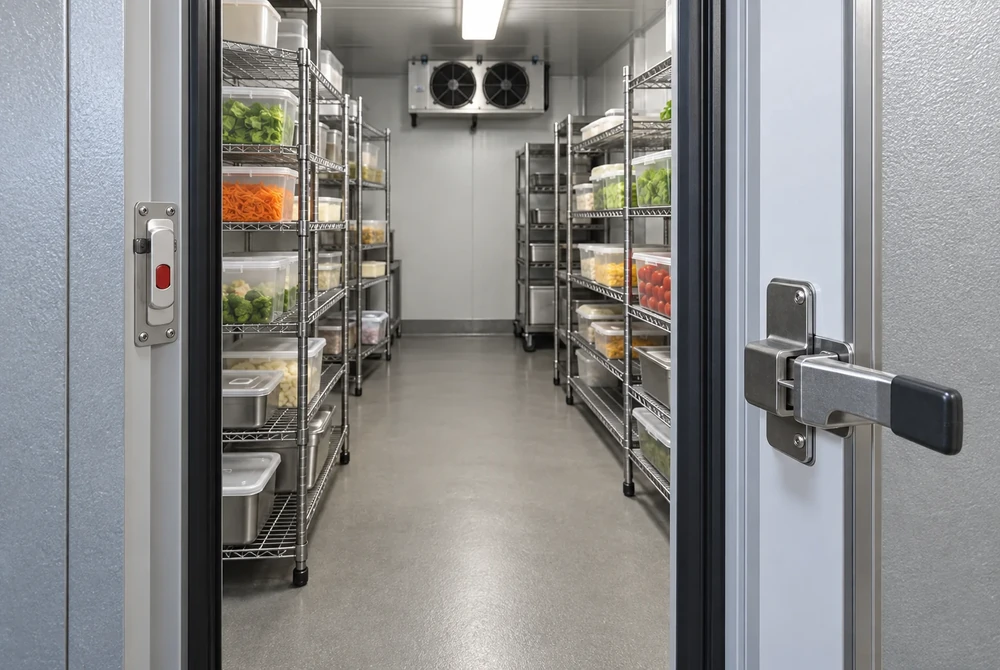
Commercial refrigeration maintenance: divide staff checks from technical service
Manager-level maintenance begins with observation, approved housekeeping, work-order management, and verification that the promised work was completed. It does not include opening electrical compartments, reaching through guards, testing live circuits, adjusting refrigerant charge, or defeating controls. A task that requires special access, energy isolation, technical diagnosis, or handling refrigerant belongs with appropriately qualified personnel under the site’s safety procedures.
The Heatcraft HFC unit cooler manual, June 2026, directs installation and maintenance to qualified personnel and includes warnings about power sources and sharp coil surfaces. That supports a practical distinction: staff can notice a dirty or damaged area without being assigned to service the equipment inside it. Follow the manual that matches the installed model and refrigerant.
Write the boundary directly on the task list. Instead of saying clean condenser, state whether trained staff may clean an accessible exterior surface under an approved procedure or whether the contractor must perform the work. Instead of saying check fans, say observe unusual sound or visible damage from a safe normal position. Specific language avoids the assumption that any item on a manager’s checklist is a do-it-yourself repair.
Build the equipment record for preventive maintenance
Give the cooler an identifier that appears on the door, monitoring system, checklist, and service requests. Keep the equipment make and model, controller identification, installed manuals, and service contact in a place managers can reach during an incident. Include the separate condensing unit where applicable. A room may contain components from different manufacturers, so a single door-brand name may not identify the refrigeration equipment.
Record approved operating references and who controls them. Managers should know where the target operating range, alarm response procedure, and maintenance schedule are documented. Avoid copying technical settings into a kitchen checklist without explaining their purpose. Staff should be able to recognize a departure and contact the right person without entering a controller’s service menu or making an unreviewed adjustment.
Keep a short history of recurring issues and completed repairs. A door that has needed repeated adjustment, a drain that repeatedly leaks, or an unresolved alarm pattern deserves attention even when today’s spot check looks acceptable. The record should help the next technician understand what changed. It should not become a collection of invoices with no connection between the original complaint and the final verification.
Daily walk-in cooler checks: review overnight conditions
At opening, review current readings and any overnight alerts before routine production begins drawing heavily from the cooler. Confirm that the data are current and that any earlier incident was actually resolved. An alarm can disappear because the measured condition changed, even when a food-disposition question remains open. Check for held inventory, service restrictions, or instructions left by the previous responsible person.
Look at the room from a normal working position. Note new water, ice, visible damage, unusual sound, or an obstruction that prevents the door from closing. Confirm that the aisle and exit route are clear. If there is an immediate hazard, stop the routine inspection and follow the site’s emergency procedure. Completing the checklist is never more important than avoiding an unsafe entry or preventing use of questionable food.
Record findings with enough detail to guide action. Door seal damaged near lower hinge side is more useful than cooler bad. Water below the evaporator at opening is more useful than floor wet. Do not infer a refrigerant leak, failed compressor, or blocked drain from a symptom alone. The manager’s observation should remain accurate even if the technician later identifies a different cause.
Door, seal and access checks
Watch whether the door closes normally during ordinary use. Look for packaging, carts, shelving, or a displaced floor mat that interferes with closure. An obstruction that can be removed safely within staff duties should be corrected and recorded. A door that still fails to close properly needs appropriate service. Do not compensate for damaged hardware by slamming the door or adding an improvised restraint.
Inspect accessible seal surfaces for obvious damage, gaps, loose sections, or accumulated soil. Clean them only with a compatible method permitted by the manufacturer and the site’s sanitation procedure. Do not stretch, cut, glue, or replace a seal with an arbitrary product to get through the shift. The correct material and fit matter, and the repair should address any associated door alignment problem.
Keep access to the inside safety release and exit route unobstructed. Staff should know how the installed release works through the approved training procedure. Report any concern about its operation promptly and restrict use as required until the issue is resolved. Never test an uncertain release by deliberately trapping someone inside, and never use stored goods or added locks in a way that interferes with safe exit.
Include door-use habits in the review without blaming staff for every equipment problem. Plan deliveries so goods can be organized before extended loading begins, and avoid using the open cooler as general staging space. If the workflow requires frequent access, discuss the operating demands with management and the contractor. A checklist should reveal when the process and equipment are poorly matched, not merely repeat close the door.
Protect airflow through the storage layout
Keep stored goods within the approved shelving arrangement and equipment clearances. Avoid placing cartons directly in front of evaporator fans or filling space reserved for circulation. The Heatcraft unit cooler manual discusses air coverage, rack layout, and product clearance. Its model-specific guidance should inform the room plan; a single clearance copied from another installation is not a universal standard.
Make the permitted layout visible to receiving staff. Identify locations where stock must not be placed, and explain why a clear aisle alone does not guarantee good circulation around every shelf. Dense loads can change the paths through which air moves. When a promotion or seasonal menu increases inventory, plan capacity before goods arrive rather than deciding afterward that the remaining space must be usable.
Do not relocate control sensors, monitoring probes, or equipment to accommodate extra stock. If the layout must change, involve the appropriate refrigeration and food-safety personnel and review the monitoring location. A sensor left in a newly isolated pocket may no longer represent the intended storage condition. Our explanation of low airflow versus low refrigerant provides related background on why a warm condition should not automatically be treated as a charge problem.
Housekeeping that respects the materials and equipment
Remove spills promptly using the approved procedure for the affected surface and food situation. Protect stock from splash, cleaning residues, and contamination while work is performed. Select chemicals according to their label, the sanitation plan, and material compatibility. More aggressive cleaning is not necessarily better: an unsuitable chemical or excessive moisture can create a maintenance problem while the surface looks temporarily cleaner.
Check the actual floor and panel requirements before choosing a cleaning method. For example, Kolpak’s published service and warranty information lists wet mopping and hose use among exclusions for specified floor arrangements. That is not a universal cleaning rule for all brands, but it demonstrates why a generic instruction to hose out every walk-in is inappropriate. Use the installed manufacturer’s cleaning directions.
Do not spray electrical equipment, controls, lights, sensors, or refrigeration components. Do not introduce cleaning tools through fan guards or attempt to scrub inaccessible coil surfaces while the unit is in service. Where a cleaning task requires opening equipment or isolating energy, arrange qualified service. Managers can coordinate the timing and protect food without performing the technical portion themselves.
Keep cleaning equipment and chemicals stored in their approved locations, separate from food and from ventilation paths. After housekeeping, verify that the area is dry enough for safe use, containers are protected, sensors remain in position, and nothing was left against the door or equipment. A short post-cleaning check can catch a displaced probe or blocked aisle before it becomes an overnight problem.
Water, drainage and ice: observe early, do not improvise a repair
Look for changes in where moisture appears: water below an evaporator, a new wet area near a panel joint, or recurring moisture at the threshold. Record the location, timing, and any related operating activity. Keep food and people away from affected areas as appropriate. The observation may point toward a drainage, door, insulation, or equipment problem, but its cause needs proper assessment.
Managers should not pour arbitrary chemicals into refrigeration drains, insert improvised tools into concealed piping, or disconnect a drain to see whether water flows. Such actions can damage components, move contamination, or create another leak. If the approved housekeeping procedure includes an accessible drain-related task, follow that exact scope; anything beyond it should become a service request with a clear description.
Do not chip ice from an evaporator, use a torch, apply an improvised heater, or force ice from a panel with a sharp tool. Protect the area and request the appropriate service. Visible ice is an observation, not permission to use whichever method removes it fastest. Our article on moisture inside refrigeration systems addresses a separate technical issue; room condensation and moisture within a sealed circuit should not be confused.
| When | Manager-level check | Required follow-up |
|---|---|---|
| Opening and shift handover | Current data, unresolved alarms, food holds, door and access | Assign an owner to any unresolved condition |
| During ordinary use | Spills, obstructions, damaged packaging and unusual observations | Apply approved housekeeping or escalate |
| After cleaning or deliveries | Door closure, sensor position, safe floor and airflow arrangement | Correct safe operational obstructions; document equipment concerns |
| Periodic manager review | Recurring faults, contacts, logs and overdue work orders | Agree priorities and verify closure evidence |
| Manufacturer or contractor interval | Confirm qualified technical maintenance is scheduled | Obtain a service report and return-to-service instructions |
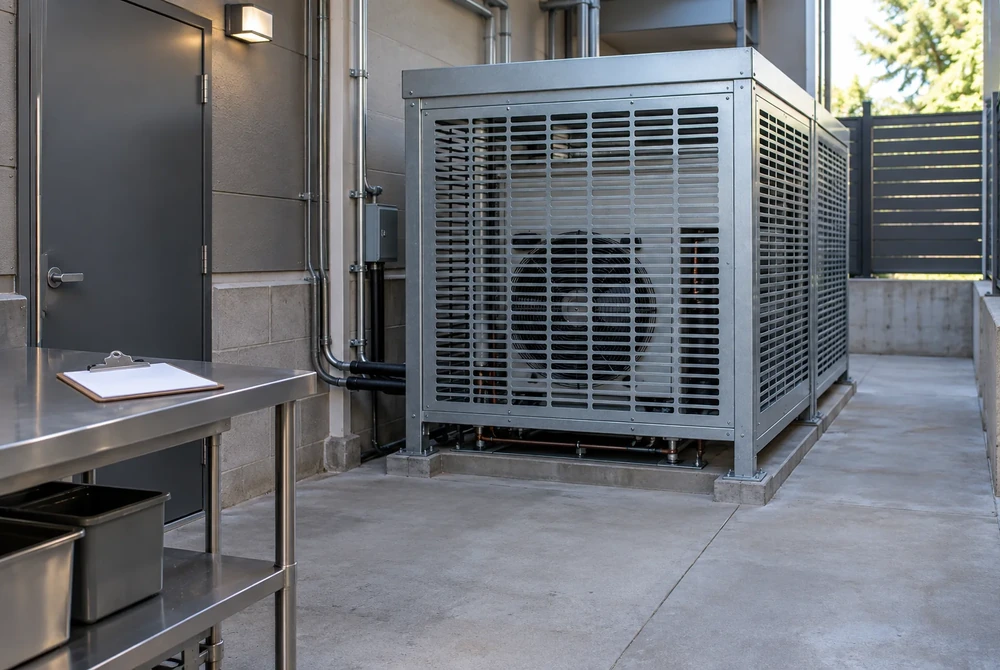
Check the accessible condensing-unit area
Where the condensing unit is safely accessible, look at the surrounding area without removing panels or guards. Keep approved ventilation and service access clear of boxes, bags, cleaning supplies, and other stored materials. Do not turn the area into overflow storage simply because the equipment is outside the food room. Record any obstruction that cannot be safely corrected within ordinary staff duties.
Visible soil, debris, damage, or unusual noise should be described in a service request. Coil cleaning methods and access requirements vary with equipment and location, so this guide does not assign managers a universal brush, chemical, or pressure-washing procedure. Have the contractor define what, if anything, trained on-site staff may safely do and what belongs in scheduled technical maintenance.
Do not access roofs, restricted plant areas, elevated equipment, or unfamiliar disconnects just to complete a routine kitchen checklist. If the unit is not safely observable, the manager’s task is to confirm that an appropriate service arrangement exists. Marking not accessible with a named service responsibility is more honest and useful than checking inspected when nobody could actually see the equipment.
Maintain confidence in monitoring without changing the settings
Confirm that the monitoring device is present, in its approved location, and reporting current data. Check for visible cable damage, a displaced probe, or a low-battery or communication warning according to the device instructions. Record the sensor identity so a replacement or movement can be traced. The manager’s checklist should reveal loss of monitoring confidence rather than treating any displayed number as satisfactory.
Keep calibration or accuracy-verification tasks on a separate approved schedule. The FDA Food Code 2026, section 4-502.11, addresses measuring-device accuracy and calibration, while section 4-501.11 addresses equipment repair. Follow the requirements that your jurisdiction has adopted and the relevant instrument instructions. A comparison with another unverified thermometer is not automatically a valid calibration.
Do not increase alarm delays or change temperature targets as a maintenance shortcut. Repeated alerts may indicate a workflow issue, equipment problem, sensor problem, or unsuitable monitoring rule. Record the pattern and arrange a review by the responsible people. The maintenance program should support the monitoring plan, not undermine it by making the warnings less visible.
Keep food protection separate from equipment condition
FDA identifies the 2026 Food Code as the latest full model edition as checked on September 30, 2026. Local adoption and amendments determine the rules applicable to a particular restaurant. Use FDA’s state code directory as a starting point, then verify the responsible authority and the establishment’s approved procedures.
Do not use this maintenance checklist as a universal food-disposition rule. If temperatures, time history, contamination, or food condition raise concern, involve the food-safety lead and hold affected stock from use as required. Repairing a cooler does not establish that food exposed before the repair is acceptable. Similarly, a routine housekeeping task can be complete while an earlier inventory decision remains unresolved.
Plan where food will go during scheduled maintenance that interrupts normal storage. Confirm suitable receiving capacity, identification, handling arrangements, and monitoring before work starts. Do not overload another cooler and create a second problem. If the scope expands unexpectedly, pause and reassess the food plan instead of assuming the original arrangement remains adequate for a longer interruption.
Use a work order that can be closed with evidence
Every failed check needs an owner, a priority, and a next step. Describe the finding, location, discovery time, and any immediate action. Attach relevant photographs or monitoring information without opening equipment for a better view. State whether food, safe access, or normal operation is affected. Those details help the service provider prepare without forcing the manager to make an unsupported technical diagnosis.
Distinguish reported, scheduled, attended, repaired, and verified. A work order is not complete merely because someone called the contractor or a technician visited. The service report should describe the work performed and any outstanding limitation. If a part is on order, identify the temporary operating restrictions and who will track the return visit rather than allowing the ticket to disappear into a completed folder.
Ask the contractor to document authorized setting changes and the reason for them. Update the operating reference used by staff when the change affects visible behavior or response instructions. Otherwise, the next manager may interpret a deliberate change as a new fault, or dismiss a real fault because the expected sequence was never explained. Clear handover is part of maintenance quality.
Set the preventive maintenance schedule from the actual installation
Obtain a schedule based on the installed manuals, environment, usage, condition, and qualified service advice. Avoid advertising a fixed monthly or quarterly interval as correct for every cooler. A kitchen with grease exposure, heavy traffic, or recurring damage may need a different plan from a protected installation. The manager’s role is to ensure that the basis is documented and the scheduled work is actually completed.
Ask the service provider to define the technical scope in understandable terms: equipment condition, required cleaning, drainage, fans, controls, electrical components, and refrigeration performance as applicable. Do not turn that scope into a step-by-step staff repair list. The contractor is responsible for selecting safe methods, appropriate isolation, compatible parts, and the tests needed for the installed system.
Discuss refrigerant identity and equipment compatibility only through the proper service process. A warm room does not establish that refrigerant needs to be added, and a refrigerant name on an old invoice may not describe a modified installation accurately. Our article on why charging by pressure alone can be incorrect explains a related diagnostic limitation. Managers should request evidence-based service rather than a routine top-up.
Prepare the site for a service visit
Tell the contractor about access restrictions, operating hours, current food protection arrangements, and the exact equipment identifier. Provide the recent symptom history and any relevant monitoring trace. Confirm who can authorize additional work if the initial inspection identifies a broader problem. Good preparation reduces confusion without asking staff to dismantle anything in advance.
Move ordinary stored items out of required access areas when that can be done safely and without compromising food. Keep customers and uninvolved staff away from the work zone. Let qualified personnel establish the necessary technical isolation and safety controls. A manager should coordinate access and operations, not energize or de-energize unfamiliar equipment simply because a checklist contains a service appointment.
Agree on the return-to-service handover before the contractor leaves. Ask what was observed, what was corrected, what evidence supports normal operation, and whether any later check is required. If a fault could not be reproduced, record that honestly with the recommended next observation. Fault not found is different from proof that the original complaint was mistaken.
Verify the room after work or cleaning
Walk through the accessible area with the responsible person after work. Confirm that guards and panels are restored, tools and cleaning materials are removed, the floor and access route are safe, and stored goods are protected. Verify that sensors and displays are operating as intended and that any temporary test arrangement has been removed by the authorized person.
Use the contractor’s return-to-service criteria and the food-safety plan to decide when normal loading and use may resume. Do not treat a cool-feeling room or one satisfactory display reading as a complete verification of every issue. Where an operating cycle or trend needs review, assign a named person and time for that follow-up. Keep restrictions visible until the required evidence is available.
Close food holds separately with the appropriate authorization. Reconcile any inventory moved elsewhere and confirm that the receiving location remains suitable. Record disposal or other decisions under the established procedure. The final handover should tell the next shift what is resolved, what remains restricted, and who is responsible for anything still open.
Review repeat defects and the maintenance schedule
Review repeated observations periodically rather than treating every occurrence as a new isolated problem. A recurring door obstruction may call for a receiving-workflow change. Repeated seal damage may indicate a hardware or traffic issue. A recurring wet area needs investigation even when it is wiped dry each time. The review should ask why the same task keeps appearing, not simply whether staff completed it again.
Choose a small set of records that help manage the work: overdue issues, repeat faults, missing verification, and unresolved restrictions. These are practical indicators, not promises of a particular energy or food-loss saving. Do not claim a percentage improvement without a defined baseline and evidence. A maintenance program is valuable because it creates reliable action, even before a numerical benefit can be measured.
Update the checklist when experience shows that an item is ambiguous or assigned to the wrong role. Remove duplicative entries that encourage mechanical checking, but retain the observations needed for safe operation. Explain changes to staff. A document that evolves with the installation and workflow is more useful than a generic form that remains unchanged while equipment and responsibilities move around it.
Keep outsourced maintenance accountable
When maintenance is covered by a service agreement, compare the promised scope with the report from each visit. A generic inspection completed statement may not explain whether the recurring issue that prompted the appointment was examined. Ask for an understandable description of the relevant findings, any work deferred, and the next action. This is a review of the service record, not an invitation for the manager to repeat technical tests.
Keep responsibility clear when different companies maintain the enclosure, refrigeration system, monitoring devices, and building services. A water problem or door-related complaint can cross those boundaries. The restaurant should have one person coordinating the handoffs so the issue is not considered closed by every provider merely because another trade may be involved. Record which party accepted the next step and when an update is due.
Before approving replacement equipment or a change in routine, ask how it affects staff procedures, approved cleaning methods, monitoring, and storage capacity. A replacement controller may display information differently; a new door assembly may require different cleaning instructions. Obtain the applicable documentation and explain the practical changes to the people using the room. Keeping an old checklist unchanged can make a technically successful repair harder to operate correctly.
At a manager handover, review a sample of recent completed tickets and every currently open restriction. Confirm that the incoming manager can find manuals, contacts, instrument records, and the food protection procedure. Do not depend on knowledge held only by a departing employee or an individual technician. This small transfer of operational knowledge helps the restaurant preserve a consistent maintenance program through staffing changes without adding unnecessary technical duties to the kitchen team.
Prioritize findings before signing the maintenance checklist
Give every finding an owner, a next action and a verification requirement. A row marked checked says little if the person signing it cannot explain what happened to the defect. Use the following triage framework alongside the establishment’s approved safety and food-protection procedures. It does not supply a universal temperature limit or authorize staff to make technical repairs.
| Finding | Immediate management action | Evidence required before closure |
|---|---|---|
| Unsafe access, uncertain exit release, electrical concern or food-protection issue | Stop the routine check, protect people and stock, and follow the site’s escalation procedure | Responsible specialist’s disposition and clear restrictions or release instructions |
| Recurring ice, water, abnormal noise or repeated temperature complaint | Record location, time and operating context; arrange qualified diagnosis | Service findings, completed correction or a named follow-up with due date |
| Safe-to-remove stock obstruction or approved housekeeping item | Correct only within trained staff duties and record the action | Clear access, restored permitted layout and any required post-cleaning check |
| Missing log, expired contact list or overdue service record | Assign a person to restore the information; do not mark the underlying condition verified | Current documentation and completion of the check that was previously unsupported |
For example, a manager may safely move a carton that blocks the approved aisle, yet still need a service visit for a door that fails to close after the carton is removed. Record those as separate findings. Otherwise, an easy operational correction can accidentally close a work order whose equipment problem remains. The same distinction applies when wiping a floor removes water but does not resolve its source.
Before signing the shift handover, identify who owns every open restriction and when the next update is due. An unanswered service call needs a backup route, not another checkmark. When a task cannot be completed, leave it visibly incomplete with its reason. Do not copy yesterday’s satisfactory result into today’s log or ask staff to enter a restricted equipment area to avoid a blank field.
Review intervals when use, load or equipment changes. Obtain a documented adjustment to the maintenance plan from the responsible personnel rather than treating this example as a fixed service contract. The resulting checklist should tell the next shift what was observed, what changed, and what still needs action.
Order refrigerant only for an approved service scope
Routine maintenance does not automatically require a refrigerant purchase. If a qualified contractor identifies work that needs replacement refrigerant, obtain the exact designation, equipment approval and required quantity before ordering. Keep any retrofit decision separate from an ordinary replenishment order; a similar application does not make two refrigerants interchangeable.
For equipment specifically approved for those materials, review the existing R448A 22 lb product details or R449A 22 lb product details against the contractor’s written requirement. Confirm the current purchase conditions and delivery arrangements on the product page before committing. These links support an identified service need; they are not a recommendation to convert the cooler or add refrigerant because a checklist found poor cooling.
Frequently asked questions
Can restaurant staff clean the refrigeration coils?
Only where the manufacturer and site procedures explicitly permit a defined task for trained staff with safe access and appropriate controls. This guide does not provide a general authorization to remove guards, reach into equipment, or apply chemicals to coils. If cleaning requires technical access or energy isolation, arrange qualified service. Managers can observe soil and coordinate the work without performing it.
How often should the cooler receive professional maintenance?
Use the installed manufacturer’s requirements and a schedule agreed with the qualified service provider based on the environment, workload, equipment condition, and history. There is no single interval suitable for every restaurant. Manager checks can reveal a need for earlier attention, but they do not replace scheduled technical work or justify extending an interval without review.
Is a small amount of water on the floor normal?
Do not dismiss a new or recurring wet area without understanding its source. Protect people from slipping and food from contamination, record the location and timing, and follow the approved cleaning and escalation procedure. Wiping the floor may address the immediate surface condition while leaving the underlying issue unresolved. Do not improvise a drain repair to make the symptom disappear.
Should the manager change settings when the cooler seems warm?
Follow the established response plan and contact the responsible personnel. A warmer condition may have several causes, and changing the target or alarm delay can obscure useful evidence. Record the actual reading, source, time, and operating context. Protect food according to the applicable procedure while qualified personnel determine whether an equipment adjustment or repair is appropriate.
Does a completed checklist prove that stored food is safe?
No. The checklist documents specified observations and actions; it does not establish every product’s condition or full exposure history. Food safety also depends on receiving, handling, storage, preparation, monitoring, and the applicable rules. A maintenance issue that affects food requires the separate food-safety assessment and disposition process, even if the equipment has since been repaired.
What if a required check cannot be completed?
Record why it could not be completed, identify any resulting uncertainty, and assign an alternate action or qualified service responsibility. Do not check passed merely because the area is inaccessible or the instrument is missing. A visible incomplete item with an owner is more useful than a false record that later makes the establishment believe a condition was verified.
Make commercial refrigeration maintenance a closed-loop routine
End each review by identifying the open items, the person responsible for each, and the next action. Keep the working form near the established operating records and ensure that the next shift can find it. The objective is a cooler that is observed consistently, cleaned appropriately, serviced by the right people, and returned to use with clear evidence. A completed page matters only when it reflects that work.











