Condensation on commercial refrigerator glass is a surface-moisture problem to locate before it is a fault to name. Establish whether water is on the accessible room-side surface, the cabinet-side surface, or appears to be within the glazing. Then compare the pattern with the cabinet’s identified glass design, permitted environment and operating history. Fogged glass alone cannot establish a failed door, a refrigerant shortage or unsafe food. Protect people from water on the floor and keep product-temperature decisions on their own evidence.
For a cafe, restaurant or retail manager, the immediate questions are practical: can customers see the stock, where is the water going, and who should investigate the unresolved condition? This guide addresses glass-front refrigerated cabinets and viewing panels. It does not provide a universal humidity target, a heater setting, a glazing repair procedure or permission to change food holding temperatures. The useful outcome is a clearly located complaint that the equipment supplier or building team can assess without guessing.
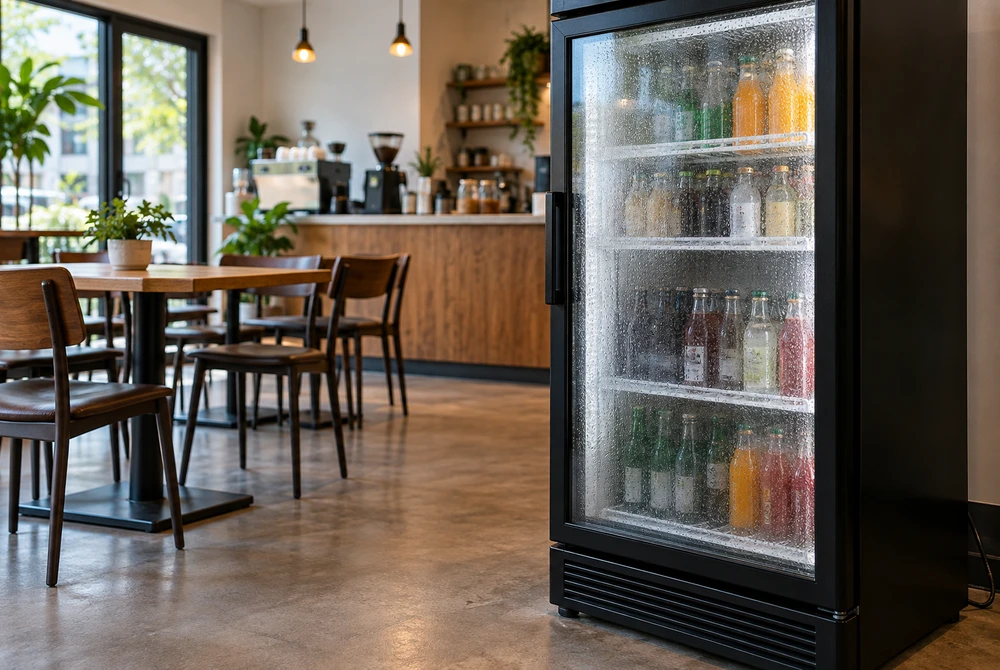
Start with the location of the moisture
Describe the actual panel, door and affected area. An observation such as room-side droplets across the lower half of the left viewing door gives a service provider more usable information than the fridge is sweating. Include whether the water is a light film, separate droplets or runoff. If the location is uncertain, record uncertain. Reflections, lighting and more than one pane can make a photograph misleading, so do not turn a visual impression into a confirmed internal condition.
Where ordinary approved cleaning makes it possible to identify an accessible wet face safely, keep that observation separate from any conclusion about the glazing. Do not dismantle a frame, reach behind guards, probe a seal or use tools to investigate a gap. A manager can report where water can be seen without opening an assembly. If neither accessible face explains the appearance, ask the supplier to establish what is happening rather than declaring that an insulated glass unit has failed.
Also identify whether the complaint concerns a customer viewing panel or a door assembly. Those may have different construction, opening patterns and manufacturer provisions. A fixed service-display panel is not automatically comparable to a hinged beverage door. Retain a picture of the whole cabinet as well as the affected area, so a technician does not have to infer the equipment type from a close photograph of droplets.
Give floor water its own immediate response
Visibility can be inconvenient; water reaching a walking route creates a different operational problem. Follow the site’s established process for protecting the area and removing water safely. Keep customers and staff away from an affected route where necessary, and involve the responsible manager. Do not wait for a perfect explanation of the glass before addressing a wet floor. Record that protective action without describing it as a repair to the refrigerator.
Do not assume every puddle beside the cabinet came down the glass. A cleaning spill, nearby equipment or another water path may coincide with visible condensation. Note where water first appears and where it travels without moving heavy equipment or opening a drainage system. The glass complaint and a separate leak can exist together. A useful report preserves that possibility until the responsible person has established the source.
Electrical concerns, damaged glass or an unsafe access condition need the site’s appropriate escalation rather than continued observation. Avoid placing absorbent material over ventilation openings, controls or equipment access to hide runoff. Any temporary housekeeping arrangement must remain compatible with the business’s safety and equipment instructions. The purpose is to protect the area while the cause is investigated, not to improvise a permanent drainage or electrical modification.
Keep glass appearance separate from the stock decision
A clear panel is not a temperature measurement, and a fogged panel does not tell you how long a product has been warm. Use the applicable product controls and the site’s normal temperature-assessment process for stock. If there is an independent temperature concern, handle it through that process immediately. Do not leave an unsuitable product condition unresolved while waiting for the glass to become easier to see through.
This distinction also works in the other direction. A satisfactory product check does not explain why water is collecting on a viewing surface or reaching the floor. Keep two records where needed: the product decision and the equipment or environment complaint. That prevents a statement such as the drinks are cold from being mistaken for closure of a recurring floor-water problem. Each question needs the evidence that actually answers it.
Do not raise a food holding setting simply to make the door look better. Nor should staff repeatedly lower the setting because they think a wet door proves weak cooling. The cabinet’s intended duty and the product requirements remain in force. Any proposed operating change belongs with the manufacturer’s instructions and the responsible qualified assessment, rather than an experiment driven by the appearance of the glass.
Understand the surface and nearby air together
The National Weather Service explanation of dew point describes the condition at which water vapor condenses into droplets. Relative humidity changes with air temperature, so a humidity percentage alone is incomplete context. For a cold viewing surface, the surrounding air and the surface condition both matter. This physical explanation does not supply an operating limit for a particular refrigerator.
Keep the explanation useful without making it a diagnosis. A wet exterior face can justify questions about the air around the cabinet and the way the panel is designed to perform there. It does not identify which part, if any, needs replacement. Several explanations can fit a photograph of a wet door. The next step is to identify which conditions actually apply to this installation, not to select the most familiar explanation.
Where environmental measurements are requested, ask the assessor to identify the measurement location, time, instrument and purpose. A general room reading may not describe the air immediately at the affected door. Likewise, a building weather report does not establish conditions inside the cafe. Keep observations and measurements labelled differently so a manager’s impression of a humid afternoon does not become a recorded technical value.
Identify the cabinet before borrowing a limit
Locate the model identification using the normal accessible equipment record or label. Retain the exact designation, electrical version where relevant, and any known door or glass replacement history. A brand name or matching cabinet width is insufficient when asking about glazing, anti-condensation provisions or environmental suitability. If the identification is missing or unreadable, make that the first question for the supplier rather than selecting a manual from a similar photograph.
Ask for the documentation that applies to the installed arrangement, including any supported replacement door or glass assembly. A secondhand cabinet may not retain every original component, and the site’s paperwork may describe an earlier configuration. Record what is confirmed and what remains unknown. Do not assume an option shown on a current sales page is present on an older machine merely because the exterior looks familiar.
When an environmental rating is supplied, retain its source and scope rather than copying a number into a general instruction for every refrigerator. Check whether it applies to the actual equipment and intended placement. A published condition is useful only when its application is understood. This guide intentionally supplies no universal room-temperature or humidity threshold for all glass-front cabinets.
Read glass-feature claims narrowly
The True TVM Full Door Series sheet, identified AB_273815_7.26, describes Low-E double-pane insulated glass as reducing condensation. This is a feature claim for the identified series, not a promise that every glass surface remains dry in every environment. It also does not establish what glass is fitted to another True model, another brand or a previously modified cabinet.
Use that example to ask precise questions, not to prescribe a replacement. Ask which glass construction belongs to the installed model, which performance statement the supplier is relying on, and whether the proposed part is supported for that assembly. A feature’s name cannot establish the condition of the actual panel. Keep any recommendation tied to an identified cabinet and a documented reason for the work.
A claim about reduced condensation also leaves the operating complaint to be assessed. Reduced compared with what, and under which stated scope, are legitimate questions where a comparison matters. Avoid translating a brief sales statement into a guaranteed remedy or a percentage improvement. The manager needs an explanation applicable to the installed equipment, not a more confident version of an advertisement.
Do not borrow placement advice from a different case
The Structural Concepts placement document for Oasis FSI660R and FSI860R includes service-display glass guidance. It is a reminder to examine model-specific installation information. Its placement distances and case-specific provisions must not become universal instructions for a closed beverage refrigerator. A service display and a glass-door cabinet can present different relationships between room air, viewing glass and refrigerated space.
For the installed cabinet, ask whether its current location matches its own documentation. Describe nearby entrances, cooking or washing activity, and building air outlets as observations, not proven causes. Do not reposition a heavy refrigerator, redirect ventilation or alter building controls simply because another manufacturer’s diagram looks relevant. Those changes may affect other equipment and responsibilities beyond the viewing-glass complaint.
If a location change is proposed, require the proposal to address the whole installation. Access, required clearances, utilities and the intended customer or staff route remain relevant even when visibility is the original complaint. A move that makes one panel easier to see through should not be accepted without checking whether the equipment is supported at the proposed position. Resolve those questions before authorizing physical work.
Record the pattern across ordinary service
Note when the appearance begins, which panel is affected and whether it changes during the normal trading day. Include known door-opening periods, cleaning and deliveries without inventing a precise opening count from memory. A brief dated sequence of observations is more useful than a claim that the glass is always wet when nobody has actually watched the whole period. Preserve uncertainty about unattended intervals.
Compare like observations. A photograph taken just after cleaning and another taken hours into service do not necessarily show a change caused by the refrigerator. State the timing and any intervening activity. If staff notice that the complaint began after relocation or a component replacement, include the date and the known change. That association is a reason to investigate, not proof that the most recent work caused the condition.
Where two adjacent cabinets behave differently, record their identities and duties before treating one as a control for the other. Similar doors can hide different construction or operating arrangements. Report the difference without declaring the drier cabinet correct or the wetter one defective. The comparison becomes useful when the assessor can establish whether it is technically meaningful.
Use a short observation sheet
The following fields keep the glass complaint specific while leaving product controls intact. Use concise entries and attach photographs or documents separately. A record need not contain a diagnosis to be useful; it should make clear what the team saw and which questions remain unanswered. Avoid filling an unknown field with a guess simply to complete the form.
| Field | Useful entry | Keep separate |
|---|---|---|
| Asset | Model and affected panel | Unconfirmed options |
| Surface | Exterior, interior or uncertain | Glazing diagnosis |
| Timing | Observation and activity times | Assumed whole-day pattern |
| Water route | Where runoff is seen | Unverified source |
| Product | Existing stock assessment record | Glass appearance |
Assign someone to keep the observation record available across shifts. Otherwise, one team may report that the door cleared while another is still dealing with water later in the day. A short handover can preserve both facts without deciding they contradict one another. State whether the issue remains open and who owns the next contact with the supplier or building team.

Separate operator observation from service work
Operators can describe the accessible appearance and follow ordinary approved care instructions. Assessing a heater, wiring, controller, glazing assembly or refrigeration system is a different task. Do not disable an anti-condensation feature, bridge a control, remove a panel or apply an external heat source to test a theory. A dry patch produced by an improvised intervention is not a valid acceptance result for the original installed arrangement.
If the model has a documented anti-condensation function, ask the provider to identify it and explain how its operation is to be assessed under the applicable instructions. Do not assume every panel has a heater or every visible control operates one. A feature that exists on another model cannot be used to diagnose an absent feature here. Keep responsibility for any technical testing with the qualified person doing that work.
The same boundary applies to coatings, films and cleaning chemicals suggested online. Use only care products and methods supported for the installed glass and surrounding materials. A product marketed for automotive glass is not automatically suitable for a commercial food-service cabinet. Do not apply an unverified treatment to change droplet appearance and then describe the underlying condition as resolved.
Give the building team a bounded question
Contact the building or HVAC team when the evidence raises a question about the installation’s surroundings, while retaining the equipment supplier’s role. Ask whether the relevant conditions at the cabinet have been assessed against the cabinet’s documented requirements. This is more useful than asking someone to make the restaurant less humid without a defined observation, location or equipment reference. No universal setpoint follows from this article.
Keep building changes under the appropriate responsibility. A suggestion to change ventilation or room conditions can affect staff comfort, other equipment and the premises as a whole. The refrigerator’s appearance alone does not establish which building adjustment is justified. Ask the team to state what it found, what it proposes and how the cabinet-specific question will be reassessed after any authorized change.
Where the equipment and building providers offer conflicting explanations, place both against the same dated record and model documentation. Do not erase one account to make the other easier to accept. Identify the missing comparison or observation that would help resolve the disagreement. A shared factual record is more productive than having staff repeat different versions of the complaint to each contractor.
Ask for an explanation before accepting a replacement
A proposal for new glazing, a door assembly or replacement equipment should name the finding it addresses. Ask which installed component was identified, what evidence supports the recommendation and whether the proposed part is approved for the exact cabinet. A quotation that simply says condensation repair leaves the manager unable to distinguish a supported remedy from a trial replacement. Clarify the scope before ordering.
Include the conditions under which the result will be checked. If the complaint occurs during ordinary service, an inspection of an empty cabinet before opening may not answer it. The provider should explain the relevant assessment conditions without the manager inventing an artificial stress test. Do not ask staff to leave doors open or manipulate equipment to reproduce a problem outside permitted use.
Keep glass visibility and product performance distinct in the proposed completion record. Work intended to address panel condensation does not automatically validate food history or every aspect of cabinet performance. Conversely, demonstrating cooling alone may leave the original wet-glass complaint unanswered. Name the promised outcome in plain language, and identify any part of the original question that the service scope does not cover.
Do not let the complaint become a refrigerant order
The presence of moisture on glass does not identify a refrigerant, establish a leak or show that refrigerant should be added. The site’s actual catalog includes refrigerant products, but no verified material requirement follows from this complaint. Purchasing should remain downstream of an identified service need and the installed equipment specification. Adding a product link here would imply a connection the evidence does not establish.
For a separate cooling complaint, our commercial reach-in repair-or-replace guide addresses a different decision path. Verify stock and equipment concerns through their applicable procedures rather than using a glass photograph to decide on refrigerant or replacement. Keep the records connected where useful, but do not collapse different questions into a single presumed fault.
Close the issue with the original question
At the end of the assessment, return to the stated complaint: the affected panel, the observed surface, the period and the water route. Record what was established, any authorized work, the relevant conditions and what remains unresolved. If the explanation is that the installation does not meet a documented requirement, retain that requirement and the proposed next step rather than writing no fault found without context.
If the panel appears clear after work, record when and under what ordinary conditions it was checked. That is a useful observation, not a guarantee covering every future day. Agree who should be contacted if the pattern returns and what information should accompany the report. Preserve the earlier record so a recurrence can be compared with the original condition instead of starting with an unsupported new diagnosis.
Make photographs answer a specific question
Take an ordinary view that shows the affected door in its surrounding installation, then a closer view of the visible water where access is safe. Keep the original photographs with their capture times. Avoid filters that change reflections or make a light film look more severe. If the panel has just been cleaned, say so. A photograph is evidence of appearance at a moment, not a measurement of surface temperature, room humidity or the condition of the stock behind it.
Describe what each image is intended to show. One may establish which cabinet is involved; another may show where a trail reaches the lower frame. Do not label a picture failed seal when that conclusion has not been established. A neutral description allows the assessor to review the evidence without first having to undo a diagnosis built into the filename or maintenance request. If reflections prevent a clear observation, retain that limitation instead of enhancing the image into apparent certainty.
Handle cleaning and visibility as separate records
Normal approved cleaning can change how a panel looks, but that does not make every change evidence of altered condensation. Record whether the complaint is a film that remains after ordinary care or water that returns during service. Ask for the correct care instructions if the installed glass or coating is uncertain. Do not introduce a new polishing compound or treatment while trying to document the original complaint, because the resulting appearance may add a second question to the first.
Keep the cleaning team’s information in the same handover. A manager observing water at opening may not know whether the panel was recently washed or whether water was already present before cleaning. Neither account should be guessed from the photograph. Simple timing notes help separate the activities without blaming staff or assuming the refrigerator is responsible. Where normal cleaning cannot safely establish a useful observation, leave the condition for the appropriate assessment rather than adding an intrusive inspection to a housekeeping task.
Retain uncertainty when responsibilities overlap
Some complaints remain unresolved after an initial visit. In that situation, ask which fact is still missing rather than requesting a more confident diagnosis from the same evidence. The equipment provider may need confirmation of the installed glass; the building team may need observations at the affected location. Name the next bounded question and its owner. A record that says awaiting panel identification is more actionable than a series of incompatible instructions to adjust the room, replace a door and change the cabinet setting.
Keep completion of an individual visit separate from resolution of the whole complaint. A provider can finish its agreed inspection while a question outside that scope remains open. Record both states explicitly, including any continuing protection for the walking route and the ongoing product controls. Do not let a signed attendance sheet erase those operational responsibilities. Equally, do not describe an unconfirmed technical defect as established merely because the first appointment did not reproduce the wet appearance.
When management considers an improvement rather than a repair, retain that distinction in the decision. Better visibility under the intended trading conditions can be a legitimate purchasing objective, but it needs its own documented requirements. It should not depend on declaring the existing appliance defective without evidence. Ask suppliers to explain the proposed equipment’s applicable glass and environmental provisions, then assess the installation as a whole before committing to a change.
Questions operators commonly ask
Does fogging mean the insulated glass has failed?
No. First establish where the moisture is visible and which assembly is fitted. A photograph cannot reliably resolve every accessible-surface or within-glazing question. If the appearance seems inaccessible, report that uncertainty and obtain an assessment of the identified assembly. Do not separate panes or remove trim to prove a suspected fault. Replacement needs its own evidence and supported part identification.
Should we change the refrigerator temperature?
Do not change food holding conditions to improve glass visibility. The stock requirements and permitted cabinet operation continue to apply. If there is a separate temperature complaint, use the relevant product and equipment assessment process. A change that makes a panel look different does not by itself establish that the new operating condition is suitable or that the original cause has been identified.
Can a dehumidifier solve the problem?
That cannot be decided from visible droplets alone. Establish the local conditions, cabinet requirements and installation question before selecting building equipment. Any proposal should state its intended scope and how performance will be checked. Do not promise that a portable appliance will correct every glass design, water source or operating condition. Equipment and building assessments may need to proceed together.
Why does the glass clear while the cabinet is still cold?
Changing appearance is an observation to record alongside timing and ordinary activity. It does not prove a particular control operated or a component recovered. Ask whether the surrounding conditions or documented operating stage changed, and keep unmeasured explanations tentative. A clear interval can help describe the pattern without authorizing food release or proving that a recurring issue has permanently ended.
Is this the same problem as a wet walk-in door gasket?
No single explanation should be borrowed between them. Our walk-in door gasket condensation guide concerns a doorway assembly and its water or icing complaint. This guide concerns viewing glass, its identified construction and the surrounding conditions. Use the appropriate equipment record and assessment rather than transferring a part diagnosis between unrelated assemblies.
Keep the final written finding available with the cabinet record, especially if responsibility is shared between a landlord, operator and equipment supplier. Identify who can authorize the next action and who should receive a recurrence report. This avoids turning a useful technical explanation into an instruction that nobody owns. Retain the original observation dates when copying the finding into a later maintenance system.
Sources and limits
The manufacturer documents above retain their named-model boundaries. The weather reference explains a physical concept, not cabinet approval. Neither source establishes the condition of an unidentified installation. Keep the actual equipment record and any qualified findings with the operating decision, and obtain clarification when the supplied documentation does not cover the fitted glass. A useful explanation should say what remains uncertain as clearly as it states what has been confirmed.