A cake that becomes dry or firm in a refrigerated display needs a product-quality investigation, even when the cabinet display looks cold. Keep the food’s required temperature control in place, then separate the product and its exposure history from the case’s intended use and actual operating condition. A dry cut surface does not prove a refrigeration fault, and a cold air reading does not establish the cake’s temperature history. Do not choose a colder setting or a higher humidity target before identifying which question needs an answer.
For a cafe or bakery, the useful result is a practical decision about the actual product: whether to review its preparation and protection, change an appropriate display practice, or request qualified equipment assessment. This guide concerns cakes and pastries already being merchandised during service. It does not prescribe a universal cake-storage life, authorize unrefrigerated display, or provide a recipe for changing the cabinet’s controls.
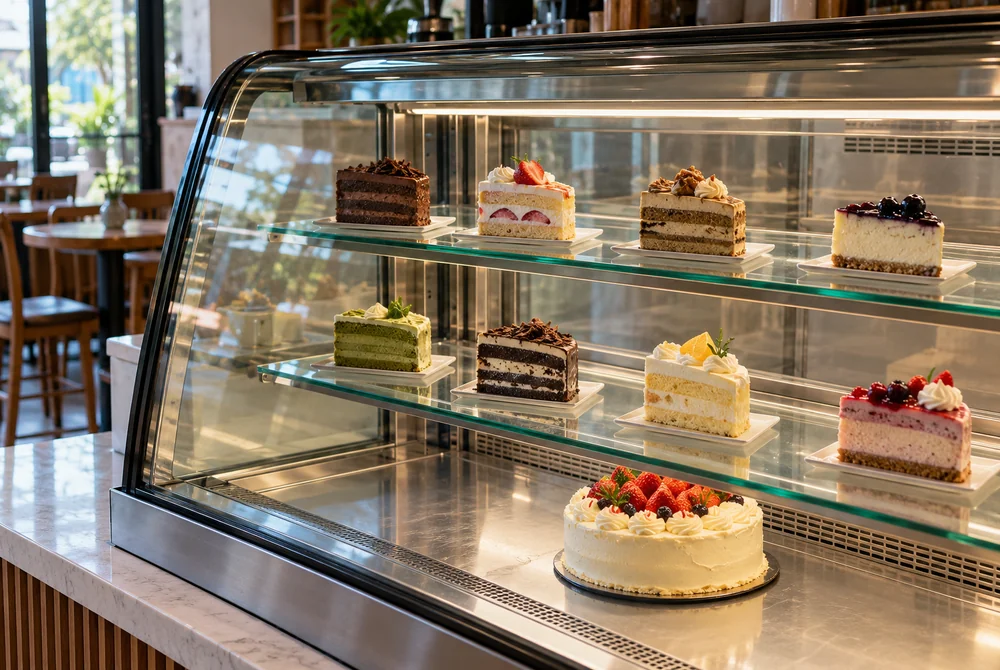
Describe what changed before naming a cause
Write down the observed change in ordinary, specific language. An exposed sponge edge becoming hard, an icing surface forming a crust, a filling losing shape and a moist-looking product receiving a freshness complaint are different observations. Calling every result dry can send the investigation toward the wrong explanation. Keep the description tied to the product, affected part and time it was first noticed.
Compare the complaint with the bakery’s own acceptable presentation, not with an unrelated photograph online. A cut slice and a whole decorated cake expose different surfaces. Different fillings, coatings and portions also make unlike products poor comparisons. Identify what staff actually prepared and displayed before deciding that a particular shelf or the refrigeration system caused the result.
Record whether this is a new pattern or a longstanding product limitation. Ask what changed around its first appearance: recipe, ingredient supplier, portion size, display quantity, protection, case loading or sales pace. These are leads to examine, not proven causes. Keeping several plausible explanations visible is more useful than immediately purchasing a humidity accessory or asking for refrigerant.
Separate three questions that a cold display cannot answer
First consider equipment operation: is the case being used for its intended product and arrangement, and is there a reason to request a service assessment? Then consider food temperature and history under the establishment’s applicable procedures. Finally consider product quality: which feature became unacceptable, and after what preparation and exposure? The answers can differ without contradicting one another.
A controller may show normal air behavior while an exposed cut face changes in quality. A product may also look attractive without a complete temperature history. Neither observation should cancel the other investigation. Give each question its own evidence so the employee responsible for presentation is not asked to decide refrigeration performance from appearance, or food acceptability from a control display.
The True TCGR manual linked from the manufacturer’s manual index makes an important distinction: its cabinet thermometer represents cabinet temperature rather than product temperature. The same manual gives model-specific product-placement and circulation instructions. Use those examples to understand the separate questions, not as settings or clearances for another bakery case. Obtain the instructions applicable to the installed model and configuration.
Identify the product as carefully as the refrigerator
Give the affected product a useful identity. Include its established recipe or supplier designation, filling and coating, portion form and preparation batch. Note whether it entered the case whole, was cut before loading or was portioned during service. If the preparation changed, preserve that fact instead of treating the new result as a like-for-like comparison with yesterday’s cake.
For purchased cakes, retain the supplier’s storage, handling and product-protection instructions. Ask about a quality problem using the actual designation and batch information. A familiar product name may cover several formulations, and a generic instruction to keep chilled may not answer every presentation question. Request clarification rather than replacing the supplier’s conditions with a rule drawn from a different dessert.
For an in-house product, involve the person responsible for the standardized preparation. A cabinet investigation cannot establish whether an undocumented recipe adjustment changed the product. Likewise, a recipe discussion does not prove that the display is operating correctly. Keep the product record and the equipment observations connected while allowing the responsible people to assess their own part.
Do not equate firmness with simple water loss
Bakery quality can involve changes in structure as well as moisture. A 2018 sponge-cake study recorded by LSU examined formulation, firmness, moisture and starch crystallinity during room-temperature storage. It supports treating cake firmness as more than a cabinet-air diagnosis. It was not a trial of refrigerated, filled cakes in a cafe, and it does not establish that every cake becomes stale faster when refrigerated.
A 2017 sponge-cake study provides a particularly useful caution. Its accessible abstract reports that one studied formulation became harder than another while losing moisture more slowly. That is a limited experimental example of why harder does not automatically mean more water escaped. It is not a reason to add the study’s ingredients to a recipe or select a new display temperature.
The operating consequence is to describe the quality change accurately and keep the product formulation consistent when comparing observations. Staff do not need to diagnose starch behavior during service. They do need to avoid turning a firm crumb, frosting crust or customer complaint into an unsupported statement that the case has excessively dry air or needs a refrigeration repair.
Establish whether the case permits the displayed arrangement
Find the installed case’s model and applicable operating instructions. Confirm whether it is intended for refrigerated bakery display, another food application, packaged products, a dry section or a combination of functions. A glass cabinet with shelves is not a complete use specification. Labels and instructions for the actual section matter when several functions share a similar exterior.
The Structural Concepts Harmony manual, revision B dated October 18, 2024, describes its covered cases as merchandising packaged, pre-chilled products. This is a useful boundary: its refrigerated appearance does not authorize exposed cake slices. The document also separates air indications from food measurements. Apply the manual only to the models and configurations it covers; it does not decide the use of an unidentified case.
If the intended arrangement cannot be established, ask the manufacturer or responsible provider to resolve that specific question. Do not improvise an answer from another shop’s photographs. A cover, liner, tray or container may change the displayed arrangement, so check that proposal against both the product’s requirements and the case’s permitted use rather than treating any physical fit as approval.
| Question | Useful evidence | Does not establish |
|---|---|---|
| Product quality | Specific change and batch | Food acceptability |
| Temperature history | Appropriate measurement record | A drying cause |
| Case use | Exact model instructions | All bakery applications |
| Exposure | Cutting and replenishment record | Universal display life |
Track the age of the exposed portion
Before assigning the change to the display interval, establish the condition when the product arrived. A purchased portion may have a preparation and transport history outside the cafe, while an in-house batch may have passed through cooling, decorating and reserve storage before loading. Ask what the available records actually show. Do not backfill an acceptable starting condition merely because the delivery was received without a complaint.
Where a product-quality issue is already evident at receipt or portioning, preserve the batch reference and contact the responsible supplier or bakery lead. This does not automatically remove the case from consideration. It changes the comparison: the team needs to understand the starting condition before deciding which changes developed during display. Keep any separate receiving or food-acceptability decision within the establishment’s applicable process.
Record the sequence that matters to the complaint: when the batch was prepared or received, when it was cut, when the portion entered the case and when its appearance changed. Keep earlier storage and handling information with that sequence. A newly filled shelf does not necessarily contain newly prepared or newly cut product, and a fresh display card does not restart the product’s history.
Distinguish first exposure from time available for sale. A slice may spend part of its history being portioned, decorated, transported or held elsewhere. Include relevant stages without guessing missing times. If staff cannot reconstruct the sequence, keep that uncertainty visible. Do not use an apparently satisfactory cabinet reading later in the day to fill an earlier gap.
Use the record to choose an appropriate question for the product maker or responsible manager. A change first noticed after cutting may deserve a different review from a whole cake arriving with an unusual texture. The chronology helps direct that review, but it does not establish a universal number of display hours or replace the establishment’s applicable product-disposition process.
Include the sales pace in the display decision
A case arranged for a busy service can present a different quality problem when sales slow. More portions may remain exposed for longer even though staff follow the same filling routine. Check actual replenishment and sales observations before assuming the cabinet suddenly changed. A full-looking shelf and a reasonable service quantity are different business choices.
Consider whether the displayed quantity reflects current demand and the product’s approved handling plan. A smaller service presentation with appropriate replenishment may be a useful operational option to evaluate. It is not permission to retain old portions longer or to extend a supplier’s limits. Any reserve stock also needs a suitable destination and a process that preserves its identity and history.
Give the opening and later shifts the same understanding of how the display is replenished. Avoid repeatedly topping up an old tray in a way that loses batch or exposure information. Staff should be able to distinguish retained portions from newly introduced ones. The quality review becomes much harder when the only record is that the case was filled twice.
Compare shelf positions without assuming the top row is guilty
If staff report a position-specific pattern, map the actual locations. Identify the shelf, tray area, product orientation and whether the observation follows the same product across more than one service. A statement that the top is worse is useful starting information. It is not proof of a defective fan, an incorrect humidity level or a universal rule that cakes should occupy another shelf.
Check whether positions also differ in product type, time loaded, protection or turnover. The last slices of one preparation on an upper shelf may not be comparable with newly replenished portions below. A useful comparison keeps those differences visible rather than attributing every result to position. Ask the responsible manager to choose a permitted comparison that does not change required food controls.
Keep observations outside the service boundary. Do not remove guards, expose fans, alter baffles or reach into unfamiliar components to investigate a quality complaint. If a repeated position pattern remains after the ordinary differences are understood, provide that evidence to the qualified case provider. Let the equipment assessment establish whether the installed arrangement or performance requires correction.
Distinguish display duty from cooling a new batch
Establish the condition in which the product is supposed to enter the case. The covered Harmony example requires pre-chilled product; it is not evidence that an arbitrary new batch can be loaded warm and brought into its required condition there. Check the installed case’s intended duty and the product’s approved preparation process instead of interpreting empty shelf space as available cooling capacity.
This matters when service pressure changes the normal sequence. A new batch may reach the sales area earlier, or staff may move product directly from decorating to display because another storage location is full. Record that change and refer it to the responsible person. Do not create a cooling method or waiting period from this article, and do not use a quality complaint to obscure a separate process question.
Keep the distinction useful for the team: which equipment or process prepares the product for display, and which case maintains the permitted display arrangement? An unresolved answer belongs in the operating review. Increasing the case load or adjusting its controls does not, by itself, establish that the changed preparation sequence is suitable.
Keep permitted loading and product protection together
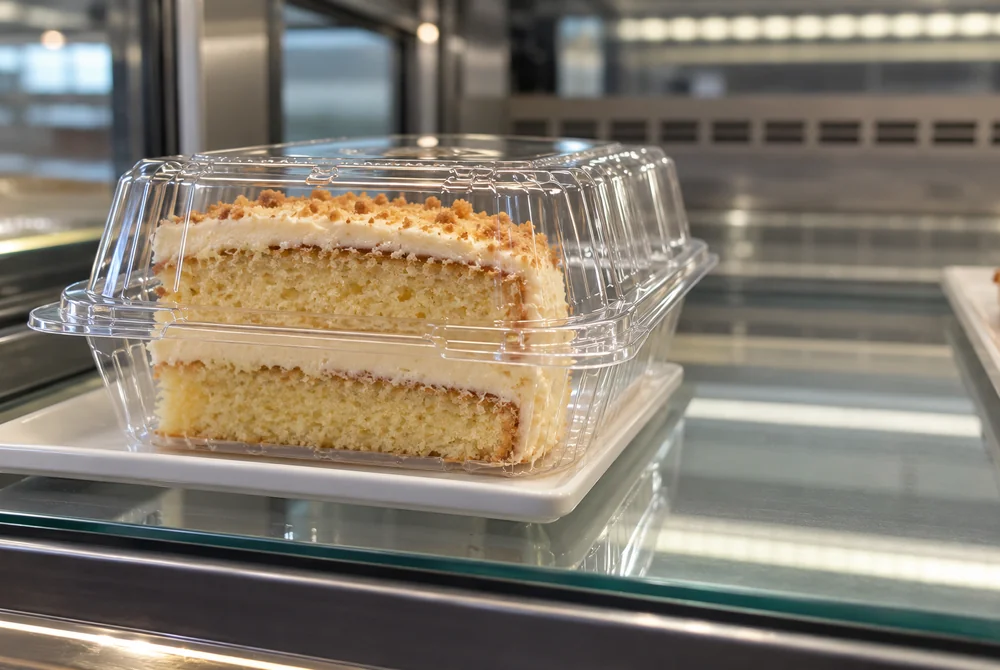
A proposed cover or container should protect the intended product while preserving the case’s approved arrangement. Check its dimensions and placement against the applicable instructions. Do not solve an exposed-surface concern by obstructing a return opening or placing a large cover where the model requires circulation. The product and equipment conditions both remain relevant.
Separate a food container from a cabinet accessory. A clear food-grade clamshell, an individual display dome and an equipment night cover have different purposes and instructions. None should be described as an interchangeable cure for dryness. Ask the product maker and case provider the specific question that remains unresolved rather than buying whichever item resembles a photograph from another bakery.
Use approved protection consistently if it forms part of an evaluated operating arrangement. Record whether portions were protected and when the protection changed. Otherwise a comparison between two shelves may actually be a comparison between different exposures. A container’s presence is evidence of an arrangement, not proof that food is safe, that quality will remain acceptable or that the case allows the configuration.
Distinguish store humidity from a product requirement
An equipment document may state surrounding temperature and relative-humidity conditions for the case. Read what those conditions describe. They are not automatically the desired humidity around every cake, and a limit for one machine is not a target for another. Keep a room measurement, an equipment operating condition and a product-specific requirement as separate entries in the investigation.
The same care applies to water activity mentioned in food assessments. That concerns available water in the food; it is not simply a reading from a room humidity instrument. Do not infer a cake’s safety classification from the shop’s relative humidity or assume a dry-looking surface establishes a suitable water activity. These measurements answer different questions and require appropriate interpretation.
Do not add water trays, misters, fans or improvised humidification devices to test a theory during service. Such changes can introduce new equipment, sanitation and product conditions without establishing the original cause. Ask for the applicable supported arrangement instead. If an environmental change is relevant, have the responsible provider evaluate it while preserving the case and product requirements.
Keep safety decisions tied to the actual formulation
Frostings and fillings cannot be classified by appearance alone. Kansas State’s Food Safety of Frostings and Fillings, published in December 2020, reports testing of submitted recipes for properties relevant to safety. The document explicitly limits its findings to the recipes and conditions evaluated and warns that recipe changes can affect classification. Its fair and exhibition context is not a nationwide cafe operating rule.
Minnesota’s retail guidance on frostings and fillings separately illustrates the need to distinguish refrigeration for quality from refrigeration for safety and to assess the actual recipe and process. That is a state-specific example, not permission for every bakery to move a product to an unrefrigerated case. Follow the applicable authority, establishment procedures and product instructions for the operation concerned.
If a product’s required conditions are uncertain, resolve them with the responsible food specialist or authority before changing display practice. Do not treat improved softness, attractive icing or a successful sale as a safety assessment. A quality experiment must not become a reason to raise the holding temperature, extend an approved interval or release product whose history is unresolved.
Record temperature evidence for the temperature question
Keep glass appearance separate from the cake observation as well. Fogging on a viewing panel, visible moisture on packaging and a dry-looking cut face are observations at different surfaces. Record where the condition actually appears. Do not use a clear front panel to conclude that the product has the correct moisture condition, or assume that wet glass proves the cake is receiving useful humidity.
Tell the equipment provider whether the concern is loss of visibility, a packaging observation, a product texture complaint or more than one condition. Photographs can document the locations without measuring humidity, product water activity or food temperature. Keeping their limits clear helps prevent a presentation issue from becoming an unsupported instruction to increase heat, disable a feature or add moisture to the case.
Use the establishment’s appropriate measurement method and identify what was measured, where and when. Keep the case indication separate from any actual food measurement. A reading described only as the fridge temperature cannot show whether it came from a controller, a shelf-area instrument or the product. Preserve the measurement context instead of collecting more numbers that cannot be compared.
Also record the operating stage and normal activity around the observation. Loading, service access and the case’s documented cycle can affect what staff see. These details help the responsible provider interpret the equipment evidence. They do not excuse an unexplained product condition or establish that a particular temperature change is acceptable for every case or food.
When the primary complaint is that the case or food is warm, use the appropriate temperature and service process rather than keeping the issue inside a presentation review. Our open refrigerated display guide addresses a different warm-restocking scene. Its equipment-specific examples should not be transferred onto a bakery cabinet, but the distinction helps route the unanswered question correctly.
Arrange a comparison that can actually answer something
Begin with one clear question. For example, the manager may want to know whether the same preparation develops the reported quality change at different permitted display positions, or whether an approved protection arrangement changes the observation during normal service. State what remains the same and what changes. Do not simultaneously change the recipe, display quantity, shelf and cabinet setting and then attribute the result to one factor.
Keep the comparison within the product’s required controls and the case’s permitted use. Use the establishment’s approved assessment process and identify any samples separately from saleable stock where appropriate. Do not extend an exposure interval solely to obtain a more dramatic result. The aim is a useful observation for a business decision, not an informal shelf-life or food-safety experiment.
Record results using the original description of the problem. A cut edge, frosting surface and whole crumb do not have to change in the same way. Note when the observation was made and any difference in the actual service conditions. A result that cannot distinguish the alternatives is still useful if it identifies the missing information instead of manufacturing certainty.
| Comparison | Keep consistent | Record separately |
|---|---|---|
| Shelf position | Product and exposure | Actual service conditions |
| Protection | Approved arrangement | Case air openings |
| Sales pace | Batch identity | Replenishment timing |
| Equipment concern | Installed model | Unresolved pattern |
A quieter cafe service illustrates the difference
Consider a fictional cafe that notices firmer exposed edges on a sliced cake while the cabinet indication looks familiar. Staff initially blame the upper shelf. The display arrangement also changed when sales slowed: more slices now remain from the opening presentation, while the lower shelf is replenished more often. The observations do not yet isolate a shelf effect.
The manager first confirms the product’s required handling and the case’s permitted arrangement. The team then keeps batch and cutting information with the displayed portions and reviews actual replenishment. If a comparison is appropriate, it holds those differences as consistently as the approved operating process allows. No one changes the thermostat, creates a humidity target or declares the food safe from its appearance.
The review may identify a question for the product maker, an operating mismatch to correct or a persistent equipment pattern for service. It may also remain inconclusive. The example does not claim a particular cause or a guaranteed improvement. It shows how to avoid buying a repair for an untested theory while preserving both quality and food-management responsibilities.
Send the unresolved question to the right person
A product maker or bakery specialist needs the preparation, batch, portion form, protection and observed quality change. A refrigeration provider needs the actual case identity, permitted layout, operating observations and any repeatable location pattern. The responsible food-safety contact needs the product’s formulation, process and relevant history. Sending every person the same statement that the fridge dries cake can leave all three questions unanswered.
Make the requested next action specific. Ask for confirmation of a product instruction, clarification of permitted case use or assessment of a repeated operating condition. Preserve any limitation in the answer. A supplier’s general description of gentle cooling does not diagnose the installed case, and a service invoice saying runs cold does not explain every product-quality result.
If circuit work is proposed, refrigerant purchasing follows the qualified finding and the installed equipment identity. Dry cake alone does not establish a material requirement. Do not choose refrigerant from the case’s appearance, a display reading or a generic bakery equipment category. The product-quality review can produce a well-defined service request without becoming a charging or component-replacement procedure.
Questions cafe and bakery teams commonly ask
Does a cold controller mean the cake cannot be drying out?
No. The indication and the quality observation answer different questions. Establish what the instrument measures and preserve the product’s actual preparation, exposure and temperature history. A normal-looking number neither explains the texture change nor proves the food’s history was satisfactory.
Does a harder slice prove that the case removed more moisture?
No. Texture can change with formulation and structural processes as well as moisture. Record the specific change and compare like products before naming a cause. The cited sponge-cake studies support that distinction within their experimental scope; they do not diagnose the cafe’s appliance.
Can we simply turn the temperature down or add humidity?
Do not treat either change as a default response. Preserve the required product controls and verify the equipment’s permitted arrangement. An unsupported adjustment introduces another variable without establishing why the quality changed. Obtain the applicable product and case guidance for the unresolved question.
Is a clear container always the answer?
No. Check the product’s instructions, the case’s intended use and the proposed placement. Protection may be a relevant operating option, but its presence cannot establish shelf life, food acceptability or a universal cure. Avoid replacing one unknown arrangement with another that blocks circulation.
Should every bakery product move into a dry display?
No. The required conditions depend on the actual product and applicable process. A quality complaint does not authorize removal of necessary refrigeration. Resolve uncertain formulation or safety questions with the responsible specialist or authority before changing the display method.
What if the first review does not identify a cause?
Keep the unknown visible and assign the next specific question. Preserve the observations already collected rather than repeatedly changing settings or discarding the evidence. An honest distinction between product, operation and equipment is more useful than an unsupported explanation that sends the next shift in the wrong direction.
Sources and practical limits
Sources were checked October 19, 2026. The True document is a currently linked, older-format manual whose printed revision date was not established. The Harmony document identifies revision B of October 18, 2024. Their instructions remain model-specific. The cited science uses particular sponge-cake formulations and storage conditions; it does not establish a universal effect of refrigerated display or a recipe change for this operation.
Independent cafe and bakery questions describe genuine reported drying problems, but their regions are unknown and they establish no current prevalence. The fictional example and comparison worksheet are editorial tools. The intended outcome is a focused next decision for the actual product and case, with required controls preserved and unresolved evidence identified instead of replaced by a familiar setting or a promised shelf life.