A chef base refrigerator should be purchased for the specific cooking equipment it will support, not simply for a matching width or a convenient number of drawers. Before ordering, connect the exact refrigerator and cooking-appliance identities to the applicable load limit, original cooking-equipment legs, required heat separation, ventilation and service access. Where the documents do not resolve the proposed arrangement, obtain a model-specific answer before approving the order. There is no universal list that makes every griddle and refrigerated base an approved combination.
This guide is for restaurant owners, kitchen purchasers and fit-out managers keeping an existing griddle or selecting a replacement cooking station. It provides questions for the supplier and installer, not instructions for lifting equipment, modifying supports or connecting utilities. A credible purchase describes the finished station and its remaining limitations. Delivery of a refrigerator that fits beneath the cooking surface is only one part of that decision.
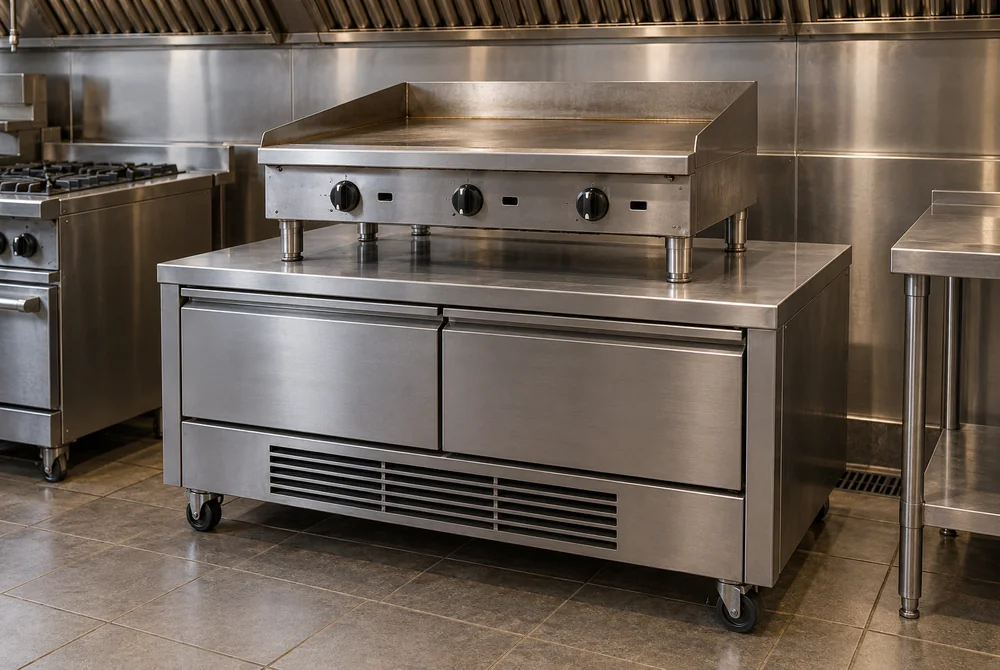
Begin with the cooking appliance you intend to retain
Record the complete model and available serial information for the existing griddle, range top or other countertop appliance. Photograph its accessible identification and external arrangement without moving heavy equipment or opening service panels. Establish whether the proposal retains that exact unit or replaces it. An estimate described as a new base for the grill can conceal two different projects with different support and installation requirements.
Look at how the current appliance is supported. A standalone griddle with an integral frame is not automatically a countertop appliance that can be separated from its stand. Missing, altered or unidentified legs need resolution by the manufacturer or responsible service provider. Do not let a new refrigerator order silently authorize cutting a frame, removing supports or changing the appliance’s intended mounting arrangement.
Include accessories that remain attached or will be added. Give the supplier an accurate description rather than assuming the bare appliance specification represents the assembled station. If the retained equipment cannot be identified confidently, make that a purchasing hold point. It is easier to investigate an unknown assembly before a delivery date is promised than after the old support has been removed.
Specify a chef base, not just refrigerated space
A worktop refrigerator, prep table and refrigerated chef base can all offer storage beneath a stainless surface. Their appearance does not establish that the top is intended to support cooking equipment. Ask the supplier to identify the offered product’s intended use and the documents supporting that use. A cabinet advertised with drawers is not a substitute specification for an equipment-supporting base.
Keep the base identity separate from its storage layout. Drawer count, pan arrangement and usable capacity matter to the kitchen, but they do not answer the structural or thermal pairing question. A convenient drawer layout can still belong to a model unsuitable for the intended appliance. Approve both the equipment interface and the storage function rather than trading one unanswered question for a useful feature.
This also keeps the article’s purchasing decision distinct from overnight food-storage policy or rapid chilling. Whether a pan fits in a drawer does not establish an approved holding procedure or a batch-cooling capacity. Establish those operating requirements separately. Here the first question is whether the refrigerator and the retained cooking equipment can form a supported station in the proposed location.
Match the load limit to the exact base model
The True Chef Base Series installation manual, revision B dated March 11, 2026, lists different maximum cooking-equipment weights for different TRCB groups. Its table gives 717 pounds for TRCB-36/48/52/52-60, for example. That number belongs to those listed models, not every chef base or every cabinet of a similar width. Use the actual offered designation and its applicable documentation rather than copying a favorable value from another row.
Have the provider establish the relevant installed cooking-equipment load and compare it with the applicable limit. A shipping weight, a remembered catalog figure and an assembled operating configuration are not interchangeable records. Ask what the comparison includes and what remains unknown. Purchasing should receive a traceable basis, not a calculation reconstructed from photographs by someone who cannot identify the equipment.
Do not invent a universal reserve percentage or assume several small appliances can be added because their combined advertised weight appears acceptable. Their support locations and intended arrangement also need assessment. A supplier confirming a maximum total has not necessarily addressed every foot position or a later accessory. Describe the complete proposal and request confirmation for the configuration that will actually arrive.
Check the footprint and support positions together
Overall width can be useful for the initial space plan, but it is not a drawing of where the appliance transfers its load. Ask the provider to compare the cooking equipment’s support footprint with the usable base top and applicable restrictions. A wide body may have supports in different positions from a narrower-looking appliance. Keep the actual support arrangement visible in the approval.
Edges, raised rims and top features can affect the usable arrangement. They should not become improvised mounting points simply because they are convenient. The installer should establish where the supports belong and whether any proposed accessory changes the arrangement. Managers can request a marked equipment drawing without designing the connection or treating an informal sketch as a manufacturer’s approval.
If a salesperson suggests an overhang, bridging plate or altered support, ask who specifies and accepts it for the two identified appliances. Do not convert an unanswered exception into an assumed standard practice. Keep the original proposal on hold until the responsible provider explains the supported solution, or compare a different base or cooking appliance that resolves the interface directly.
Preserve the cooking equipment’s supplied legs
True’s cited manual directs installation of countertop cooking equipment using the cooking manufacturer’s supplied legs. It also requires at least four inches between the base top and the bottoms of the cooking equipment’s heating elements, and recommends a heat shield that True does not supply. These are requirements and guidance for the documented series. They do not authorize a replacement leg, custom spacer or another manufacturer’s installation.
The purchasing implication is to identify the retained appliance’s correct supports before accepting a finished station height. Removing legs to align with an adjacent counter may change the arrangement that made the proposal acceptable. So can substituting a lower set merely because its threads fit. Ask the responsible provider to resolve any discrepancy between the present equipment and its documented configuration.
Distinguish the cooking appliance’s legs from the refrigerator’s legs or casters. They serve different positions in the assembled station. A quote that lists casters has not identified what supports the griddle above the base. Use separate names in the order and acceptance record so that a delivery substitution cannot disappear behind the general phrase supplied with supports.
| Interface | Confirm | Keep |
|---|---|---|
| Equipment identity | Exact upper and base models | Applicable documents |
| Supported load | Complete proposed arrangement | Provider assessment |
| Cooking supports | Correct supplied legs | Configuration record |
| Thermal conditions | Named measurement endpoints | Unresolved items |
Read the thermal condition from the correct reference points
Clearance measurements need named endpoints. A dimension from the cooking surface to the floor cannot establish a requirement stated between a heating element and the refrigerator top. Ask the installer to identify the relevant surfaces on the actual equipment and explain how the documented condition will be checked. Do not estimate a hidden element position from the appliance’s external side panel.
The Hoshizaki CR98A specification sheet, dated May 12, 2025, describes that model’s integral ceramic heat shield. It still specifies a minimum four-inch separation from the cooking equipment’s heating element bottom to the appliance top and a top temperature no higher than 180 degrees Fahrenheit. It also states side clearance and retention of the factory rear bumpers. An integrated shield therefore does not erase that model’s other stated conditions.
A cold drawer display is a different observation from the external interface condition. Likewise, a visually generous space does not establish a temperature limit under the proposed cooking duty. Ask the installer how applicable conditions will be assessed and documented. Management should know which questions have been answered by documents and which require a check of the completed station.
Keep heat protection distinct from clearance
Where heat protection is specified or recommended for the proposed model, identify its scope in the quotation. State whether it is part of the base, supplied separately or still to be specified by the responsible provider. A description such as heat resistant does not identify an accessory, its intended position or the instructions governing its use.
Do not assume adding a metal sheet permits a smaller gap, a heavier appliance or a changed support position. Those are separate conditions unless the applicable instructions explicitly connect them. An installer proposing a variation should explain its basis for the actual equipment. Treat unresolved exceptions as open items rather than allowing an accessory name to stand in for technical confirmation.
For a used base, establish what is installed today. A listing may repeat the original specification without confirming the condition or presence of the relevant components. Ask the provider to assess the retained assembly and identify any required restoration. Purchasing needs the proposed delivered configuration, not only evidence that a model once left the factory with a useful feature.
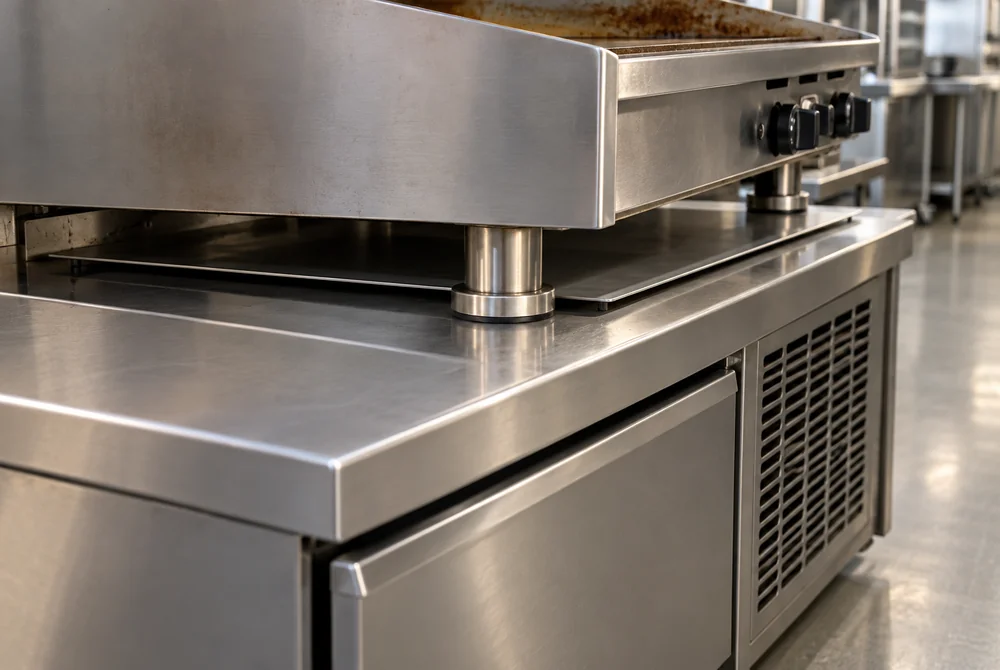
Protect the refrigerator’s actual air path
Identify where the proposed refrigerator takes in and rejects air. Then assess those openings in the completed cooking line, including nearby equipment, trim, stored supplies and the position of the station. A grille visible in a catalog photograph can become obstructed when another item is installed beside it. Include the final surroundings in the site assessment.
Front breathing does not mean that every other installation condition disappears. Nor does a narrow-looking space prove that an opening provides adequate airflow. Use the instructions for the exact offered model and have the provider resolve any unclear placement. Do not transfer a different refrigerator’s side or rear allowance into the order because the two units share a general product category.
Keep routine housekeeping practical. If staff normally store sheet pans, bins or supplies in the area proposed for an opening, address that operating conflict before installation. An instruction that simply says keep clear may fail when the kitchen has nowhere else to put its equipment. Provide a workable layout and make the protected area recognizable without asking staff to redesign ventilation.
Plan access with drawers open and service underway
Draw the station with the drawers in their usable positions, not only with every front closed. Check whether a cook can retrieve the intended pans without blocking an essential route or colliding with another appliance. Have the provider identify the correct drawer arrangement and permitted loading. Storage convenience should be assessed alongside the equipment interface rather than after the purchase.
Ask how the refrigeration service area will be reached. Another appliance or decorative panel may make a removable panel impossible to remove in practice. The provider should identify the required access and any work needed to create it. Being able to clean the visible grille does not establish that a technician can reach the components requiring service.
Consider what happens when access requires moving the assembled station. Heavy upper equipment, utility connections and the base support arrangement make that a coordinated service question. Record who plans and performs it. Do not assume casters authorize employees to pull the station forward or that a refrigeration visit automatically includes work on the cooking appliance’s connections.
Assess the completed height and surrounding cookline
The final working height includes the refrigerator’s installed supports, the base top, the cooking equipment’s specified legs and the appliance itself. Ask the provider to show the assembled dimensions rather than quoting the refrigerator height alone. If a proposed height is awkward, resolve the equipment selection instead of assuming a support can be shortened later.
Include the neighboring cooking equipment and the actual extraction arrangement in the site review. The refrigerator specification is not approval of the entire cooking line or its building services. Assign those interfaces to the appropriate installer or project professional. Purchasing needs a clear boundary so a base supplier’s answer is not mistaken for acceptance of unrelated work.
For an existing line, record changes introduced by the new station. A drawer, side panel or support position may differ even when overall width remains familiar. If the plan depends on moving another appliance or altering a counter, identify that dependency before ordering. The useful comparison is between completed arrangements that can be operated and maintained, not between cabinet dimensions alone.
Make the supplier answer for the proposed pair
Send one concise equipment packet containing the actual cooking-appliance identity, proposed base designation, current support arrangement and site drawing. Ask the supplier to state what its documents establish and what needs further confirmation. Request a model-specific response to the unresolved items. There may be no published cross-brand pairing list, and an unanswered list search should not be presented as approval.
Where the cooking-equipment and refrigeration providers give different answers, keep both statements with their scope. One may be addressing the base top while another is discussing the upper appliance’s mounting or access. Identify the exact disputed condition and ask the responsible parties to resolve it. A general assurance from one supplier should not silently overrule another appliance’s instructions.
Use a purchasing hold when a material question remains unresolved. State the missing answer, who owns it and the consequence for the order. That is more useful than collecting several messages that each say should be fine. The goal is a supportable configuration with visible limitations, not an absolute guarantee that no service issue will ever arise.
Compare quotations on the same installed scope
A lower cabinet price can omit items another proposal includes. Compare the actual cooking appliance retained, base supplied, required supports and heat protection, delivery arrangement, installation interfaces and completion checks. Identify which provider is responsible for each item. A refrigerator-only quote and a completed station quote are different offers even if they mention the same base model.
Include the work around the retained equipment. Who assesses its present supports, coordinates its handling and restores the finished station? Who resolves the cooking and refrigeration utility interfaces? Keep exclusions explicit. Do not let the schedule assume that the delivery crew will perform work outside its agreed scope or that a later service contractor has already accepted it.
Separate optional operating preferences from conditions required for the proposed installation. A drawer arrangement may be a choice; a documented support requirement is not merely a feature to negotiate away. Ask the supplier to distinguish substitutions that preserve the accepted arrangement from changes that require review. That makes price comparisons usable without encouraging unsupported compromises.
Distinguish the top load from the storage load
The cooking-equipment capacity is not a drawer-loading allowance. Give the kitchen team the separate applicable instructions for containers, drawer use and storage. Do not approve a heavier upper appliance because a drawer will normally be empty, or assume a top rating describes every force on an open drawer. Ask the provider to resolve each intended use within its own documented conditions.
Map the actual containers the station needs. Check usable access, pan arrangement and the way the cook retrieves ingredients while working at the appliance above. A cabinet can meet the equipment-support requirement while providing an inconvenient storage layout for the menu. Resolve that mismatch during selection rather than adding unsupported rails or accessories after the installed station has been accepted.
Check service support without treating warranty as compatibility
Ask who will provide refrigeration service at the actual restaurant and which work that provider can perform. Separately identify responsibility for the cooking equipment. A single sales contact may coordinate both, but a repair visit still needs an agreed scope. The kitchen should not discover during an interruption that each contractor expected the other to move or assess the upper appliance.
Request the applicable warranty information for the actual purchase and installation, including how questions or claims are submitted. A long advertised term does not resolve an unsupported mounting arrangement, establish coverage for every event or guarantee a particular local response. Keep the commercial service discussion separate from confirmation that the two identified appliances meet their installation conditions.
Where a used appliance is retained above a new base, clarify which supplier’s responsibilities cover each item. The base purchase does not automatically renew the griddle’s service support or transfer responsibility for earlier modifications. Record the actual agreement rather than inferring it from a combined invoice. This helps compare complete proposals without making speculative promises about reliability or repair costs.
Include cleaning access in the finished arrangement
Show the provider how routine cleaning will be carried out around the station. An accessible front does not explain how spills or deposits at another interface will be handled. Ask for the permitted cleaning and access instructions for the actual appliances, with staff tasks distinguished from work requiring a service professional. Do not create a routine that depends on employees lifting the cooking appliance.
Keep loose cleaning supplies and spare containers out of spaces reserved by the accepted arrangement. If the planned storage location conflicts with an air opening or service panel, assign another location before opening the station. The approved drawing needs an operating counterpart that staff can maintain during a busy shift, rather than an empty demonstration area that cannot exist during normal use.
| Quotation item | Include | Owner |
|---|---|---|
| Equipment | Exact supplied configuration | Named supplier |
| Site work | Utilities and access scope | Responsible installer |
| Heat protection | Integral or specified accessory | Confirmed provider |
| Completion | Applicable checks and limitations | Acceptance contact |
Work through an existing-griddle replacement proposal
Consider a fictional restaurant retaining a heavily built griddle while replacing its support with refrigerated drawers. The owner first selects a base of similar width. The initial quotation contains a refrigerator and delivery charge, but no confirmed cooking-equipment weight, no identified original legs and no assessment of the assembled height. The apparent match is still an incomplete proposal.
The next useful step is to identify the retained griddle and establish whether its present frame can be separated as proposed. The provider then evaluates the documented load, support footprint, thermal conditions and access against a specific base. If the existing appliance cannot be used in a supported arrangement, the owner needs a different equipment proposal rather than an improvised mounting solution.
The owner can compare retaining the existing support, selecting a different suitable base or replacing the upper equipment as part of a defined project. The right business choice depends on the verified options and operational need. The example establishes no particular model’s suitability and promises no savings. It shows why the unanswered pairing questions belong before the purchase commitment.
Carry substitutions back through the decision
A last-minute alternative may differ in more than drawer count or price. If the offered base changes, reopen the relevant load, top, heat-protection, airflow, height and service-access questions. Keep the revised designation on the order. Do not leave the original model’s supporting documents attached to a substituted cabinet as if they describe the same installation.
The same applies when the cooking appliance changes after the base is selected. A new griddle’s width alone cannot preserve the old assessment. Request its supported arrangement and have the provider revisit the actual interfaces. A purchasing approval should describe what it covers so a later employee can recognize when a change falls outside it.
Used equipment requires particular attention to identity and condition. A replacement support, missing bumper or uncertain top arrangement can make the present unit different from the catalog description. Ask for the discrepancy to be resolved before accepting it. Keep the condition evidence with the purchase, without treating a used listing’s photograph as confirmation of concealed components.
Set completion checks before delivery day
Agree on what the responsible provider will document once the station is in its intended position. Connect the delivered equipment identities to the accepted support arrangement, applicable thermal conditions, clear air openings and practical service access. Record any exception or unfinished work. A delivery signature proves a transfer occurred; it does not establish all installation conditions.
Ask the provider to explain how representative operating conditions will be considered where relevant to the applicable instructions. Do not invent a universal test duration, surface-measurement method or acceptance temperature from another appliance. A limitation during the demonstration should remain visible, with an assigned follow-up, rather than becoming an unconditional statement that the arrangement has been verified.
Keep food-management decisions separate from equipment acceptance. A completed installation record does not reconstruct the temperature history of ingredients moved during the project. Use the establishment’s applicable procedures for storage and product disposition. The operating team should receive both a clear equipment handoff and an appropriate plan for loading and use, without confusing one approval with the other.
Keep service and refrigerant purchases on their own evidence
A future warming complaint does not prove the original pairing was wrong or that the cabinet needs refrigerant. Preserve the operating conditions and ask the service provider to establish the cause. An altered support arrangement or obstructed opening may be relevant observations, but management should not convert them into an unverified refrigeration diagnosis.
For an already failing cabinet, our commercial reach-in repair-or-replace guide explains the separate evidence-based service decision. Its upright-cabinet examples do not approve a chef-base installation. Keep the present article’s purchase approval tied to the actual supported pair, while a service authorization identifies the installed equipment and verified fault.
Likewise, do not add a cylinder to the order merely because the site sells refrigerants or the base contains a refrigeration circuit. Material selection belongs to the identified equipment and an established service requirement. Buying a complete supported cabinet is a different transaction from authorizing circuit work. Preserve that boundary in the purchase order and service record.
Questions buyers ask before committing
Is matching width enough to put my griddle on a chef base?
No. Establish the exact equipment, applicable supported load, support positions, cooking-appliance legs, thermal conditions, ventilation and access. Width is one space-planning dimension. It does not resolve an unidentified upper appliance or an installation exception.
Does an integrated heat shield remove the clearance requirement?
Do not assume it does. Read the complete applicable instructions and retain their separate conditions. A feature description cannot replace the documented installation requirements. Ask the provider to resolve the exact proposed arrangement rather than borrowing another model’s allowance.
Can we remove the griddle legs to lower the working surface?
Do not approve that change on a height preference alone. Have the responsible manufacturer or provider establish the permitted support arrangement. If the intended height cannot be achieved within the applicable conditions, compare another supported equipment configuration before ordering.
Can a supplier give us a universal approved-pair list?
Such a list may not exist. Ask for the precise documents and answers supporting your proposed equipment and location. Preserve their scope and any unresolved condition. A model-specific installation requirement is not blanket cross-brand compatibility approval.
What if the refrigerator is delivered before the questions are resolved?
Keep the unresolved installation decision visible and coordinate the next action with the responsible provider. Delivery does not answer the missing technical question. Do not let pressure to reopen the line turn an uncertain support or thermal arrangement into an accepted installation.
Source scope and a usable purchasing outcome
The linked True manual and Hoshizaki specification were checked October 18, 2026. Their identified editions describe their own models; obtain the applicable current documents for the offered equipment and retained cooking appliance. The fictional example and purchasing worksheets are editorial tools, not records of a tested installation. Operator discussions establish that buyers ask about griddles and refrigerated bases; their recommendations are not technical approval.
Leave the purchase with two clear equipment identities, a supported arrangement, assigned installation responsibilities and a record of what was actually checked. Preserve any unresolved condition instead of filling it with a familiar number or an attractive feature claim. That gives the kitchen a decision it can review when equipment, layout or service needs change.