
A blast chiller can support a larger cook-chill batch only when the actual food, containers, loading pattern, probe placement and production schedule have been checked together. A tray count, cold cabinet display or advertised cycle time cannot establish that your next batch will reach its required food temperatures. Before increasing output, run a controlled acceptance exercise using the intended menu and the installed machine’s instructions, then keep the measured batch record with the operating procedure.
The practical question is not simply how many pounds fit inside. It is how much of a particular preparation the kitchen can cool, unload and move into suitable storage before another batch needs the same space. A chiller that works well for shallow sauce pans may need a different arrangement for a dense whole joint. A machine with a holding mode may also be unavailable for the next production run while yesterday’s food remains inside.
This guide is for commercial kitchen managers, chefs and facilities teams planning an ordinary cooked-food cooling process in the United States. It is an operational acceptance plan, not a recipe, a refrigerant charging procedure or permission to start reduced-oxygen packaging. Use the locally adopted food rules, the establishment’s approved procedures and the exact equipment manual. Packaging, specialized processing and institutional requirements may need separate review.
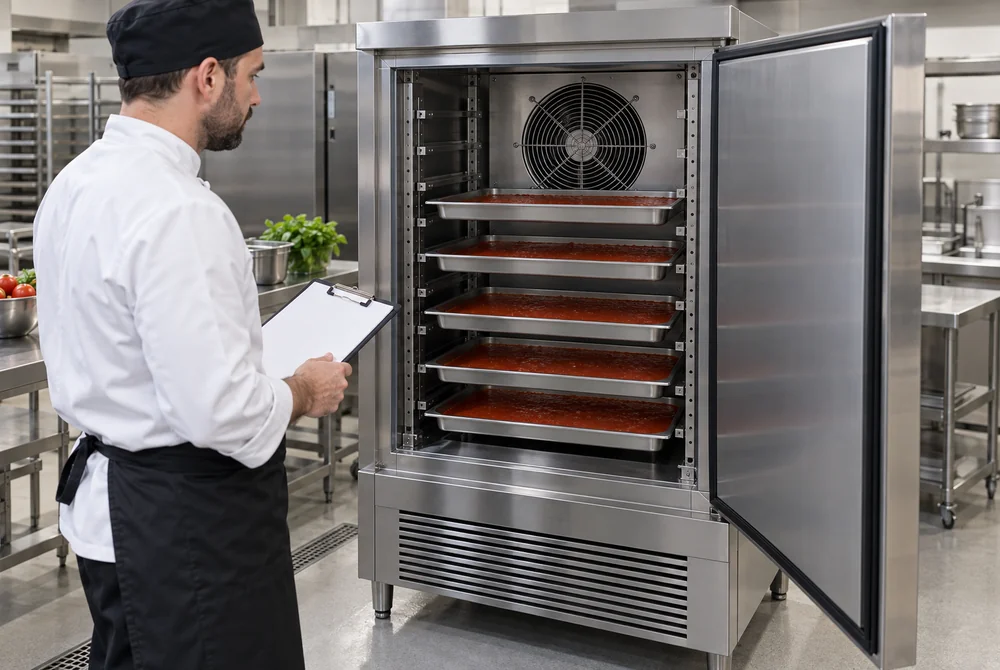
Start with the batch you intend to produce
Write down the preparation, recipe version, finished batch weight, container type and intended fill depth. Include any portioning that occurs before cooling. Those details describe the work the chiller will actually receive. A purchase quotation saying only “ten pans” leaves too much unresolved: ten lightly filled shallow pans and ten deep, densely packed pans are different loads.
Identify when cooking finishes and who transfers the batch. Include the real handoff from kettle, oven or preparation station rather than beginning the record only when the machine door closes. If staff need to portion a large preparation, organize the tools, containers and labor beforehand. The acceptance exercise should examine the intended process without inventing a waiting period for hot food.
Choose a representative demanding preparation with the food-safety lead and supplier. Do not assume that the largest batch by weight is always the slowest to cool. Keep different menu families separate in the initial record so a successful result for one food does not silently approve another. Where the operation needs more than one loading arrangement, each arrangement needs a defensible basis.
Separate a rating, a food requirement and your production deadline
These are three different promises. A manufacturer’s rating describes performance under stated conditions. Food requirements govern the process that applies to the preparation. Your production deadline determines whether the equipment and staff can finish the work when the business needs it. Passing one does not automatically satisfy the other two.
The FDA model provision for ordinary cooked time/temperature control for safety food is cooling from 135°F to 70°F within two hours, and to 41°F or below within a total of six hours from 135°F. A manufacturer’s 90-minute benchmark is not a universal legal limit. Confirm the locally adopted requirements and any applicable approved alternative. See the FDA Food Code 2026, sections 3-501.14 and 3-501.15.
FDA’s 2026 change summary identifies a new alternative cooling method requiring regulatory approval. Its existence does not authorize an establishment to substitute a cold air display for its existing food checks. Ask the local authority which adopted provision and approved procedure apply; this article does not implement that alternative.
For scheduling, use your measured preparation and turnaround record. If a menu needs the machine free before lunch production begins, a batch that meets the applicable food requirement but occupies the cabinet until after that handoff may still be unsuitable for the planned workflow.
Read the test conditions behind the capacity number
The Electrolux Professional 725214 specification, dated July 24, 2025, illustrates why this matters. Its EN17032 product-information block lists a 40 kg chilling load and a 79-minute cycle from 65°C to 10°C. The accompanying test description identifies a 30°C room and 40 mm-deep trays containing mashed potatoes distributed to a height of 35 mm.
Those details belong together. The endpoint of that listed test is not the final food temperature required by every U.S. cooling procedure. The same sheet describes other operating functions, but a buyer should not merge different test conditions into one stronger performance claim. Ask the supplier to identify the exact specification used for the offered configuration.
Then place your own batch description beside it. Record differences in food, loading, starting conditions and kitchen environment. Ask which differences the supplier has assessed and which require a demonstration. Keep unanswered questions visible in the procurement file rather than treating an attractive headline capacity as acceptance of every menu.
Do not confuse storage space with chilling capacity
A cabinet can physically accommodate more food than its refrigeration system is rated to rapidly chill in one batch. Rail positions, maximum stored weight, freezing duty and chilling duty may be separate specifications. Purchasing should retain their labels and conditions instead of selecting the biggest number on the sheet.
An older manufacturer’s example makes the distinction concrete. The Alto-Shaam Quickchiller MN-36580 Rev. 0 manual, available through a document mirror, lists approximately 480 lb maximum product capacity for the QC2-100, but approximately 240 lb maximum chilling capacity. This is a legacy document, not a current sales specification or permission to load a different model to those values.
The purchasing lesson is to ask which capacity is relevant to the job. If the offered machine includes accessories, determine whether the quoted rating assumes those accessories. If it is a used cabinet, verify the installed configuration rather than relying on a brochure for a machine with a similar front panel.
Make the loading arrangement repeatable
A useful acceptance plan identifies the pans, rack positions and permitted spacing in a way staff can reproduce. Photograph the approved arrangement without including private documents or people unnecessarily. Keep the photo with the recipe or batch instruction so “load as tested” has a clear meaning on another shift.
Do not choose a universal pan depth from an unrelated guide. Obtain the installed machine’s loading instructions and assess the intended preparation with the responsible food-safety personnel. Write the permitted fill into the actual process record. A pan’s external depth does not tell staff how deeply it should be filled.
Record whether the batch is uniform or mixed. If different preparations share the cabinet, the supplier and process lead should address how the arrangement will be checked. Avoid using a quick-cooling tray to represent a slower item elsewhere in the load. The acceptance result should describe precisely what was assessed, including any limitation on mixed loading.
Choose the cycle for the preparation, then identify how it ends
Before a trial, note the selected program and whether its completion depends on elapsed time, a food probe or another specified control sequence. Record the operator’s actual selection. A saved program name can be misleading if someone has changed its parameters, so the supplier should confirm the configuration where that is part of commissioning.
A time-based cycle can finish because its timer expires. A probe-based cycle depends on the probe signal and the machine’s logic. Neither description alone establishes that every item in a mixed batch has been assessed. Ask how the program handles a missing or improperly inserted probe and whether it changes to another operating mode.
Keep recipe decisions with the kitchen and equipment configuration with authorized personnel. Staff should use documented operator functions, not undocumented service menus or borrowed settings. If the intended cycle cannot support the preparation, change the approved process or obtain appropriate equipment guidance before increasing production.
Treat the food probe as part of the batch record
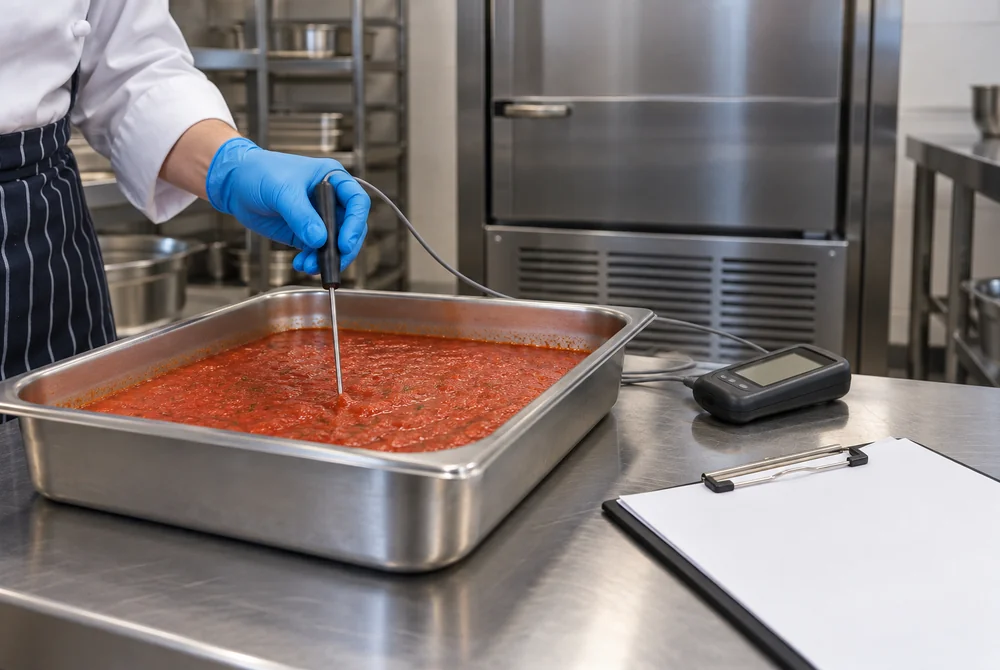
Identify the probe used, the sampled preparation and its location. Ask the supplier to show the intended insertion method for the actual food and sensor. Record the selected location so the next operator knows what the temperature trace represents. A sensor resting against a pan or sitting outside the food does not describe the same condition as a correctly placed food probe.
Use the establishment’s hygienic handling and instrument-check procedures. Keep the instrument’s status and any relevant comparison check with the trial record. If the displayed probe reading disagrees with an authorized independent food measurement, retain both readings and investigate timing, location and instrument condition rather than choosing the more convenient number.
For several pans or a mixed load, agree beforehand how the process lead will assess representativeness. One convenient reading should not become an unsupported statement about all trays. Additional checks belong in a planned method that accounts for access and contamination control, rather than repeated unscheduled door openings during a trial.
Use a short acceptance sheet
The following worksheet is an editorial planning aid. It does not replace a regulatory form, an approved food-safety plan or the manufacturer’s commissioning procedure. Its purpose is to connect the measured batch with the equipment and the operating arrangement that produced it.
| Item | Record | Owner |
|---|---|---|
| Food | Recipe; batch identity | Kitchen lead |
| Load | Weight; pans; fill | Assigned operator |
| Arrangement | Rack positions; photo | Assigned operator |
| Program | Cycle; termination mode | Supplier and operator |
| Measurement | Probe; location; checks | Food-safety lead |
| Timeline | Preparation; load; finish | Assigned operator |
| Exceptions | Alarm; interruption; action | Responsible supervisor |
| Destination | Storage; receiving record | Receiving operator |
| Approval | Scope; limits; follow-up | Authorized process lead |
Keep the measured temperatures and times in the linked cooling record, not squeezed into a crowded equipment table. The approval row should identify which recipe, load and arrangement are supported. If the trial was interrupted, say so. A completed worksheet with an unresolved exception is not the same as an accepted process.
Include the environment that the machine actually works in
Observe the installation during the production period being evaluated. Note accessible ventilation openings, nearby heat-producing equipment and any change since commissioning. A clear machine at opening time may be surrounded by stored containers during service. Ask the supplier to assess the relevant installation conditions against its instructions.
The acceptance record should distinguish room conditions from food readings and cabinet readings. Label the location and time of each observation. Avoid deriving a refrigeration diagnosis from a kitchen temperature alone. Its role is to describe the conditions of the trial and any difference from the documented rating.
Where access, drainage, electrical supply or refrigeration service needs examination, involve the appropriate qualified provider. Managers can document the operating environment without opening panels or altering safety devices. A trial should not become an excuse to modify the installation before the original complaint has been assessed.
Plan the second batch before accepting the first
A single successful run may establish useful information about one arrangement. It does not show that the cabinet will be available when the next cooked preparation arrives. Build the production sequence with loading, chilling, unloading, required cleaning and any documented equipment recovery or defrost stage included.
Write the actual time the next batch is ready, rather than a daily average. Two preparations finishing together create a different problem from the same total weight spread across a shift. Assign the receiving position for each batch and identify what happens if that position is unavailable. The plan must use approved handling, not an improvised wait beside the kettle.
Ask the supplier what repeated-run assessment is appropriate for the machine. Do not promise a fixed number of cycles by dividing the shift length by the advertised chilling time. The additional work between batches and the installed control sequence are part of available production time.
A fictional schedule shows why daily pounds are insufficient
Consider a fictional catering kitchen that prepares two separate sauce batches and one cooked vegetable batch during the morning. This example contains no claimed customer results or equipment performance. The manager’s task is to place the actual preparation times and accepted loading arrangements on one schedule.
If both sauce batches finish cooking together, one chiller position may not serve both immediately, even though their combined weight is below a daily production estimate. If the first batch stays in a holding mode while staff portion the vegetables, the machine may remain occupied. The bottleneck can therefore be cabinet availability or transfer labor rather than an established refrigeration fault.
The useful changes to evaluate are cooking sequence, approved batch division, unloading responsibility and receiving storage. If those changes cannot satisfy the required process and service schedule, the kitchen has a defined capacity question for the supplier. It has not proved a need for refrigerant, a larger compressor or a universal percentage of extra capacity.
Give holding mode its own operational decision
Some machines offer a holding function after chilling. That feature requires confirmation on the actual model and configuration. Ask what the display indicates, how the transition occurs and which alarms remain active. Also establish how the batch record is retained and who receives an exception when staff are absent.
A published model example should not become a fleet-wide rule. Beverage-Air identifies R290 blast chiller models in its current range, while the Electrolux sheet above identifies R452A and automatic holding. Those are different equipment specifications. Neither statement establishes that another cabinet can be left unattended overnight.
For the business, overnight occupancy also means the machine may not be available for early production. Decide whether cooled food should move to suitable storage through the approved workflow. Keep shelf-life, date-marking and packaging decisions separate; a holding button does not create a universal storage duration for every preparation.
Make the receiving refrigerator part of the plan
Identify where the completed batch will go, which operator moves it and how the receiving space will be kept available. A blast chiller is one stage in production. An accepted cooling run can still be followed by an unresolved transfer or storage problem if the destination is full, unsuitable or not ready.
Check the intended container arrangement and storage duty with the responsible team. Keep batch identity attached during movement. Record the handoff required by the establishment’s procedure so an incoming shift does not have to infer which trays completed cooling and which remain under review.
Our commercial refrigeration maintenance guide addresses routine facility upkeep. Use it for the surrounding maintenance program, while retaining the batch acceptance record as a separate production document. A routine equipment inspection does not independently approve a new cooling recipe.
When a trial disappoints, preserve the facts before changing the machine
Keep the batch description, selected program, readings, alarms and interruptions together. Identify what differed from the intended arrangement. If staff cannot reconstruct the loading or probe position, record that uncertainty. It may limit the trial’s usefulness without proving that the refrigeration circuit failed.
The immediate product decision belongs to the establishment’s approved food-safety process and responsible personnel. Do not restart the record to hide a missed requirement or use a later cold reading to erase an earlier exception. If a food decision is unresolved, keep its status explicit while the equipment question is investigated.
For the supplier or contractor, state whether the concern is an unexplained alarm, a measurement disagreement, an inability to complete the specified load or a scheduling conflict. These complaints need different investigations. A precise description reduces the chance that an operational capacity problem is treated as an unsupported repair order.
Separate service authorization from production expansion
A facilities team may authorize an equipment assessment while the kitchen retains its existing accepted production limits. That arrangement lets the contractor investigate without assuming that a new menu or larger load has already been approved. Put both scopes in the work request.
Ask the provider to distinguish confirmed findings, recommended work and remaining uncertainty. A report should identify the installed model, relevant control configuration and the condition assessed. If the result comes from an empty cabinet test, retain that boundary; it is not automatically evidence of performance on the intended food batch.
After any relevant service, decide with the process lead which part of the acceptance exercise must be repeated. The business needs evidence linked to the preparation and arrangement it plans to use. Mechanical completion and approval to expand production should have their own records and responsible people.
Verify the refrigerant before any supply decision
Blast chillers do not share one universal refrigerant. The legacy Alto-Shaam manual identifies R404A in specified QC2 models; current manufacturer examples above identify R452A and R290. These examples show why a generic equipment name cannot choose a cylinder. Confirm the installed label, serial-specific documentation and any documented service changes with the qualified provider.
If a verified legacy R404A installation needs an established professional service quantity, the site’s R404A refrigerant listing is a supply reference for that specified application. It is not an instruction to add refrigerant to improve a slow batch. R404A is not a substitute for the R452A or R290 examples, and this article proposes no conversion.
Use the applicable purchase eligibility and professional service requirements. EPA’s refrigerant sales restriction guidance, updated March 23, 2026, describes Section 608 purchasing provisions and relevant exceptions. The contractor’s diagnosis and exact equipment specification should precede procurement; a kitchen production deadline does not establish charge condition.
Turn the accepted arrangement into a usable instruction
Once the responsible people accept the process, translate the result into the kitchen’s normal working format. Include the recipe version, batch limit, containers, loading photo, program selection and required measurement record. Name the person responsible for loading and the person responsible for the final transfer.
Keep the instruction specific enough that a substitute operator can use it. “Run until cold” leaves the endpoint and evidence unclear. “Use the approved arrangement for this recipe and complete its cooling record” points staff to the process that was actually assessed. Retain the exception contact and response in the same accessible location.
Train staff on the actual controls and probe handling, then observe the normal handoff. A signature alone cannot establish that the practical steps are understood. Use any difficulty found during training to clarify the instruction before increasing output, rather than relying on the acceptance team’s memory.
Know which changes reopen the capacity question
Review the record when the recipe, portion size, pan, fill, loading arrangement, cycle or production sequence changes materially. A successful older batch remains useful evidence of what was assessed; it does not automatically cover the altered preparation. Keep revision dates so staff can identify the applicable instruction.
Equipment work can also affect the basis of acceptance. Ask the provider whether changes to probes, controls or refrigeration performance require renewed verification. Record the answer and the relevant follow-up. Do not treat every minor maintenance visit as a reason to rewrite recipes, but do not ignore a change that affects the measured process.
For a proposed purchase, ask the supplier to demonstrate the unresolved requirement rather than merely offer a bigger cabinet. Your evidence should identify whether the need is a different batch arrangement, more simultaneous space, faster turnaround, better record access or another verified capability. That makes competing quotations easier to assess without invented savings.
Check the record export before the demonstration ends
If logging is part of the proposed machine or workflow, ask the supplier to demonstrate retrieval of a real trial record. Check whether the exported information identifies the cycle, date, time and relevant temperature channel. A brochure mentioning data logging does not show that staff can find the record after a busy shift or distinguish it from a cabinet-air history.
Compare the machine clock with the kitchen’s recording method and document any difference. Keep the original export alongside the operator’s observations. Avoid correcting a timestamp silently or replacing an interrupted trace with a tidy spreadsheet. An explanatory note can preserve context without making missing information look measured.
Identify where records will be retained and who can retrieve them through existing approved access. If an optional module, subscription or network arrangement is necessary, make that requirement explicit before purchase. A local operating record can remain useful when remote access is unavailable; do not describe an untested connection as established monitoring.
Write the demonstration scope into the quotation
When requesting a supplier demonstration, send the intended recipe, containers and production sequence in advance. Agree who provides the food, who operates the unit, which measurements will be retained and what result would leave the purchase question unresolved. This makes the demonstration a relevant assessment rather than a showroom cycle with an unrelated sample.
Ask which installation and commissioning work is included, and which work remains with the building team. List the offered model, accessories, probe arrangement and training. Where the supplier proposes a different loading pattern, have the kitchen assess whether staff can reproduce it during normal production before treating that proposal as a workable solution.
Keep a distinction between a demonstration result and a commercial guarantee. The quotation should state any agreed performance scope and exclusions in its own terms. Do not invent a promised payback period, extra production percentage or savings estimate from one successful run. Evaluate the business case using documented costs and the actual bottleneck the trial identified.
Frequently asked questions
Does a 90-minute rating mean every food must finish in 90 minutes?
No. It is a model-specific performance statement with test conditions. Use the applicable food procedure and compare the intended preparation with the rating’s actual load and endpoint. A rating should support purchasing questions, not replace the measured batch record.
Can I use every rail because the pans fit?
Physical fit is only one constraint. Confirm the chilling load and approved arrangement for the installed configuration. Retain distinctions between storage, chilling and freezing capacity. Empty positions in a photograph do not establish what another machine can process.
Does a cold air display prove the batch is ready?
It establishes only the reading that display represents. For an ordinary food-measured process, retain the planned food checks and batch identity. Do not switch to a different regulatory method without the required local approval and applicable conditions.
Can one probe approve a mixed load?
The process lead and supplier should establish how the load is represented and checked. Record the sampled food and location. A convenient fast-cooling item cannot automatically describe a different preparation in another pan.
Can we leave the batch overnight?
Confirm the model’s intended holding function and the approved operating plan, including exception response and the next production run. Do not assume that a cabinet has suitable overnight capability because another model does. Storage duration and packaging requirements need their own basis.
Should we buy refrigerant if the new batch cools slowly?
Only after qualified assessment establishes a refrigerant service requirement for the exact installation. First preserve the load, program and measurement evidence. Different blast chillers use different refrigerants, and a heavier batch is not proof of low charge.
What should acceptance leave behind?
A traceable recipe and loading arrangement, the measured cooling record, the program and equipment identity, the transfer plan and explicit approval limits. Keep any unfinished check visible. The next shift should be able to reproduce the supported process without guessing what the trial team intended.
Source and application notes
Manufacturer and FDA materials were checked October 12, 2026. The Electrolux sheet describes a specific non-U.S. electrical configuration and test conditions; it is an illustration of specification reading, not a U.S. installation recommendation. The Alto-Shaam document is a legacy manual hosted by a document mirror. Obtain serial-specific current instructions for actual service. FDA model provisions require local adoption or approval as applicable. The worksheet and fictional schedule are editorial planning tools, not documented customer outcomes.











