
If an open refrigerated display case becomes warm after restocking, protect affected products under the store’s food-safety procedures and check what changed in the display. Product above the marked load limit, blocked discharge or return openings, added signs or baskets, incoming product temperature and nearby air currents can interfere with the case’s intended operation. A normal controller reading does not establish the temperature of every package. Persistent or unexplained warming needs a qualified refrigeration assessment.
The useful starting point is the relationship between the warm location and the recent stocking change. Establish which shelf or front row is affected, what was moved, whether the relevant air paths remain clear and what the installed manufacturer’s instructions allow. Keep equipment recovery separate from decisions about selling, transferring or disposing of affected food. A case that cools again cannot erase an uncertain product temperature history.
This guide is for U.S. grocery, convenience-store and food-service managers responsible for open-front refrigerated displays. It concerns merchandising and operating conditions around medium-temperature cases. Electrical testing, sealed-system service and changes to refrigeration controls remain with qualified personnel. Use the exact case manual, the store’s approved food-safety program and the requirements adopted by the responsible local authority.
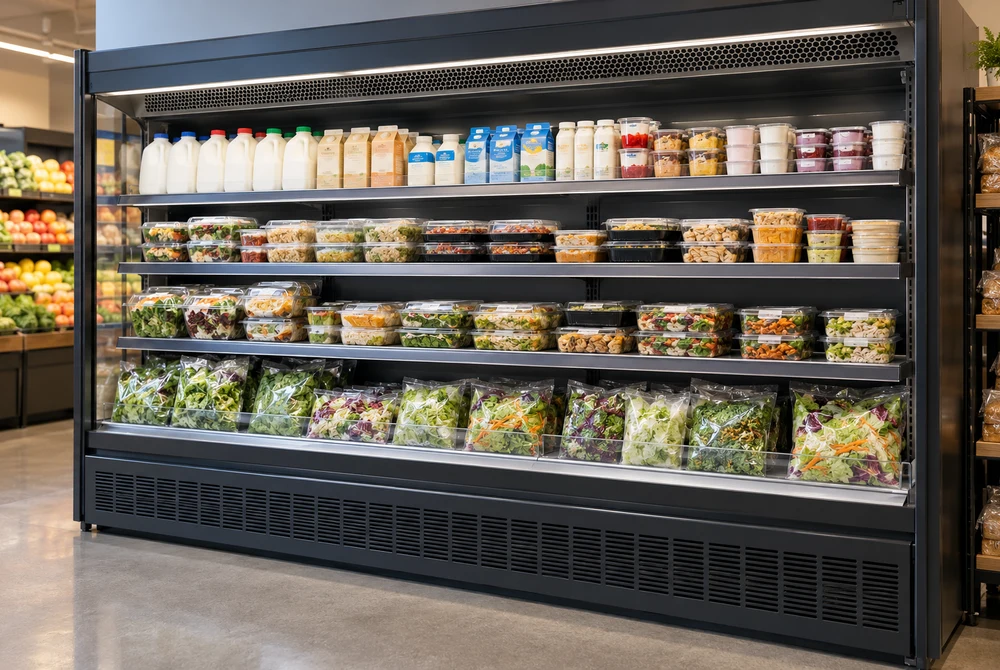
Understand the open-front display you operate
An open display depends on its intended air distribution to maintain the refrigerated product zone while customers can reach inside. The discharge arrangement, shelves, return path and product positions work together. A case may continue running while an altered display prevents some merchandise from receiving the intended refrigeration. That makes layout a legitimate maintenance observation, rather than simply a sales presentation choice.
Identify whether the case is a vertical multideck, a single-deck display or another design. This article focuses on open-front medium-temperature equipment. A procedure for a closed reach-in, walk-in or open freezer may not fit it. Even two open cabinets can have different discharge arrangements, load markings, environmental limits and approved accessories.
Record the model and refrigerant information accessible through ordinary operator access. Some cases have an integral condensing unit; others are connected to remote equipment or a shared system. That distinction affects what a technician needs to investigate. It does not change the manager’s first responsibility to protect stock and preserve useful observations without opening service compartments.
Follow the air path before blaming the refrigerant
Look for the discharge and return openings identified in the case manual. The operating air path may be less obvious than a visible fan. A narrow grille near the front can appear to be spare shelf space, and a honeycomb outlet can be mistaken for a convenient place to hang a promotional sign. Those areas need to remain in their intended condition.
Hussmann’s MD10/MD14 installation and operation manual provides a concrete manufacturer example. Its stocking instructions require the discharge and return flues to remain unobstructed and prohibit products, packages, signs and unapproved accessories from interfering with those paths. Use that example to understand why the installed cabinet’s own diagram matters; do not copy an MD cabinet’s exact layout to every brand.
A warm case can also have a mechanical fault. Finding an obstruction is useful evidence, but it should not automatically close the investigation. Restore only the operator-permitted arrangement, assess the result under the appropriate procedure and arrange service when the problem remains unexplained. Clearing a grille is not a refrigerant measurement and does not establish that refrigerant should be added.
Treat the load limit as part of the equipment design
A marked load limit defines where product may be placed for the intended operation. It is more specific than the physical ability to fit another row into the cabinet. A shelf can carry the weight of a package while the package projects into an air path. Shelf weight capacity and refrigerated display limits therefore answer different questions.
Locate the installed markings and match them to the manufacturer’s illustration. Inspect the front edge, top of the stack and any location where merchandise extends beyond the intended zone. Tall packages, leaning stacks and products moved forward to improve visibility can change the arrangement. Check each shelf’s permitted configuration rather than judging the case by how neatly it appears stocked.
If markings are missing or unreadable, obtain the correct information from the manufacturer or service provider. Do not replace an unknown line with a distance remembered from another store. A restocking instruction needs a clear basis that staff can follow. An approved photograph or diagram of the permitted layout can help, provided it reflects this exact cabinet and its current shelves.
Distinguish fresh stock from warm stock
Restocking can change both the arrangement and the heat introduced into a case. Establish whether incoming merchandise was already at its required storage temperature before it reached the display. An operating display’s intended holding function should not be assumed to provide an approved cooling process for products that arrived warm or spent too long outside controlled storage.
Use the store’s receiving and handling procedures for the relevant product. Record available temperature and handling information without inventing a precise exposure time. If delivery records are missing, keep that uncertainty attached to the affected lot. Moving it into a colder case does not reconstruct the earlier history or independently authorize sale.
Also distinguish a recently started cabinet from an established operating case. The equipment manual may specify a startup condition before loading. Hussmann’s MD manual contains a model-specific startup instruction; it is not a universal waiting period after every routine restock. Apply the installed equipment’s procedure and avoid turning one manufacturer’s number into a rule for all cases.
Find the affected part of the display
“Case warm” leaves the contractor with little direction. Determine whether the problem appears at the front, the back, one shelf, one end or throughout the displayed product. Use the store’s approved measurement method and distinguish product observations from air readings. A spatial pattern can help identify which operating conditions need attention, without providing a diagnosis by itself.
Keep measurements tied to locations. A reading described as “top shelf, front row” is more useful than an unlabeled number. Where safe and permitted, a simple cabinet sketch can identify the observed positions. Do not remove guards, reach into moving components or disturb held product simply to obtain a more complete pattern.
Compare the pattern with recent changes. Was an endcap display added nearby? Did a particular shelf receive a taller package? Was the front return covered when staff pulled products forward? These questions use facts that managers can often establish before a service visit. Avoid assuming the last employee to stock the case caused the fault merely because the timing overlaps.
Scroll sideways to view all columns.
| Observation | Manager-level check | Keep separate |
|---|---|---|
| Front row or one shelf is warm | Compare actual package positions with the installed load-limit diagram and accessible air openings. | A spatial pattern is evidence for investigation, not a refrigerant diagnosis. |
| Warming followed a delivery | Retrieve receiving and handling information and preserve the affected lot identity. | A later cold display does not reconstruct missing product history. |
| New signs or baskets were added | Confirm approval and check whether the intended air path remains clear. | Accessory suitability requires equipment information, not appearance alone. |
| Controller and product readings differ | Identify measurement type, location and the method approved for that product. | Equipment-control temperature and food acceptability answer different questions. |
| Cabinet improves after layout correction | Record what changed and assess the appropriate completed configuration. | Equipment recovery and release of held food remain separate decisions. |
Use product measurements for product questions
The controller sensor measures a particular condition at its installed location. Its reading may be important to equipment control, but it cannot stand in for every product temperature across an open display. An independent air thermometer also measures air where it is placed. Neither observation automatically describes the temperature inside each package.
Use the approved instrument and method for the relevant food and packaging. FDA’s specific guidance for cut leafy greens discusses checking product temperature and warns that infrared measurements of bagged product can be affected by packaging reflections. That is a useful caution about method. It is not permission to apply a leafy-green technique to every sealed meat, dairy or prepared-food package.
If the appropriate method is uncertain, involve the store’s person in charge or food-safety lead. Keep the measurement type visible in the record: product, package surface, air or controller. Selecting whichever display looks reassuring can hide a real difference between quantities. Equally, a difference alone does not identify a refrigerant fault or establish a universal product-disposal decision.
Check signs, baskets and shelf accessories
Promotional materials can change more than appearance. A sign placed over a discharge opening, a basket that redirects airflow or a shelf extension that moves products beyond the intended zone may interfere with the installed design. Review what was introduced since the last known normal operation, including items supplied by a merchandising vendor.
Confirm that accessories are approved for the exact case and installed as specified. Similar dimensions are not evidence of approval. An attachment that worked on a closed cabinet may be unsuitable on an open multideck. Where documentation is unavailable, ask the responsible manufacturer or equipment provider before treating the accessory as part of the permanent arrangement.
Remove or reposition items only within the operator-permitted scope and the store’s authority. Do not modify shelves, drill a panel or attach material to a grille to test a theory. The comparison should preserve the equipment’s intended structure. If a changed layout improves performance, keep a clear account of what changed and seek further assessment if recovery or product conditions remain uncertain.
Look outside the case for air disturbances
An open-front cabinet interacts with the surrounding store environment. Air-conditioning outlets, electric fans, frequently opened exterior doors and other sources of air movement can disturb the intended air distribution. A display that was satisfactory before a store-layout change may now encounter a different environment even though its refrigeration components were untouched.
Observe the surroundings from normal operator access. Note whether a portable fan was introduced, an adjacent door is being held open or an HVAC outlet now directs air toward the display. Report the timing and visible condition rather than trying to measure airflow with an improvised method. These facts help the responsible facilities staff or contractor evaluate the installation.
Hussmann’s MD manual specifically addresses air disturbances around the merchandiser and its intended indoor environment. The allowed conditions and clearances belong to that equipment. Do not assume one model’s maximum ambient temperature, humidity or rear clearance applies to another. Relocation or changes to building HVAC should be assessed by the appropriate responsible provider.
Keep condenser ventilation separate from the product air path
A self-contained case has to reject heat as well as distribute cold air around the products. Blocking the condensing unit’s intended inlet or exhaust can impair that function. This is a different airflow problem from merchandise covering a front return. A storage box near the base and an overfilled product shelf should be documented as separate findings.
Check only the accessible clearances and openings described in the operator instructions. Do not remove panels or reach through grilles to see whether a fan turns. If cleaning or access requires isolation, special tools or service work, assign it to qualified personnel under the applicable procedure. Visible dust does not authorize staff to spray water or chemicals into the cabinet.
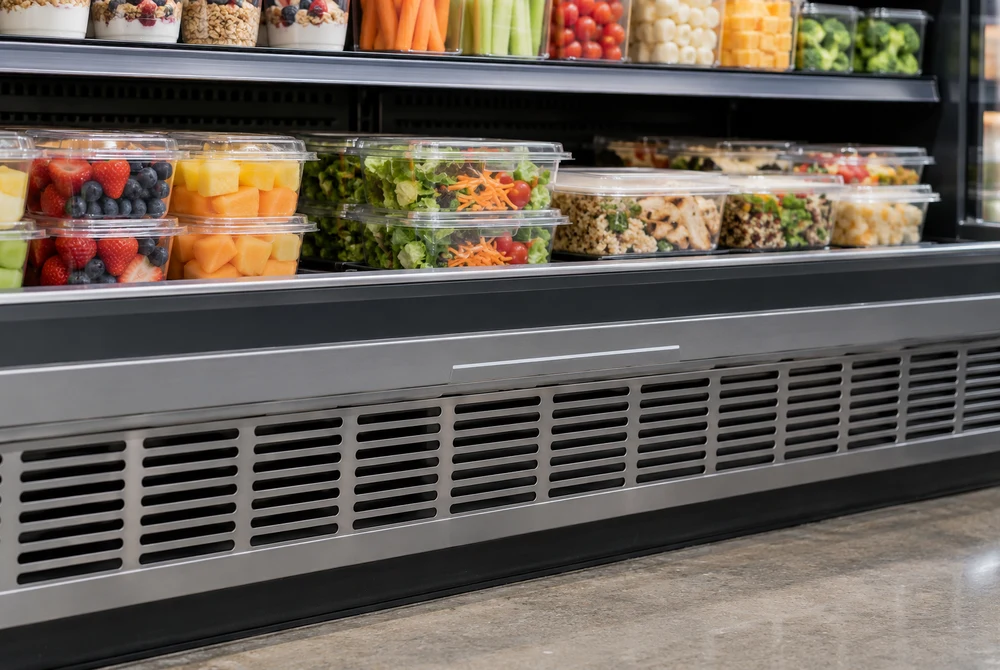
Remote cases need a different service view because heat rejection occurs elsewhere. Inform the contractor whether multiple cases on the same system are affected, if that information is known. A shared symptom can be relevant, but it is not a reason for a manager to change rack settings. Keep ordinary merchandising observations and system-level service decisions with their respective responsible people.
Record the night-curtain state without making it the whole diagnosis
Some open cases have an approved night curtain or cover. Its intended use, position and condition can affect operating conditions. Note whether it was up, down, partially deployed or damaged when readings were taken. A comparison with the curtain down is not automatically comparable to customer-hours operation with the front open.
Follow the installed manufacturer’s operating instructions. Do not substitute a blanket, plastic sheet or unapproved screen to see whether temperatures improve. Such a change may obstruct ventilation, create sanitation or access concerns, or produce conditions that do not represent normal use. A successful temporary experiment would not establish an acceptable operating arrangement.
If a curtain problem is suspected, document the condition and obtain the appropriate service or replacement guidance. This article’s central task remains restocking and local product warming. Curtain state is one contextual variable, alongside loading, incoming temperature and surrounding air movement. Avoid reducing every open-case complaint to a curtain issue simply because closing the front changes the observed temperature.
Establish the operating stage before interpreting recovery
A reading during a normal operating transition can differ from a settled condition. Determine whether the case was recently started, in an identified defrost period or returning from another documented operating stage. Use accessible status information and the exact controller instructions. Staff should not force defrost or alter settings to make a comparison convenient.
A warm observation should not be dismissed simply because someone says the unit is defrosting. Establish what was actually observed, whether the sequence belongs to the installed equipment and how the responsible provider expects recovery to be assessed. Keep product protection active while that equipment question is resolved. An explanation of an operating stage does not establish every item’s acceptability.
Our guide to walk-in freezer defrost illustrates the importance of observing a complete sequence, but its equipment-specific context does not supply timing for an open merchandiser. The contractor should identify the relevant criteria for this case. Do not create a universal recovery allowance that staff can use to ignore repeated warm products.
Choose a controlled merchandising correction
When a clearly unauthorized obstruction is found, correct it using the equipment’s operator instructions and the store’s approved handling process. Keep affected lots under their required status. Restore the designated load boundary and unobstructed air path; do not change controller setpoints at the same time simply to increase the apparent effect.
Record the before-and-after arrangement when safe to do so. A useful photograph shows the package position relative to the marked limit or opening, rather than merely showing a full shelf. Note whether additional stock was transferred elsewhere and how its status was preserved. This allows the contractor to distinguish a layout correction from a change in total load.
Observe the resulting conditions according to the appropriate plan. Improved air temperature is evidence about the changed operating arrangement, but it is not an automatic release of held food. If the expected equipment behavior is unknown or the warm region remains, arrange service rather than repeating changes until one display happens to look acceptable.
Define the service handover around the unanswered question
A contractor can investigate more efficiently when the request describes a specific remaining problem. State the affected region, relevant stocking change, measurements with their types and locations, visible air-path condition and any operator-permitted correction already made. Include the installed model and whether the case is remote or self-contained when known.
Name what is still uncertain. For example, the operational issue might be whether front-row product temperatures remain abnormal in the approved layout, or whether the equipment recovers as expected after the observed operating stage. This is a question for investigation, not a suggestion that the contractor should replace a particular valve or add a predetermined amount of refrigerant.
Ask the service provider to connect the finding to the proposed work. The report should distinguish a verified equipment defect from an installation condition, merchandising condition or unresolved symptom. If more than one issue is found, each deserves its own explanation. That is more useful for the store than an invoice that describes every warm-case call as a refrigerant recharge.
Keep food holds attached to the actual stock
When products require a hold or transfer under the store’s procedures, preserve their identity and decision status. Staff on the next shift should know which goods are affected and who can authorize their disposition. Moving a held lot into another cabinet should not make it indistinguishable from saleable stock already stored there.
Use the designated food-safety process for product decisions. FDA’s Food Code is a model used by jurisdictions, and local adoption and amendments determine the rules applicable to a particular operation. The current model’s publication does not automatically change every store’s legally adopted requirements. Consult the responsible authority when the approved process requires it.
Do not infer safety from appearance, smell, a restored controller display or a later cold measurement. The important information can include the product’s actual history and uncertainties. The refrigeration contractor provides equipment findings within their scope; the authorized store personnel and regulatory process govern product release. Keep those roles explicit when an incident spans several shifts or service visits.
Avoid turning the setpoint into a substitute for diagnosis
Lowering the controller setting may conceal an uneven display problem while exposing other products to different conditions. It also changes the baseline the technician needs to evaluate. A warm front row beside a cold rear row deserves investigation of the actual pattern, rather than an unsupported instruction to make the whole case colder.
Use only operator actions expressly permitted by the installed instructions and store procedures. Refrigeration control configuration, sensor relocation and protective-control changes should be handled through the responsible qualified provider. Do not bypass a control or copy a parameter from a similar-looking cabinet. The same controller hardware can be configured for different equipment applications.
If a provider recommends a settings change, ask for the documented basis, any product or operating restrictions and the method of verification. Keep the original and new configuration identifiable in the service record. The goal is an intended operating arrangement that meets the equipment’s requirements, rather than a favorable number obtained under an unexplained altered setting.
Make repair acceptance represent normal merchandising
A brief empty-case check may not represent the condition that generated the complaint. Discuss how the contractor will verify the relevant behavior in the completed configuration, including the approved shelves, air paths and permitted loading. That does not mean filling a case with questionable food for a demonstration. The verification method must suit the equipment and the store’s protection plan.
Record whether the check represents normal customer-hours operation, an approved curtain state or another defined condition. If the visit cannot establish performance under the necessary condition, retain that limitation and agree on the next observation. Do not describe the repair as fully verified merely because the compressor ran while the front was covered.
Acceptance should also include restoration of items disturbed during service. Panels, guards and approved accessories need to be in their intended condition. If a temporary arrangement remains, identify its restrictions and responsibility. The store’s decision to resume normal merchandising should use the relevant equipment evidence while preserving the separate product-disposition decision.
Turn the finding into a usable restocking instruction
If loading contributed to the problem, update the instruction at the point where staff actually restock. Identify the permitted boundary, the openings that must remain clear and the approved package arrangement. A concise cabinet-specific instruction can be more useful than a general reminder to avoid overfilling refrigerators.
Coordinate sales and facilities expectations. A promotional plan that requires staff to exceed the equipment’s permitted arrangement cannot be solved by telling them to be more careful. Choose an approved layout, suitable accessories or different display equipment through the appropriate process. Do not ask staff to trade away refrigeration performance to meet an unexamined merchandising target.
Review the result during relevant routine checks. A different package size or seasonal display can reintroduce the obstruction without anyone deliberately ignoring instructions. Keep the layout information current and give staff a clear route for reporting conflicts. This follow-through addresses the operational cause rather than relying on another emergency service call to reveal it.
Buy refrigerant only for an established service requirement
Open display cases do not all use the same refrigerant. Equipment identity and service history must determine the supply specification. An integral R290 unit is not a candidate for topping off with R404A, R448A or R449A. A manufacturer manual discussing one of those designs does not establish compatibility with the other.
Refrigerant Centers has actual R404A, R448A and R449A product listings for compatible applications. These can support a separate supply decision after qualified personnel establish the installed specification, necessary service scope and applicable purchasing requirements. None of those products repairs an obstructed air return, an unsuitable display accessory or an incoming-product handling gap.
The Hussmann MD manual used here concerns R290 equipment, and this article does not claim Refrigerant Centers supplies R290. Keep that distinction visible. Applicable refrigerant qualification, handling and environmental requirements belong to the actual equipment and end use. EPA’s equipment-management resources are an appropriate starting point; they are not a universal servicing procedure for every commercial case.
Frequently asked questions
Why is the front row warm when the controller looks normal?
The controller measures its installed sensor location, while front-row products occupy a different part of the display. Loading, air-path obstructions, surrounding disturbances or equipment faults can create differences. Check the approved layout and obtain appropriate product measurements. A normal control reading cannot establish every package’s temperature.
Can we fill the case above the load line for a promotion?
Follow the exact manufacturer’s limits. Available physical space or shelf weight capacity does not authorize filling beyond a refrigerated load boundary. Ask the equipment provider about an approved arrangement or a suitable alternate display. Do not rely on a lower setpoint to compensate for an unapproved layout.
Does clearing the return grille mean the food is safe?
It may correct an operating condition, but food acceptability is a separate decision. Preserve the affected product history and follow the store’s food-safety procedures and local requirements. A later cold air or product reading does not automatically resolve an earlier unknown exposure.
Should staff add refrigerant after a warm restock?
No. Loading and airflow observations do not establish refrigerant quantity. Qualified personnel must determine whether refrigerant work is required through the actual equipment’s service procedure. Confirm the installed refrigerant before any purchasing decision, and do not substitute a product based on the general label “commercial refrigeration.”
Can an infrared thermometer check sealed packages?
Use the approved method for the product and packaging. Infrared readings can be influenced by packaging and surface conditions and may describe surface temperature rather than the quantity needed for the decision. FDA’s cut-leafy-greens guidance specifically discusses bagged-product limitations. Consult the responsible food-safety lead when the method is unclear.
How long should we wait for the case to recover?
There is no universal recovery interval for all open cases or stocking events. Use the installed manufacturer’s criteria and the store’s protection plan. Keep affected stock under the required status while assessing recovery. Persistent warming or an unclear operating sequence needs qualified investigation rather than an invented waiting rule.
Is a portable fan beside the display helpful?
An external air current can interfere with an open cabinet’s intended air distribution. Consult the equipment’s placement and environment instructions before adding a fan or changing surrounding airflow. Report the condition to facilities staff or the contractor; do not assume moving more air around the case improves refrigeration.
What should the repair report contain?
The equipment identity, affected product region, operating conditions, verified cause, work performed and completion evidence. It should also state limitations and any remaining observation. Keep food disposition and equipment acceptance separate so the next shift understands which decisions have actually been made.
Technical sources and application limits
Sources checked October 10, 2026 include Hussmann’s MD10/MD14 installation and operation manual, P/N 3196825_B, May 2024; FDA’s Food Code resources and its specific cut-leafy-greens storage-and-display interpretation; and EPA’s refrigeration equipment-management resources. Manufacturer requirements apply to the identified equipment. FDA model provisions require attention to local adoption. Use current instructions and the responsible authority’s requirements for the particular store and service date.











