
Walk-in freezer defrost can temporarily raise the displayed air temperature without indicating a refrigeration failure. The useful test is what happens through the complete cycle: does defrost end as intended, does the fan resume under the controller’s normal sequence, and does the room return toward its established operating pattern? A warm air reading alone cannot establish either equipment failure or the condition of every stored item.
For a restaurant manager, the immediate task is to identify the operating stage, avoid unnecessary door openings, assess the food situation under the establishment’s procedures, and escalate when recovery is abnormal. This guide follows that sequence from the first temperature rise to the service handover. It does not ask staff to test heater circuits, bypass a control, or change refrigerant charge.
Use the installed freezer and controller manuals to define the expected sequence. There is no single defrost peak, fan delay or recovery time that applies to every walk-in freezer. Food decisions also depend on the products, their documented condition and history, and the applicable local rules. A normal-looking controller display is useful evidence, but it is not a substitute for those checks.
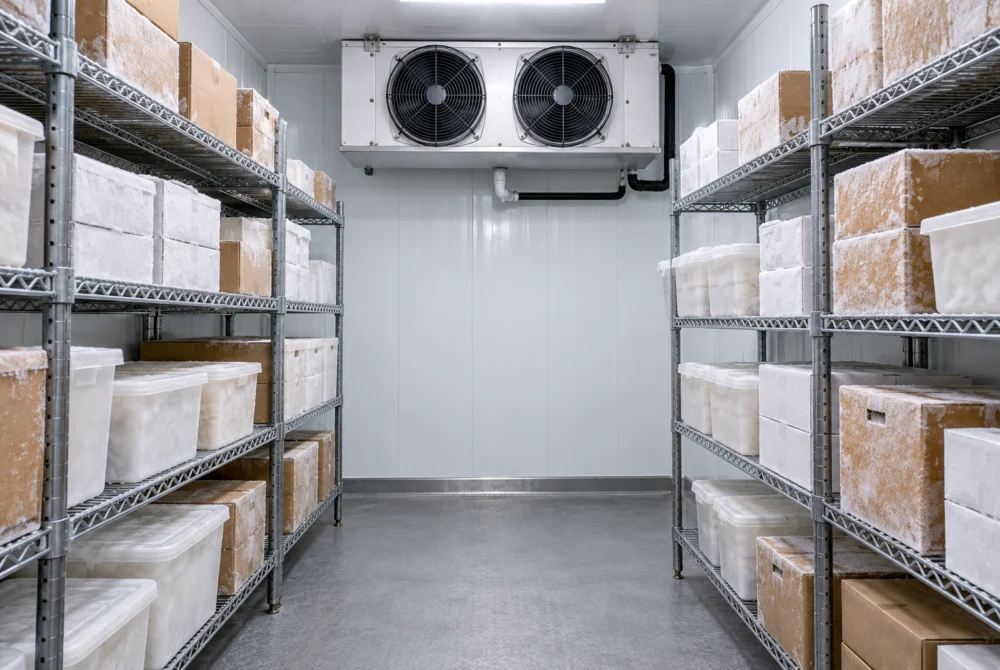
Walk-in freezer defrost: separate the cycle, recovery and food condition
First, is the freezer actually in a defrost-related operating state? Look at the ordinary user display, the documented schedule, or the monitoring record. A temperature rise that happens near a customary defrost time is a clue, not confirmation. A door left ajar or a loss of cooling can occur at the same time. If the display has a status symbol, use the installed controller’s documentation to interpret it rather than guessing from another unit.
Second, is the equipment progressing through the expected stages? An observable sequence might include refrigeration stopping, defrost operating, a drainage period, refrigeration resuming, and fans restarting. Not every system exposes each stage on its display, and some systems use different arrangements. The important comparison is with the documented behavior of this particular installation, not a universal timetable found online.
Third, what is happening to the stored food? Room air, an evaporator sensor, and food inside a package are different measurements. Check the establishment’s food protection procedure and record the relevant evidence. A recovering air reading does not erase an earlier unknown exposure. Conversely, an air spike does not establish that every package reached the same temperature. Keep equipment assessment and food disposition as related but separate decisions.
Why freezer air temperature rises during defrost
Moisture entering a freezer can accumulate as frost on a cold evaporator. Defrost removes that accumulation so the equipment can continue moving air and transferring heat effectively. During the process, the normal cooling pattern is interrupted and heat may be introduced at the coil. A nearby air sensor can respond rapidly, especially if its location is strongly influenced by the evaporator. This is why the beginning of a temperature rise matters less than its full context.
Electric defrost, hot-gas defrost, and other control arrangements do not produce identical room-temperature traces. Room size, stored mass, delivery activity, door use, and sensor position also influence the observed curve. Two freezers next to each other can therefore have visibly different recovery patterns even when both are operating as intended. Borrowing a neighboring freezer’s alarm delay or judging both against one expected peak can create misleading reassurance.
Read a controller display carefully. It may show a defrost indication, a selected sensor, or a value held according to its display logic. Record exactly what was visible and identify which measurement it represents. Do not describe a coil temperature as the room temperature or transcribe a setpoint as an actual reading. Where the display’s meaning is uncertain, preserve a photograph of the ordinary screen for the service provider and check food with the approved method.
Fan delay after defrost: why cooling and airflow may resume separately
A pause in evaporator airflow after heating ends can be deliberate. For example, the Danfoss ERC 21X user guide describes separate drip-off and fan-delay functions, including a fan-start temperature where an evaporator sensor is fitted. This illustrates why heater shutdown, compressor restart, and fan restart should not be treated as one simultaneous event. It is an example of control logic, not a recommendation to apply those parameters to another freezer.
From the manager’s position, an expected pause becomes concerning when it exceeds the installed system’s documented behavior, fails to lead into recovery, or differs substantially from its established pattern. Record when the mode changed and when airflow returned if those events can be observed safely. If the fans are inaccessible, use the monitoring history and call the technician; climbing onto shelving to watch them adds risk and little useful evidence.
Some fans stop when a door opens, independently of defrost. A staff member who opens the freezer repeatedly to listen may therefore create a misleading observation while also adding heat. Use a short planned check, keep clear of fan guards, and distinguish a door-related stop from a persistent failure. Do not bypass a door switch to prove that a fan can run. The technician can verify the relevant inputs and outputs using the correct service procedure.
Build the expected sequence before the next alarm
Ask the refrigeration contractor to leave a brief operating note for each freezer. It should identify the equipment and controller, explain the visible status indications, describe how defrost starts and ends, and state which pauses are intentional. Include who may adjust settings and where the approved settings record is kept. Managers need an understandable sequence, not a copied list of every parameter in the service menu.
Next, establish a reference from normal operation that the contractor considers satisfactory. Keep a few complete temperature traces covering comparable stocking and door-use conditions. Mark known defrost periods and any delivery activity. The goal is not to turn yesterday’s performance into a safety limit; it is to make a meaningful departure visible. A freezer that has been recovering poorly for weeks needs evaluation even if its recent traces look similar.
Make the reference usable during a busy shift. A one-page note should answer where the relevant readings are obtained, what observation triggers a call, and who authorizes moving inventory. If the manufacturer does not specify a room recovery time, do not invent one and label it a manufacturer limit. Agree on an operational escalation point with the service provider and the food-safety lead, then document its basis.
What to do when the temperature starts rising
Begin by recording the discovery time, the displayed reading or status, and the last trustworthy normal observation. Note whether the alarm came from the refrigeration controller, a separate logger, or a staff check. Those channels may measure different locations and apply different delays. Capturing the discovery time separately from the likely start of the event prevents the common mistake of assuming the problem began when someone finally saw the notification.
Limit avoidable door openings and pause nonessential stocking. Confirm from a safe position that the door can close normally and that packages are not obstructing the doorway. Do not lock people inside, interfere with the emergency release, or block required access. If a physical obstruction is safely removable, correct it and record that action. Keep the event under observation rather than assuming that closing the door proves the problem is solved.
Assign one person to the event. That person coordinates food checks, communication, and the next review, while other staff continue service without repeatedly opening the room. A named owner is particularly useful when the freezer is shared by several stations. Without one, different employees may acknowledge the same alarm and each assume somebody else has called for help. Write down who has accepted responsibility, including the backup if the shift changes.
Assess freezer temperature recovery after defrost
Look for direction and continuity after the expected defrost sequence ends. Does the independent room measurement begin moving toward the normal operating range? Does it continue doing so, or flatten and rise again? Did the door remain closed during that period? A downward movement is useful evidence of recovery, but its adequacy depends on the installed system and food protection plan. It is not a universal permission to stop watching.
Compare like with like. A trace after a quiet overnight cycle is not directly equivalent to one during a large delivery. Note what changed: stock volume, starting condition of incoming goods, loading pattern, room access, or a recent service visit. These observations help the contractor separate a changed load from a changed equipment response. They do not justify accepting an unsafe food condition because the kitchen happened to be busy.
Keep the original sequence visible. Repeatedly restarting the controller can erase or interrupt the very evidence needed to understand the fault. Similarly, forcing another defrost because the first cycle looked unusual can add another disturbance before the original event is understood. Follow the established operating procedure, and let qualified service personnel decide whether a controlled test is appropriate. Record any reset someone already performed instead of omitting it from the report.
| Observation | What it may mean | Manager’s next action |
|---|---|---|
| Air rises during a confirmed defrost period | A normal part of the cycle, depending on the system | Record the phase, protect stock and watch the subsequent recovery |
| Fans remain off briefly after defrost | Possible intentional drainage or fan delay | Compare with the unit’s documented sequence; do not bypass controls |
| Air does not resume its expected recovery | A condition requiring investigation, not proof of one failed part | Escalate and implement the food protection plan |
| Each cycle starts from a warmer baseline | The room may not be recovering between events | Provide consecutive traces and recent loading history to service |
| Ice, water or abnormal noise appears | A possible drainage, airflow or equipment issue | Keep people and food clear of the affected area; request service |
Defrost and recovery warning signs that need service
Escalate when the expected sequence fails to complete, recovery stalls, alarms recur after acknowledgment, or the room begins the next cycle without returning to its accepted operating condition. Give particular attention to a change from a previously verified pattern. There is no need to identify the failed component before calling. A precise report that cooling did not recover after a confirmed cycle is more useful than an unsupported diagnosis of low refrigerant.
Other observable concerns include new water outside the intended drainage path, ice forming where it did not previously appear, unusual vibration, a fan that seems persistently inactive during expected cooling, or a damaged door seal. Observe only from normal working positions. A visual symptom can have several causes, and the absence of a visible symptom does not establish that the refrigeration circuit is healthy.
The Heatcraft HFC unit cooler installation and operations manual, June 2026 includes defrost and evaporator troubleshooting and reserves installation and maintenance work for qualified personnel. Its safety instructions reinforce the boundary here: managers collect observations and protect operations; technicians evaluate electrical, refrigerant, sensor, and control faults. Use the manual matching the installed equipment, especially where the refrigerant or control design differs.
Treat immediate hazards separately from temperature troubleshooting. Smoke, sparking, a strong unusual odor, signs of an electrical fault, or suspected refrigerant release require the site’s emergency response and appropriately qualified help. Do not enter an unsafe room to retrieve a temperature reading. Food and equipment records can be reconstructed later; nobody should be asked to remain near a suspected hazard merely to complete an incident form.
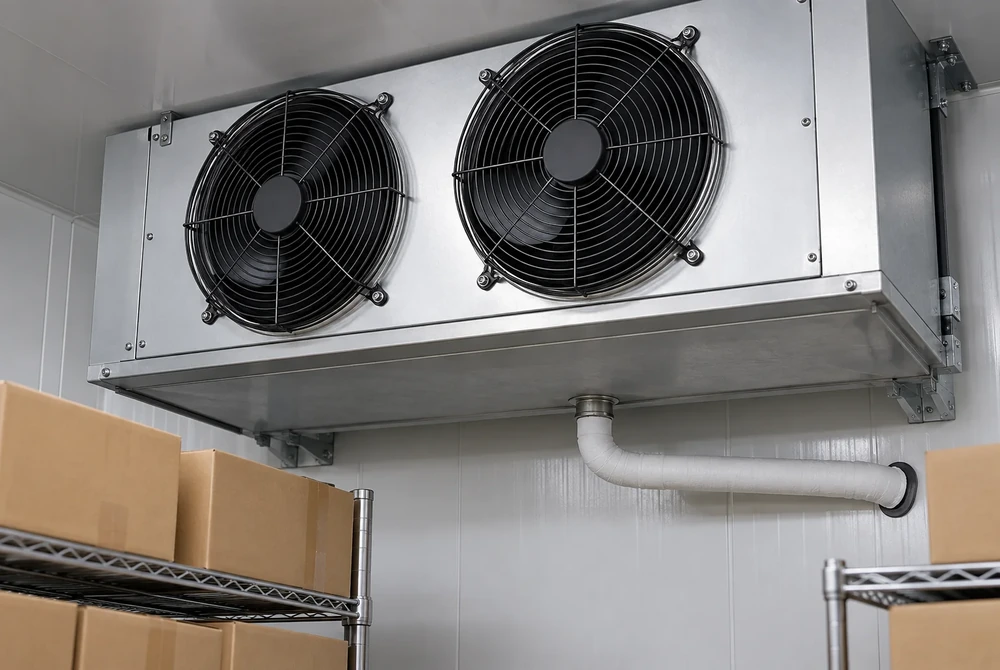
Separate frozen-food protection from the air alarm
As checked for this guide on October 1, 2026, FDA identifies the 2026 Food Code as its current full edition. It is a model for jurisdictional adoption, not a single automatically applicable restaurant law nationwide. Confirm the edition, amendments, and instructions that apply to your establishment with the local regulatory authority. FDA’s state code directory provides a starting point for locating the responsible rules.
The 2026 model text, section 3-501.11, requires stored frozen food to remain frozen. That is a different concept from choosing a room-air alarm value. Product specifications, quality requirements, and the approved storage program may call for a more specific operating target. Do not turn a familiar freezer setpoint into a universal legal threshold or use a defrost air peak as a direct measure of food condition.
When food condition is uncertain, involve the person responsible for food safety promptly. Identify affected products, the known exposure history, and the measurement method. Keep questionable stock from being served while an authorized decision is made. Moving goods into functioning cold storage can limit further exposure, but it does not establish that their earlier history was acceptable. Preserve the information needed to decide whether use, restricted use, or disposal is required.
Do not rely on smell, appearance, or the feel of the package as a complete safety assessment. Where direct food measurements are appropriate, use a suitable instrument and the establishment’s hygienic procedure. Record what was measured rather than writing only that the food was fine. A reading between packages, a surface reading, and an internal food measurement are not interchangeable; the food-safety lead should specify which evidence is needed.
A defrost event record that helps rather than delays action
Use one chronological record instead of scattered messages. Begin with the freezer identifier, discovery time, last known satisfactory observation, controller state, room measurement source, and the responsible manager. Add entries as the event develops. If an entry is an estimate, mark it as an estimate. An honest gap is preferable to a precise time reconstructed from memory and later mistaken for a logged measurement.
Record operational context in plain language: a delivery was being put away, the door would not latch, shelving had been rearranged, or no unusual activity was known. Add the time each corrective action occurred and the next observation afterward. This lets a technician connect changes to the trace without assuming causation. Closing a door followed by falling temperature is useful information, but does not rule out another issue that also needs attention.
Keep food decisions in the same incident reference but distinguish them from equipment events. Identify who assessed the stock, what was held from use, where any transfer went, and who approved final disposition. Do not hide unresolved food questions inside a service ticket marked repaired. Equipment can be functioning again while an earlier inventory question remains open, and the shift handover must make that distinction obvious.
| Event | Evidence to record | If the observation is missing |
|---|---|---|
| Defrost identified | Time, visible mode and instrument identity | Mark the start unknown; do not infer it from alarm receipt |
| Defrost ends | Documented indication or technician-confirmed event | Report the uncertainty and follow the escalation plan |
| Cooling and airflow resume | Record each observation separately where safely visible | Do not assume both restarted together |
| Room recovers | Independent trace, door activity and comparison conditions | Keep the next check assigned until recovery is verified |
| Food decision completed | Affected lots, assessment, transfers and authorized disposition | Keep the inventory hold separate from equipment repair |
What to tell the refrigeration contractor
A good call describes the sequence before suggesting a cause. State the model if available, the exact visible alarm or status, when the cycle started if known, and what failed to happen afterward. Explain whether the room is still warming or has begun recovering. Tell the contractor about visible ice or water, unusual noise, recent delivery activity, and any resets or setting changes already made by someone on site.
Share a complete trace rather than a cropped screenshot of the maximum. Include enough time before the event to show the starting condition and enough afterward to show the recovery or lack of it. Identify the sensor location and whether it measures air or a buffered medium. If two systems disagree, share both with their identities. Their disagreement can itself be useful diagnostic information.
Ask for two outcomes from the service visit: resolution of the technical problem and an updated operating reference for staff. If the technician changes an authorized setting, the report should identify the change and the reason. Managers should not need to reverse-engineer a new normal from the next alarm. Request confirmation of the observation that will show the freezer is ready to return to its intended use.
Common responses that can make the situation harder
Lowering the setpoint is not a reliable answer to stalled recovery. The freezer may already be calling for cooling, and a lower target does not repair an airflow, drainage, control, or refrigeration fault. It can also make later comparisons harder because both the equipment condition and the target have changed. Leave adjustments to the authorized procedure and document any change that is genuinely necessary.
Extending an alarm delay merely to stop repeated notifications removes an observation without addressing its cause. A delay may be appropriate for a verified defrost pattern, but its selection belongs in a reviewed monitoring plan. The plan needs enough time for someone to receive the alert, reach the site if necessary, assess the stock, and act. A quiet phone is not evidence that the freezer recovered.
Chipping ice, applying improvised heat, opening electrical panels, or forcing fan operation are not manager-level troubleshooting steps. Such actions can damage equipment, expose staff to hazards, and compromise food storage. Similarly, adding refrigerant based on the temperature trace alone is not diagnosis. Our explanation of why pressure alone is not enough for refrigerant charging describes a related measurement problem; freezer service still requires its own equipment-specific assessment.
Work through ambiguous situations without guessing
Consider a freezer whose alarm arrives while staff are unloading a delivery and the display indicates defrost. These are two overlapping events, so the alarm cannot be assigned to one cause immediately. Close the door when the necessary handling is complete, record the delivery and status, check stock under the food plan, and observe whether the documented sequence leads into recovery. Call sooner if the food situation or equipment behavior requires it.
Now consider a room that cools after every cycle but begins each successive cycle slightly warmer. The individual downward slopes can look reassuring while the overall pattern deteriorates. Show consecutive cycles to the service provider, along with loading and door records. The question is whether the equipment is restoring the room between disturbances, not whether it produces some cold air at any point.
A third situation is a normal-looking controller reading with a separate monitor still reporting elevated temperature. First confirm that the instruments represent different locations or media and that timestamps match. Do not discard the less convenient result. Ask whether stock arrangement has isolated a warm area or whether the controller display is showing something other than current room air. These are hypothetical decision exercises, not reports of customer incidents.
Return to normal operation deliberately
Close the equipment incident only after the agreed recovery evidence has been reviewed. Record the final operating observation, any technician instructions, and the remaining monitoring period. A single satisfactory reading immediately after service is useful but may not show behavior through the next comparable defrost cycle. Follow the contractor’s verification plan without manufacturing a new disturbance merely to test the room.
Confirm that food decisions are also complete. Reconcile transferred inventory, held stock, and any disposal records. Make sure the receiving storage location has not been overloaded in the process. If operations remain restricted, give the next shift a clear written instruction about what can be used and who can authorize a change. Do not leave a handwritten caution on a door as the only record of an unresolved event.
Finally, review whether the event exposed an organizational problem. Perhaps the overnight contact did not receive the alert, the freezer had no readable identifier, or the service number was buried in an old invoice. Correcting those gaps does not require changing refrigeration settings. A reliable response depends on the people and records around the equipment as well as on the equipment itself.
Prepare for an overnight event before leaving the building
An overnight defrost alarm needs a response plan that works when nobody is standing beside the freezer. Confirm who receives the first notification, who becomes responsible if that person cannot respond, and how the responder enters the building safely. The plan should identify the freezer without requiring somebody to search several rooms. Keep contact details current when shifts, managers, or service contractors change.
Do not assume that a notification marked delivered has been read or acted on. Agree on how the responsible person acknowledges ownership and communicates the next step. If the first contact cannot attend, responsibility must pass explicitly to someone who can arrange the approved action. A group message can support communication, but the incident still needs one person who knows whether the room has actually been checked.
Plan receiving storage before an emergency transfer is necessary. Identify a suitable functioning freezer, available capacity, safe handling arrangements, and a way to preserve lot identification. A transfer destination that is already full may not be able to accept the load without compromising its own operation. Keep the food-safety lead involved in this planning so emergency logistics do not become an improvised substitute for an inventory decision.
At the next opening, review unresolved overnight notifications before routine production draws from the freezer. Check whether somebody only acknowledged the alarm or actually verified recovery and assessed stock. Preserve missing-data periods and uncertain times in the record. If the history cannot support a disposition decision, escalate that uncertainty rather than filling the gap with an assumption that the cycle probably ended normally.
After an event, discuss whether the response instructions were practical. Could the contact identify the relevant display? Was the backup reachable? Did staff know which stock to hold from use? These questions improve the next response without requiring another alarm or a change to equipment settings. A short documented review is more useful than a long incident report that nobody uses to correct a known weakness.
Use the defrost history to define the next service decision
Keep the complaint specific when arranging service. A freezer that repeatedly misses its established recovery pattern after defrost presents a different question from one that stays warm throughout the day. Include the times of the defrost indication, resumed airflow if safely observable, door activity and subsequent room trend. State which events were not observed rather than filling gaps with assumed times.
Ask the contractor which finding explains the missed recovery: a defrost-control fault, restricted airflow, drainage trouble, or a diagnosed refrigeration-circuit problem. Request the evidence behind any refrigerant recommendation, together with the equipment identity and approved service scope. The air peak alone cannot distinguish those causes.
Keep procurement behind the diagnosis. If the installed equipment and written service scope specifically require R404A, compare the R404A 24 lb product details with the contractor’s required designation and quantity. This is an ordering reference for a confirmed service need, not a recommendation to add refrigerant after defrost. Another refrigerant serving similar equipment is not an interchangeable substitute. Retain the findings with the event record so a recurring failure has a clear starting point.
Frequently asked questions
How high should the freezer air temperature rise during defrost?
There is no single peak that establishes normal operation for every walk-in freezer. Sensor location, equipment design, stock, door use, and display logic all affect the reading. Use the installed manufacturer’s information and a verified operating reference, while assessing food separately. A familiar peak is not reassuring if recovery has become slower or stock condition is uncertain.
How long should recovery take?
Use the equipment-specific guidance and the operational escalation point agreed with your service provider. If no manufacturer recovery time is specified, do not present an arbitrary number as one. Record the end of the relevant cycle, the temperature direction afterward, and the load conditions. Escalate when the expected sequence or food protection plan requires action rather than waiting for an internet rule.
Does a stopped evaporator fan mean the motor failed?
No. The controller may intentionally stop fans during a stage of defrost or in response to another input such as a door switch. Persistent loss of expected airflow still needs investigation. Managers should report when the fan appears stopped and which operating state was visible, without reaching through guards, defeating switches, or opening the unit to test it.
Can staff silence the alarm while watching the freezer?
Follow the approved acknowledgment procedure. Acknowledgment should identify the responsible person and next action; it should not disable future alerts or imply that the event is resolved. Keep the original occurrence time and arrange a defined follow-up. If a mute function behaves differently from acknowledgment, have the monitoring provider explain that difference before staff use it during an incident.
Should we move all the food immediately?
Use the establishment’s food protection plan and the responsible food-safety person’s assessment. Unnecessary transfers can add handling and door openings, while delaying a necessary transfer can worsen exposure. The decision depends on the products, evidence, available receiving capacity, and applicable requirements. When stock is moved, retain its identity and time history; colder storage does not erase uncertainty about its earlier condition.
Can a normal room reading hide an airflow problem?
Yes, one measurement does not describe every storage location. Heatcraft’s technical FAQ specifically discusses product-temperature problems despite a satisfactory box-temperature log and points to air distribution. Our article on distinguishing low airflow from low refrigerant provides related background. Neither source replaces mapping and diagnosis for the actual freezer.
The manager’s closing check
Before treating a defrost rise as routine, confirm that the state was identified, the sequence completed, recovery met the agreed expectation, and food protection questions were resolved. Keep the event owner and next check visible until those points are settled. This approach avoids both unnecessary intervention in a normal cycle and the more serious mistake of dismissing a developing service problem simply because the word defrost appeared on a screen.











