
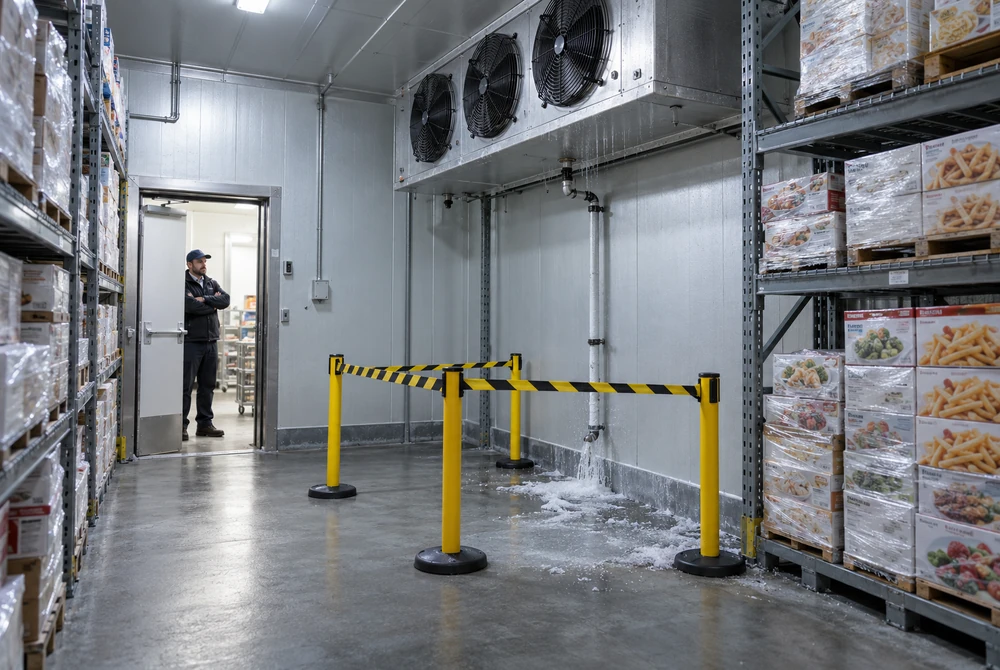
Recurring ice below a walk-in freezer evaporator usually calls for a verified water and drainage investigation, not another floor cleanup or an automatic refrigerant order. Defrost water must leave the pan and drain route without freezing or overflowing. A restriction, failed or unsuitable drain heating arrangement, damaged insulation, poor routing or a separate water source can interrupt that path. The responsible technician must identify the actual cause on the installed equipment; the manager should protect people and stock, document recurrence and require evidence that the drainage repair works through the relevant operating cycle.
Do not chip ice near electrical equipment, warm a frozen drain with a torch, change heater wiring or remove guards as an owner troubleshooting step. Restrict access to the affected area and follow the site’s approved response plan. If safe operation, access or product protection cannot be maintained, arrange the appropriate shutdown, stock transfer or specialist assistance. A clean floor is useful, but it does not establish that the fault creating ice has been repaired.
Put recurrence on the next shift’s handoff
Tell the incoming supervisor which area remains restricted, what work has been completed and what observation is still due. Include the contractor’s contact and the agreed trigger for a return call. A message that merely says “watch the freezer” leaves staff to guess whether the concern is temperature, drainage or floor access. Name the condition being watched and where to record it.
When the follow-up check is complete, retain the actual result, time and relevant operating conditions. If new water or ice appears, preserve that evidence through the approved reporting process and reopen the corrective work request. Do not treat a previous closed invoice as a reason to ignore a new hazard. A clear handoff lets routine operations continue within the authorized restrictions while keeping responsibility for the unresolved repair visible.
Start with the location of the water
The first decision is whether water is coming from the evaporator drainage arrangement or from another source. Floor ice directly below a unit makes a drainage issue plausible, but appearance alone is not enough. Water can travel along panels, pipe supports or shelving before it reaches the floor. A spill, door-related moisture or a building leak can create a similar hazard. Ask the technician to trace the path rather than selecting a heater solely because ice is nearby.
Record what can be seen from a safe position: the area where ice first appears, whether there is a trail from the unit and whether water collects at the same place after cleanup. Keep photographs of the area and the time they were taken. Do not move a barrier to obtain a closer image, and do not open an electrical enclosure. Your observations should help the contractor choose what to inspect, without creating an additional risk for the person collecting them.
Distinguish a one-time event from recurrence. Ice left after an earlier overflow may remain even after the drain has been restored. New water or new ice after the floor is cleared is different evidence. The service record should state which condition was observed. Otherwise, a later contractor may mistake residual ice for a new failure or treat fresh accumulation as harmless leftover material.
A manager also needs to establish whether the hazard blocks an exit, a safe working route or access to stored goods. Follow the site’s safety procedures and any applicable requirements when making access decisions. Do not describe the area as safe merely because a narrow route remains available. The combination of cold surfaces, limited visibility and carrying stock deserves a planned response, not an improvised path around the ice.
Separate defrost, drainage and refrigeration performance
Defrost releases water that the drainage arrangement must handle. A freezer may cool normally between cycles while a drainage fault gradually builds ice. Conversely, an abnormal refrigeration or defrost condition may increase icing or prevent the intended cycle from completing. These are related systems, but they are not interchangeable diagnoses. The contractor needs to establish which part of the sequence fails on this installation.
A simple manager’s question is: “Does the water reach the drain pan, leave the pan and reach the intended termination without freezing or overflowing?” The answer may require inspection and observation by a qualified technician. It is not a request for the manager to pour water into equipment or force a control sequence. Ask how the answer was verified and what conditions the test represented.
Keep temperature and drainage records separate. Acceptable air temperature at one moment does not prove that a drain heater works. A clear drain does not prove that the refrigeration system meets its operating requirements. If both concerns exist, the service report should identify the findings and acceptance checks for each. That prevents a cooling measurement from becoming a substitute for checking the water path.
Avoid assuming that recurring floor ice means the system needs more refrigerant. Refrigerant charge is a separate equipment-specific decision supported by the manufacturer’s procedure and actual diagnostic evidence. Water escaping a drain arrangement is not a measurement of refrigerant loss. Buying a cylinder before the source is established can leave the operational hazard unchanged while adding an unnecessary purchasing decision.
| Finding | Question for the contractor | Completion evidence |
|---|---|---|
| Frozen drain section | Why does water freeze at this location? | Applicable heating, insulation and drainage checks. |
| Pan overflow | Where does the water path become restricted? | Water reaches the intended termination without overflow. |
| Heater defect | Was the element, supply or installation faulty? | Verified correction in the restored configuration. |
| Recurring floor ice | Is this new accumulation or residual ice? | Safe cleanup baseline and relevant follow-up observation. |
What a proper drainage investigation should establish
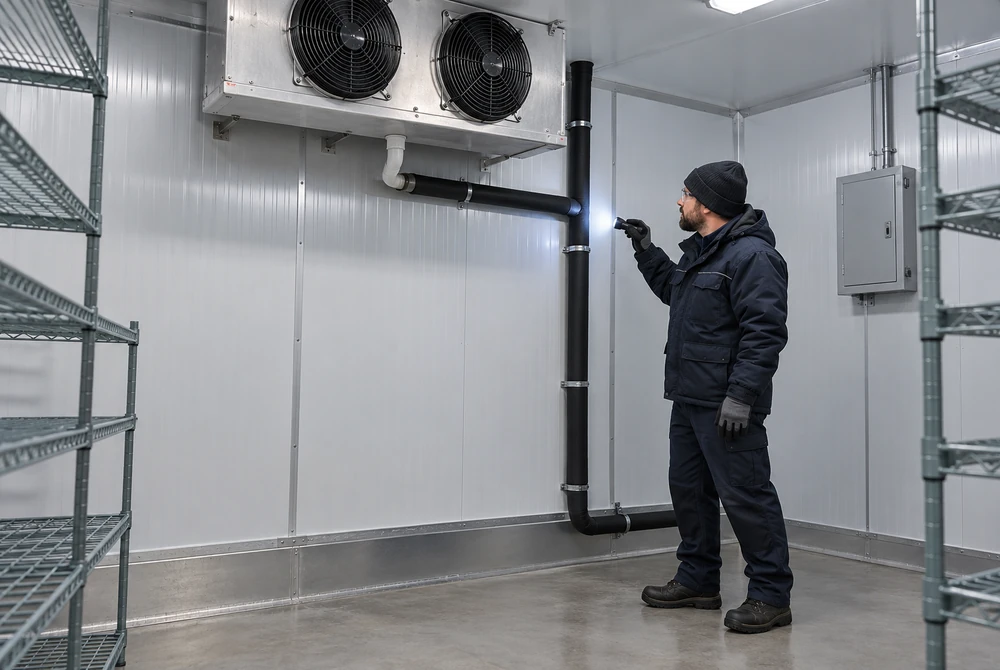
The contractor should identify the unit, drain pan and connected drain route before recommending parts. Record the model information that is accessible through the proper service procedure. An installation may include more than one evaporator, shared drainage or a route that passes through areas with different temperatures. A component described as “the freezer drain heater” may serve only part of that route.
Ask for the location of the obstruction or freezing point, if one is found. “Drain frozen” is a symptom description. A stronger finding explains where it freezes and why the existing arrangement did not prevent it. Possible contributing conditions include missing heat coverage, a heater fault, damaged insulation, an unsuitable route or a restriction that retains water. These possibilities require verification; they are not a list of parts to replace together.
The currently hosted Heatcraft MAC Series installation and operation manual (H-IM-67H, March 2018) includes drain-line installation and maintenance guidance for the equipment it covers, including attention to drain heating and drainage condition. Use the manual applicable to the actual unit and installed configuration. Its specifications should not be transferred to another manufacturer’s freezer or used as a universal heater sizing rule.
Request evidence about the condition found, the correction made and the subsequent drainage behavior. Appropriate evidence may include observations, measurements and photographs produced safely by the technician. The manager does not need to duplicate electrical testing to assess whether the report is coherent. A clear report connects a verified defect to the work performed and then to the check that establishes the correction.
Drain heating is an installed arrangement, not just a replacement cable
A replacement heater can fail to resolve the problem if it is unsuitable for the installation or leaves a cold section untreated. The technician must confirm the applicable heater specification, supply arrangement, control requirements and permitted installation method. Equipment and heater documentation determine those details. Similar appearance, a familiar brand or a cable of the same approximate length is insufficient evidence of suitability.
Ask whether the verified fault involved the heater itself, its supply or control, or the way it was installed. Those findings lead to different work scopes. A damaged heating element may require replacement; an absent supply needs a different correction. An installation problem may remain after a new element is fitted. The invoice should make the distinction clear enough that a future contractor can understand what was changed.
The heater also needs to be considered alongside insulation and the water route. Damaged insulation or an exposed cold section may change the conditions the drain experiences. A restriction that holds water can create trouble even when heating is present. The contractor should assess the complete applicable arrangement instead of treating electrical continuity as proof that water will leave the freezer correctly.
Only qualified personnel should perform the necessary electrical work using the required isolation and verification procedures. Managers should not remove covers, bridge controls or energize loose heaters to test them. If a service provider proposes a temporary arrangement, ask for its approved scope, operating restrictions and follow-up plan. A temporary measure must not be described in the record as a completed permanent repair.
Routing and termination deserve their own check
The water path extends beyond the visible pan. A line can be clear near the evaporator and obstructed farther along. A termination may be unsuitable or affected by conditions outside the refrigerated space. Access limitations should be stated rather than silently excluding the inaccessible section from the diagnosis. Otherwise, a successful local test may leave the real cause beyond the inspected area.
Ask where the drain terminates and which parts of the route were examined. The answer should refer to the actual installation. Do not accept a generic drawing as evidence that the installed line follows it. The contractor may need to coordinate with the building’s responsible maintenance provider if the problem crosses from refrigeration equipment into building drainage. Establish who owns each part of the correction.
Any alteration should follow the relevant equipment instructions and applicable site requirements. There is no universal slope, trap arrangement or heater output that this article can prescribe for every freezer. Obtain the documented basis for the proposed design. If the contractor cannot verify an existing concealed route, that limitation belongs in the report and may affect the confidence of the repair recommendation.
Check that the completed work leaves access, guards, insulation and supports in the intended condition. A drain repair should not introduce an unprotected electrical component or an obstruction in a working aisle. The service scope should address restoration of the items disturbed during repair. That restoration is part of completion, rather than an optional housekeeping task left for the next shift.
Plan the visit around the evidence that can disappear
Ice, standing water and the timing of recurrence are diagnostic evidence, but safe access and stock protection take priority. Follow the approved cleanup process and record the condition before it changes when safe to do so. Tell the contractor what was cleared and when. A dry floor on arrival should not erase the history of repeated accumulation during the preceding shift.
Provide the service provider with the sequence of events: when ice was first noticed, whether the same area was cleared before, the last known service work and any operating changes that occurred near the recurrence. Include door or delivery activity if it is relevant, but avoid assigning blame to staff without evidence. The useful record describes conditions the technician can evaluate.
If a relevant cycle will not occur during the normal appointment, agree on how verification will be completed. The contractor may need an equipment-approved test, an observation period or a return visit. The method must suit the installed controls and safe service procedure. Do not have store staff force a defrost cycle or change settings simply to fit the appointment schedule.
Define who receives the report and who can authorize further work. An emergency contractor may speak to a shift supervisor while the facilities manager approves permanent repairs. Ensure that the finding and any limitation reach both roles. A verbal message passed through several people can easily turn “temporary clearance pending heater diagnosis” into “the drain is fixed.”
Manage stock and access without inventing a temperature rule
Use the business’s established product handling and food-safety procedures, where applicable. Those procedures should determine what to monitor, when to transfer stock and who decides whether goods may remain in service. Different products and operations have different requirements. A blog article should not supply a universal acceptance temperature or declare stock acceptable based on a single freezer air reading.
Keep product decisions distinct from equipment decisions. A contractor can report refrigeration behavior and repair findings; the responsible business personnel must apply their approved product handling rules. If stock is transferred, record its destination and the relevant handling information through the normal system. Maintain traceability rather than relying on an informal note that everything was “moved somewhere cold.”
Plan delivery and picking activity around the restricted area. Staff should know which route and space remain authorized for use and who can reopen the area. A barrier that is repeatedly moved to retrieve goods does not provide reliable protection. If operations cannot continue within the approved restrictions, escalate through the site’s decision process instead of asking staff to work around the hazard.
Temporary monitoring should have an owner and an end condition. Identify who checks for recurrence, how observations are recorded and when the contractor should be contacted. Do not leave a recurring ice problem in an indefinite state where every shift assumes another shift is watching it. Monitoring supports a repair plan; it is not a substitute for correcting a known defect.
Compare repair quotes by verified cause and completion scope
A useful quote names the defect and explains what the proposed work will change. Compare whether each offer includes the relevant heater, drainage or installation correction, restoration of disturbed items and verification after the work. A low price for clearing visible ice may not include the work needed to stop recurrence. Likewise, an extensive replacement proposal should explain why a smaller verified correction would be insufficient.
Ask which findings are confirmed and which depend on further access or testing. A quote can contain a justified allowance for an unknown condition, but it should identify that condition and how the final scope will be decided. This makes later changes easier to assess. It also avoids turning a preliminary suggestion into a certainty before the contractor has inspected the full route.
Check parts suitability through the equipment and component documentation. Do not select a heater solely by online appearance or a broad description such as “freezer compatible.” Ask the contractor to identify the required part or documented equivalent. Keep that identification in the job record. It becomes useful if the same component needs attention during a future maintenance visit.
Warranty discussions should address the actual work and installed conditions. Ask what the contractor’s warranty covers and whether limitations were identified. Do not assume a new component warranty covers an unrelated drainage restriction or an uncorrected installation defect. A clear scope and acceptance record are more useful than a general promise that the freezer will never ice again.
Make cleanup and repair separate line items
Removing ice can restore access and expose the area for inspection, but it should be described accurately. The service report should distinguish cleanup, diagnosis, temporary restoration and permanent correction. This matters especially when the job spans several visits or when different providers perform the work. Each provider needs to understand which part of the problem has actually been addressed.
If the first visit clears the drain but cannot establish the cause, ask for the unresolved question and next action. A temporary improvement may be necessary for operations, yet recurrence remains possible. State the applicable restrictions and follow-up arrangement in the handoff. Avoid recording the job as closed simply because water flowed once during an incomplete investigation.
If a later visit replaces a heater, connect that work to the earlier finding. Was the heater confirmed defective, or was replacement chosen because the existing specification could not be established? Were other contributing conditions corrected? These distinctions are not paperwork for its own sake. They determine what evidence the manager should expect before treating the recurring problem as resolved.
Cleanup after repair still matters. Residual ice can remain hazardous and can confuse later observations. Follow the approved cleanup method and note when the baseline was restored. Then a subsequent observation can distinguish new accumulation from material left behind. The person responsible for the area should know that a repaired drain and a safe, usable floor are separate completion checks.
Require a relevant completion check
The acceptance check should match the cause found and the conditions that produced the complaint. If the fault involved drainage during defrost, a brief cooling run may not demonstrate the correction. Ask the contractor what was observed, whether the relevant operating sequence was represented and whether water reached its intended destination. The answer should be specific to this job.
For heater work, obtain the technician’s documented verification appropriate to the installed arrangement. A manager should not request a hazardous demonstration or perform measurements personally. The report can explain the evidence without exposing staff to live electrical work. If the contractor’s check was limited by access, operating conditions or available time, retain that limitation and the follow-up plan.
Confirm that the final configuration is the one tested. Temporary equipment, removed covers or an altered control state can make a test unrepresentative of normal operation. Restoration should be recorded before closure. If a temporary arrangement remains, identify it explicitly and state the operating conditions under which the equipment may be used according to the responsible provider’s instructions.
The next observation should be planned, not accidental. Set a check at the appropriate operating opportunity identified by the contractor, assign it to a responsible person and record the result. Absence of new ice in one short interval does not establish every future operating condition. It can still be meaningful evidence when its duration and conditions are clear and tied to the repair plan.
Build a service record the next contractor can use
Keep the equipment identity, complaint location, photographs, sequence of recurrence, verified cause, parts identification and completion evidence in one job record. Include the date and responsible provider. Store it through the business’s normal maintenance system so a different shift or future contractor can retrieve it. A record scattered across private messages is harder to use when the problem returns.
Describe unresolved issues in plain language. For example, if a concealed section of the drain route was not examined, state that limitation and what would justify further access. Do not replace an unknown with a reassuring general statement. A clear limitation helps management decide whether monitoring is sufficient or whether more investigation is needed.
When comparing visits, look for the same failure location and operating conditions rather than only the same phrase “floor ice.” A new source of water can appear after an unrelated repair. The previous record should guide investigation, but it should not prevent the contractor from considering new evidence. Reliable maintenance combines history with an examination of the current condition.
For wider planning, use the site’s commercial refrigeration maintenance guide to organize routine records and responsibilities. Keep this drainage-specific repair record alongside that plan. Routine maintenance can identify deterioration early, but a recurring hazardous defect still needs its own corrective work and documented closure rather than being deferred to the next scheduled inspection.
Keep refrigerant purchasing conditional
Identify the installed refrigerant from the actual equipment information and service record before discussing supply. A walk-in freezer is not universally charged with R404A, R449A or any other particular refrigerant. A previous conversion can also change the appropriate service material and supporting procedure. The contractor should resolve discrepancies before a purchase is made.
If the verified refrigeration work requires R404A and that matches the installed system and applicable service conditions, the R404A product listing can support a separate supply inquiry. The listing is not a diagnosis, an assurance of suitability for every freezer or evidence that a drainage repair requires refrigerant. Confirm the specification, quantity and applicable purchasing requirements with the responsible qualified party.
Work involving the refrigerant circuit must also follow the applicable EPA Section 608 requirements. Keep refrigerant handling, charge decisions and drainage work clearly described in the report. Do not infer charge loss from the area of floor ice or treat the cost of a cylinder as proof that a refrigeration repair was necessary.
This distinction helps control spending. The manager can approve a verified drain or heater correction while requesting separate evidence for any proposed refrigerant work. A contractor may find both problems, but each should have its own supporting finding and acceptance check. That makes the final invoice easier to assess and the maintenance history more useful.
Frequently asked questions
Does floor ice prove the drain heater has failed?
No. A failed heater is one possible cause, but water can freeze because of a restriction, inadequate coverage, damaged insulation, routing conditions or another water source. The technician should identify where the path fails and what evidence supports the cause. Replace parts on a verified basis rather than treating the visible symptom as a component diagnosis.
Can we keep clearing the ice and continue operating?
Use the site’s approved safety and product protection procedures to decide whether operation can continue. Repeated cleanup does not correct the source and should not be treated as permanent resolution. If safe access or stock protection cannot be maintained, escalate for the appropriate restrictions, shutdown or transfer rather than relying on repeated informal cleanup.
Is a clear drain enough to close the job?
It depends on what was found and corrected. If a restriction was the confirmed cause and the applicable completion check demonstrates drainage in the restored configuration, that evidence can support closure. If the cause remains uncertain or heating was not verified where required, a clear drain at one moment may represent only temporary restoration. Record the distinction.
Should staff change the defrost settings to reduce water?
Do not change settings as an improvised response to floor ice. Defrost controls must follow the installed equipment’s requirements and the qualified provider’s procedure. Reducing water by preventing the intended cycle can create another problem. Ask the contractor to assess the actual sequence and correct the verified fault without substituting an owner-adjusted schedule for diagnosis.
What should a successful repair invoice explain?
It should identify the fault, work performed, relevant parts and restoration, then state how the completed arrangement was checked. Include limitations and any follow-up observation. Cleanup, temporary clearance and permanent correction should be distinguishable. This gives management evidence for accepting the work and helps a future technician assess recurrence.
Do we need refrigerant when a drain heater is replaced?
Heater replacement alone does not establish a refrigerant requirement. Refrigerant work needs its own equipment-specific evidence and procedure. Ask whether the circuit was involved, what condition justified material handling and what was actually done. Keep the supply decision separate from correcting the drainage problem and making the affected area safe for use.
When can the restricted area reopen?
The responsible site personnel should use the approved safety process, taking account of the physical condition, repair status and any contractor restrictions. A verbal statement that the heater is new does not establish that residual ice has been removed or that the area is ready for use. Document both the technical repair and the site’s reopening decision.











