
A walk-in cooler evaporator fan that is not running does not automatically need a new motor or more refrigerant. First establish whether the installed controls are deliberately stopping the fans, whether one fan or the whole assembly is affected, and whether the cooler is still protecting its contents. If the expected operating sequence cannot be confirmed, temperature is deteriorating, or there is unusual noise, damaged guarding or a burning smell, escalate through the site’s incident procedure and call a qualified refrigeration contractor. Do not reach through a guard, bypass a switch or repeatedly reset the equipment.
The manager’s useful contribution is a clear operating record and a repair acceptance plan. The technician’s contribution is a verified diagnosis using the actual equipment documentation. Keep those responsibilities separate. A fan spinning at the end of a visit is encouraging, but the completed repair should also explain why it stopped, confirm the correct replacement or control correction, and demonstrate the intended operation under recorded conditions.
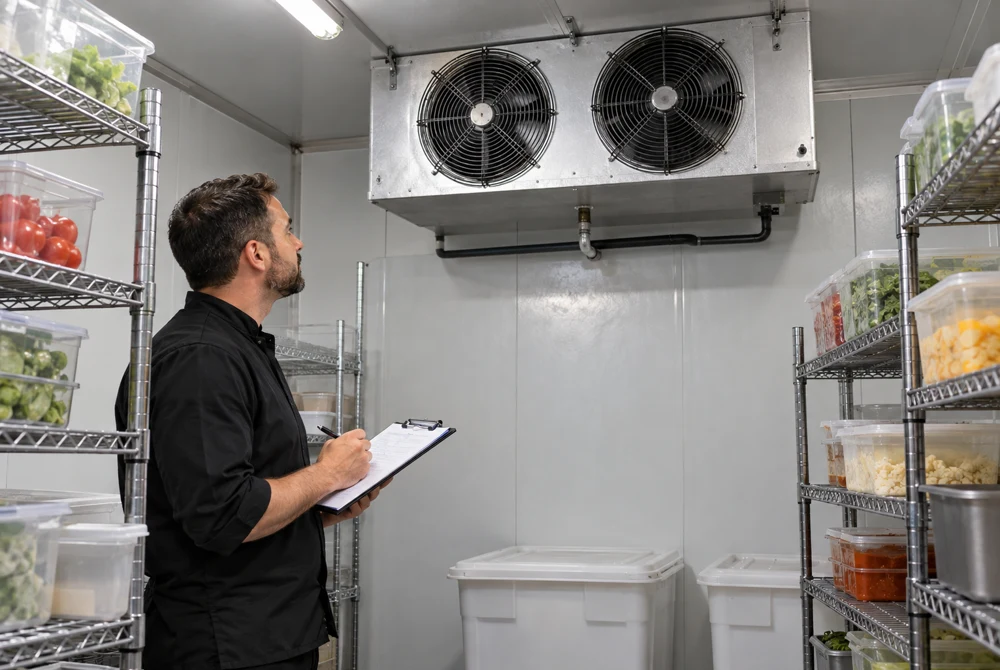
Identify the fan before describing the problem
The evaporator is the cooling assembly inside the refrigerated room. Its fans move room air across the coil and return that air to the space. A remote condenser has a different fan arrangement, usually outside the room, which serves a different part of the system. Tell the contractor which assembly you observed. Saying that the cooler fan has stopped can otherwise send the service visit toward the wrong component.
Use a location description that another person can follow: the ceiling unit above the rear aisle, the unit beside the loading area, or the evaporator serving the left-hand room. If the site has several rooms or several units in one room, include the asset number. Do not invent a model number from the appearance of the cabinet. Provide an existing equipment record or a safely accessible nameplate photograph instead.
Separate three observations. The fans may be visibly stationary; airflow may seem weaker than usual; or the room may be warming even though fans appear to turn. These are different reports. Weak airflow does not by itself establish a failed motor, and warm air does not establish refrigerant loss. A precise description gives the technician a better starting point without pretending that the manager has already diagnosed the equipment.
Also distinguish a single fan from all fans. Record the number visible from a safe position and which appears different. Do not enter a restricted area or climb shelving to count them. If the view is incomplete, say so. A photograph taken from the floor can be more useful than a confident but inaccurate statement that every fan has stopped.
Protect stock while the diagnosis is still uncertain
Follow the business’s approved temperature excursion and product disposition procedures immediately when the records show a concern. Do not wait for a motor quotation to decide who is responsible for the stock. The person responsible for food, pharmaceuticals or another temperature-sensitive product must evaluate the actual time and temperature history and applicable requirements. Equipment repair and product release are separate decisions.
Record the last reliable acceptable reading, the first abnormal reading and the instrument used. Mark missing periods honestly. A display seen after the problem was noticed cannot reconstruct several unobserved hours. If the alarm log is available to authorized staff, preserve its relevant entries. Do not change alarm settings to make the incident disappear from the screen.
Reduce unnecessary door openings and follow the site’s approved transfer or hold procedure when it applies. A transfer needs a receiving location that can accommodate the stock safely; moving everything into another overloaded cooler can create a second incident. Keep the required traceability and handling records with the goods. The refrigeration contractor can advise on the equipment, but should not be treated as the sole authority for releasing affected product.
Give the contractor a concise account of the operational stakes. Include what the room normally stores, whether stock has already been moved, the current restrictions and who can authorize work. This helps the contractor plan access and testing. It does not justify an unsafe shortcut, an improvised electrical change or operation with missing guards.
Ask whether the fan pause belongs to the intended sequence
Some refrigeration controls deliberately stop evaporator fans during particular operating states. Other arrangements keep them running through states that sound similar. The answer depends on the installed unit, defrost method, controller and approved configuration. A rule remembered from a different freezer or a home refrigerator is not sufficient evidence for this cooler.
The currently hosted Heatcraft MAC Series manual, H-IM-67H, March 2018 illustrates this distinction. Its Beacon II sections describe different fan behavior for electric and air defrost, startup delays and an operator service arrangement. Those examples apply to the equipment covered by that manual. They do not supply universal delay times, switch positions or wiring instructions for another installation.
Ask the technician to identify the actual sequence and the evidence that the equipment is in that state. A controller message, an approved operator procedure and the matching model documentation can support the explanation. Merely saying that fans sometimes stop leaves the central question unanswered: should these fans be stopped now, on this equipment, with this room temperature?
If a fan pause is normal, agree on the expected return condition and who will observe it. The relevant condition may be a control transition rather than a fixed number of minutes. Do not turn a model-specific example into a universal waiting period. The stock response procedure still applies while the observation is underway; a normal control state is not a blanket assurance about product temperatures.
| Observation | Question to resolve | Useful record |
|---|---|---|
| All visible fans stopped | Is this an intended control state? | Time, display and operating state |
| One fan differs | Is the issue local or commanded? | Unit location and affected position |
| Fans turn; room warms | Does airflow and cooling meet requirements? | Temperature trend and loading |
| Fault returns after service | Was the cause corrected? | Before-and-after event timeline |
The table organizes observations rather than diagnoses. A single stopped fan might involve its motor, connection, mechanical condition or control arrangement, but the contractor must verify the cause. An all-fan stop can still involve a fault. Use the record to direct an investigation, not to order a set of parts.
Preserve the event instead of repeatedly restarting
Capture the accessible display and note the time before making any operator action allowed by the site’s procedure. Include whether the unit had just completed loading, cleaning, service or an electrical interruption. These events can help establish the sequence, but timing alone does not prove cause. A fault noticed after a delivery may have started earlier.
Ask staff what they actually observed. One person may have heard an unusual sound; another may have seen a switch moved; a third may only have noticed the alarm. Keep these observations distinct. Avoid rewriting the incident log into a unanimous diagnosis. The technician needs reliable facts, including disagreements and gaps, more than a neat story.
Repeated resets can erase useful operating context and delay proper escalation. If an approved operator procedure allows a specific reset, document the reason, the time and what happened afterward. Do not improvise a sequence of breaker cycling, controller changes and switch adjustments. If the equipment trips again, the recurrence belongs in the service request.
A switch that appears to be off deserves an explanation, not an automatic instruction to turn it on. It may belong to an approved operating procedure, a maintenance restriction or a fault response. Confirm its purpose and the authorized action with the responsible person. Do not restore equipment that has been isolated for service or safety simply because someone wants the room colder.
Keep observation outside the service boundary
Managers can collect existing logs, report visible conditions and arrange safe access. They should not remove fan guards, push blades, open electrical compartments, probe terminals or test a motor while the equipment is energized. A stationary fan is not proof that its power source is isolated. Automatic controls can call for operation while someone is nearby.
The OSHA overview of hazardous energy control explains why servicing requires appropriate control of hazardous energy. The applicable workplace program and equipment procedures determine the necessary isolation and verification. Switching an operator control to off is not a substitute for the technician’s required process.
Keep access routes clear and report water, ice, damaged guards or unstable shelving. Do not move stock through an area that the site has restricted. A contractor may need a safe platform or other access equipment; the manager’s job is to arrange suitable access, not to offer an improvised climb. Schedule the work so that staff do not pass under an active service area.
Be equally careful with cleaning. A blocked visible air path may be an operational concern, but spraying a running assembly or applying an unapproved cleaner can add electrical, contamination or material risks. Follow the actual cleaning procedure and let the contractor address inaccessible coil or fan conditions. Do not turn a quick housekeeping observation into uncontrolled maintenance.
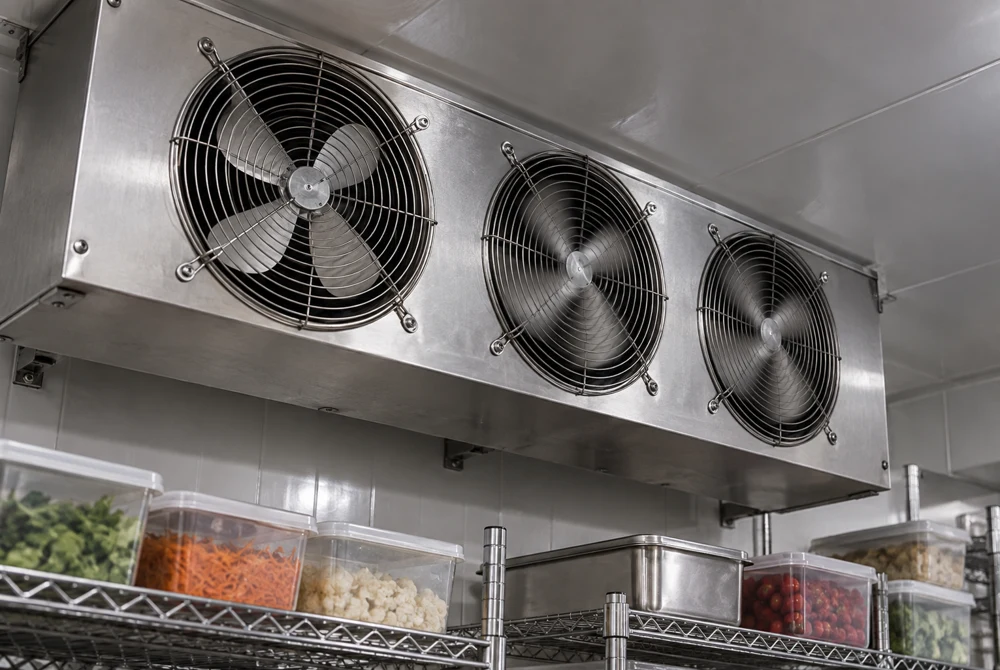
What the contractor’s diagnosis should answer
Request a finding that connects the observed symptom to the actual fault. If the recommendation is a motor replacement, ask what established that the motor was defective rather than simply receiving no operating command. If the recommendation is a control repair, ask what condition prevented the intended fan operation and how that condition was verified.
The report should identify the equipment and the affected component clearly enough for future service. A phrase such as fan issue may be adequate for the initial call, but it is weak as a final diagnosis. Require the unit identifier, component position and relevant part identification. If the contractor cannot identify the equipment confidently, clarify that limitation before approving a permanent replacement.
Ask whether another condition contributed. An assembly may need attention beyond the part that visibly stopped, or the reported stop may be a consequence of a different control state. The contractor should distinguish confirmed findings from possibilities that remain to be tested. Do not authorize multiple speculative replacements merely because a list of possible causes sounds thorough.
Record what could not be reproduced. Intermittent faults deserve a specific follow-up plan, not a claim that nothing is wrong because the fans happened to run during the visit. Ask which records would be useful if the fault returns and how to contact the contractor. Any continued operation must fit the site’s stock protection and safety procedures.
Approve the replacement on equipment evidence
A fan motor or assembly should be selected using the actual equipment requirements and a supported replacement reference. Physical fit alone is insufficient. Ask the contractor to document the original part, the proposed part and the basis for any supersession or alternative. An online listing that says suitable for walk-in coolers does not establish suitability for this unit.
Keep the proposed scope visible. A quotation may include the motor alone, a complete assembly, associated components, access work or further control diagnosis. Ask what is included and what would trigger an additional authorization. This avoids the situation in which a manager approves a motor and later learns that the contractor had only priced the first step of an unresolved investigation.
Replacement documentation should cover the relevant electrical and mechanical requirements and the intended control arrangement. The contractor should consult the appropriate manufacturer information. The manager need not calculate ratings or choose wiring connections; the useful purchasing question is whether the replacement is supported for this equipment and whether the final report will preserve that evidence.
If availability requires a temporary arrangement, separate it from the permanent repair. Get the approved operating restrictions, the reason it is acceptable, the responsible contact and the replacement plan in writing. Do not accept a bypassed protection or missing guard as an ordinary temporary solution. If an arrangement cannot be supported, the operational plan must account for the equipment being unavailable.
Do not turn a fan problem into an automatic refrigerant order
The fan diagnosis and any refrigerant recommendation should have separate support. Ask why refrigerant work is necessary, what equipment condition establishes that need and what procedure will be used. A motor repair does not by itself establish that the system has lost charge. Similarly, a low-temperature complaint should not be converted into a cylinder purchase before the cause is known.
If refrigerant work is verified, preserve the equipment’s actual refrigerant identity and any documented conversion history. Do not select a product because the cooler is old, because another unit uses it or because a cylinder happens to be available. The contractor remains responsible for the equipment-specific service decision and the applicable handling requirements.
The EPA refrigerant sales restriction guidance describes purchaser eligibility and related exceptions. Confirm the relevant requirements for the proposed purchase. A business invoice or an employee’s general maintenance role does not automatically settle refrigerant purchase eligibility.
For an installation whose documentation actually specifies R-404A, the existing R-404A product page provides a place to check the listed package and application information before procurement. The link is conditional, not a recommendation to add charge or replace another refrigerant. Check the actual supplier documentation for the exact product when it is needed; do not substitute a different supplier’s safety sheet.
Set acceptance conditions before work begins
Define what the service visit is meant to resolve. The immediate objective may be to restore the intended fan operation, establish whether a control pause is normal, or diagnose an intermittent stop. These objectives lead to different evidence. An inspection that identifies a likely cause should not be recorded as a completed repair if the correction has not been made.
For a completed repair, ask for confirmation that the installed components, guarding and normal control arrangement are restored. Any remaining restriction should be explicit. Ask whether relevant operating transitions were observed and which were not. This avoids assuming that a brief run proves correct behavior through a later defrost, startup or loading event.
Agree on the temperature follow-up and the responsible person. A service visit may end before the room has returned to its intended condition, especially when stock has been moved or the operating load has changed. The report should distinguish equipment checks completed during the visit from the later operational check. Give the follow-up an actual owner and a due condition.
Keep an open item open. If a component is on order, a repeat visit is required or an intermittent issue remains unverified, document that fact. An invoice marked completed can describe the billing stage without proving that every operational concern has been resolved. The incident record should reflect the equipment’s actual status.
| Acceptance item | Evidence to retain | Open item if missing |
|---|---|---|
| Cause identified | Finding linked to the symptom | Further diagnosis |
| Replacement supported | Equipment and part reference | Compatibility confirmation |
| Normal arrangement restored | Guarding and control closeout | Operating restriction |
| Relevant operation checked | Observed conditions and results | Follow-up observation |
| Stock decision recorded | Separate authorized disposition | Product hold review |
These are record categories, not universal technical test specifications. The actual unit and the contractor’s approved procedure determine the measurements and test conditions. The manager should be able to see which category has evidence, which remains incomplete and who is responsible for the next step.
Check recovery without hiding the operating conditions
Retain the beginning and end times of the observation, the relevant room readings and the operating context. Note whether the room was empty, partly loaded or serving normal production. A successful check with an empty room is useful evidence, but it should not be described as a demonstration of performance at the site’s busiest loading condition.
Record door activity and any planned operating restrictions. Frequent access during a service visit can make a temperature trend difficult to interpret. Conversely, a room kept closed for testing may face a different load when normal work resumes. The record should allow the next person to understand the conditions rather than judging the result from one temperature number.
Use the established monitoring process and compare like readings. A reading from a new location or a different instrument may not be directly comparable with the previous log. The existing walk-in cooler temperature monitoring guide covers placement and alarm response separately. Keep the fan repair record focused on what changed and what still needs observation.
If the fan symptom has been corrected but the temperature trend remains unacceptable, reopen the performance concern. Do not conclude that the motor repair failed solely from an isolated reading, and do not conclude that the room is satisfactory solely because the new motor runs. The contractor should assess the remaining issue using the equipment and recorded conditions.
Prevent a repeat operating mistake
When the verified cause involves an operator control, review the actual authorized procedure with the people who use it. Clarify its purpose, the permitted operating state and how normal operation is restored. Avoid adding homemade instructions to a switch before the contractor and site management have confirmed the correct meaning.
Make the handoff specific. Staff should know which unit was affected, what work was done, what remains restricted and what event requires a call. A message saying watch the cooler is too vague. Name the symptom or reading that matters and the existing place where it should be recorded.
Store the repair report with the equipment history. Include the installed part reference, the service date and the follow-up result. The next contractor should not have to infer a replacement from an unlabeled motor or a lost invoice. Preserve the manufacturer’s information that belongs to the actual part and unit, rather than a generic document downloaded for a similar model.
Use recurrence to improve the record, not to assign blame prematurely. If the fans stop again, note whether it is the same position, the same control state and the same operational circumstances. That comparison can help distinguish a recurring defect from a different event. Keep previous findings available while asking the contractor to verify the new symptom.
Compare service proposals without comparing only the total
Two proposals can describe different work even when they both mention an evaporator fan. One may include a confirmed replacement and final operating checks; another may allow time for diagnosis but exclude the part. Ask each contractor to state the finding already established, the work being authorized and the evidence expected at completion. Compare the same scope before deciding which proposal meets the business’s needs.
Separate access costs, diagnostic time, parts, associated work and follow-up where the quotation allows. This is not a request for an arbitrary price target. It makes the authorization understandable and helps avoid duplicate work. If safe access requires equipment or an operating shutdown, include that requirement in the plan rather than assuming it will be absorbed into a simple motor price.
Ask how written coverage applies to the actual work. Clarify who handles a repeat symptom, what information is needed and whether a return visit is included or assessed separately. Do not infer coverage from a verbal description such as standard warranty. Keep the actual terms with the service record so that the next shift can contact the appropriate person without reconstructing the agreement.
When a proposal depends on further testing, use a staged authorization. Permit the defined investigation, then require a documented finding before approving additional work. A staged process should still provide for urgent stock protection and safe equipment access. It should not encourage staff to keep using an uncertain system simply because a purchase order has not yet reached the next approval stage.
Build a useful fault call from incomplete information
A manager does not need a perfect diagnosis to request assistance. Start with the asset and location, the observed fan condition, the temperature concern and any safety restriction. Then provide the reliable timeline and the recent operating events. Say explicitly when a reading, model number or earlier observation is unavailable. Honest uncertainty is more useful than filling the gaps with assumptions.
Prepare a short question list for the contractor: Is this stop commanded? If not, what verified fault explains it? What work restores the intended configuration? Which operating state will be checked before departure? What follow-up remains? These questions keep the conversation on equipment evidence while allowing the contractor to choose the appropriate technical method.
If the site uses an external facilities team, ensure that the person receiving the request also receives the operating restrictions. A ticket routed as routine fan noise can lose the fact that stock has been placed on hold or access is restricted. Keep the description factual and update it when conditions change. Do not exaggerate a diagnosis to obtain faster service.
At handoff, confirm that the next responsible person has the contact details, current stock status and pending check. That person should know whether they are waiting for a part, a contractor, an operating transition or an authorized product decision. Clear ownership prevents an unresolved fan incident from becoming an unmonitored overnight assumption.
Questions managers commonly ask
Should evaporator fans run all the time?
There is no universal answer for every walk-in installation. Fan operation depends on the unit, controls and defrost arrangement. Ask for the intended sequence for the actual equipment. A deliberate pause can be normal, but an unexplained extended stop or a temperature problem still needs evaluation. Do not infer the correct behavior from a different cooler.
Can I push a stopped fan to see whether it starts?
No. Do not reach through guarding or attempt to move the blades. The assembly can restart automatically, and a stationary appearance does not establish safe isolation. Let the qualified contractor investigate under the appropriate hazardous energy procedure. Record what you can safely observe and arrange access instead.
Does one working fan mean the cooler can stay in service?
That observation alone cannot establish acceptable operation. The remaining airflow, equipment requirements, temperatures, stored products and safety conditions all matter. Follow the site’s incident plan and the contractor’s equipment-specific advice. A manager should not assume that the other fan provides enough capacity merely because air movement can still be heard.
Is a fan stop after defrost proof of a failed motor?
No. The installed control sequence may intentionally delay fan operation, or a fault may prevent the intended return. The technician must identify which condition applies. Ask for the expected transition and evidence of its completion. Avoid using a fixed waiting period copied from another model as the basis for releasing the equipment.
Should we order refrigerant with the motor?
Only if the contractor has separately established a need for refrigerant work and confirmed the correct product and purchaser eligibility. A fan symptom does not prove charge loss. Keep the diagnostic basis, equipment identity and service scope in the record before ordering. Do not buy a substitute simply because it is available.
What if the technician cannot reproduce the stop?
Retain the incident timeline and agree on a specific observation plan. Ask what operating information will help distinguish a control state from an intermittent fault. Record any limits of the visit. Continued operation and stock disposition must still follow the site’s procedures; a non-reproduced symptom is not the same as a verified repair.
What should the finished invoice tell us?
It should identify the unit, verified finding, work completed, supported replacement when applicable, conditions checked and remaining restrictions or follow-up. Keep product disposition separate. The practical goal is a record that another manager or contractor can use without guessing why the fans stopped or what remains unresolved.











