
By Refrigerant Centers Editorial Team
Both clear the limit. EPA’s Technology Transitions fact sheet holds the VRF subsector to 700 GWP, and R454B at roughly 466 and R32 at 675 are both under it. So the compliance question is settled before the comparison starts, and anyone framing this as “which refrigerant is legal” has the wrong question.
The honest answer for a VRF project is that you do not choose the refrigerant — you choose a platform and inherit its refrigerant. VRF manufacturers have committed their product lines one way or the other, and you cannot order a given manufacturer’s system in the other refrigerant. What that means practically: evaluate the platforms on the things that decide a VRF job — charge limits against your room areas, operating map against your climate and load profile, controls, and local service depth — and treat the refrigerant as one input into that, not as the decision itself.
Where the two genuinely differ and it shows up on a project: R32 runs a higher compressor discharge temperature, which narrows the operating envelope at the extremes; R454B is a blend of R32 and R1234yf, which brings a second component and a marginally different charging and recovery discipline; and each has its own charge-limit arithmetic, which on a VRF system with long pipe runs and indoor units in small rooms is the constraint most likely to change your layout.
The sections below work through each of those, then cover what neither refrigerant decides, how to compare two bids that arrive on different platforms, and what to actually write into the specification.
The Numbers, and Why US and European Guidance Disagree
This trips up design teams reading manufacturer literature from both sides of the Atlantic, and it is worth clearing up first because it makes the sources look like they contradict each other.
Published GWP values differ depending on which IPCC assessment report they come from. Honeywell’s R454B applications development guide states a GWP of 467 on the AR5 basis and identifies the blend as 68.9% R32 and 31.1% R1234yf. R32 is commonly cited at 675 in the United States and at a higher figure under AR5.
That difference is why European guidance reads harder against R32 than American guidance does. Trane’s comparison post, written for a European audience, says R32’s GWP exceeds a 750 threshold — which is a real statement about the European framework and the values it uses, and not a statement about whether R32 clears the US limit. In the United States, the governing value is the one in EPA’s regulations, and under it R32 sits below 700.| Property | R32 | R454B |
|---|---|---|
| Composition | Single component | Blend of R32 and R1234yf |
| GWP | 675 as commonly cited in the U.S.; higher on the AR5 basis | About 466, stated as 467 on the AR5 basis |
| Safety class | A2L | A2L |
| Temperature glide | None — single component | Near-azeotropic with minimal glide |
| Lubricant | Per the compressor manufacturer | Generally POE, per the compressor manufacturer |
| Discharge temperature | Higher | Lower |
Composition, GWP, glide, and lubricant figures for R454B from the Honeywell applications guide cited above; discharge-temperature direction from the Trane comparison discussed below. Confirm every value against the equipment manufacturer’s own documentation before it goes into a submittal, since the value that governs compliance is the one in EPA’s regulations.
The GWP gap is real but narrow in consequence. Both are under the current limit; R454B carries more margin against any future tightening. On a system with a twenty-year life, that margin is a legitimate thing for an owner with carbon commitments to pay attention to, and a legitimate thing for a cost-driven owner to discount.
Glide, Blend Composition, and What Service Actually Notices
R32 is a single component, so it has no glide and it cannot fractionate. That is a genuine simplification: one saturation temperature at a given pressure, and no possibility of the charge drifting off composition through a series of vapor leaks.
R454B is a blend, but a near-azeotropic one — Honeywell’s guide describes it as having minimal glide, similar to R410A in that respect. In field terms, the glide is small enough that technicians used to R410A will not find the readings unfamiliar, and it does not require mechanical compensation in the system design.
Where the blend still matters is discipline rather than difficulty. Any blend gets charged as a liquid, because pulling vapor off the cylinder removes the more volatile component preferentially and leaves both the cylinder and the system off composition. That is already standard practice for R410A, so it is not new work — but it is work that a crew accustomed to cutting corners on a small top-off will now get wrong in a way that shows up in every subsequent reading.
For a design team, this difference is close to immaterial. For a service manager inheriting the system, R32’s single-component simplicity is a small, real advantage in training and in diagnosing a system that has been topped off by someone else.
Discharge Temperature and the Operating Map
This is the substantive technical difference, and it is the one most likely to affect whether a platform suits a specific project.
R32 runs a higher compressor discharge temperature than R454B. Trane — which builds R454B equipment and is therefore arguing a position, not reporting neutrally — makes the case in its comparison of R454B and R32 that the higher discharge temperature limits R32’s operating range and reduces application flexibility, that R454B delivers an extended operating map with better performance for higher water temperatures at low ambient, and that the higher discharge temperatures place additional stress on the compressor.
Read that with the source in mind, and then take from it the part that is physics rather than marketing: the discharge temperature difference is real, and it is managed in design. Manufacturers on the R32 side address it through compressor design, injection strategies, and control logic, which is why R32 platforms exist and perform in the field rather than failing the way an unmanaged temperature rise would suggest.
What this means for a project is narrower and more useful than “one is better”:
In extreme heating conditions, ask for the published envelope. Heat pump VRF operating at low ambient with high leaving water or air temperatures is where the difference concentrates. Do not accept a general assurance — get the manufacturer’s operating map for the specific outdoor units and confirm it covers your design conditions with margin.
In ordinary comfort cooling, this difference rarely decides anything. A commercial office in a temperate climate will not see the edges of either envelope.
Compressor stress is a manufacturer-management question, not a refrigerant verdict. The right way to test it is warranty terms, published operating limits, and the local service history of that platform — not a refrigerant comparison chart.
Charge Limits: The Constraint That Decides VRF Layouts
This is where the A2L transition actually bites on VRF, and it has very little to do with which of the two you pick.
A VRF system holds a large charge and distributes it through occupied spaces. Under the A2L safety framework, the allowable charge for a given space is calculated from the refrigerant’s flammability limit and the room’s size, with the smallest served room typically governing. Honeywell’s applications guide works through the charge-limit tiers for R454B using that method; the equivalent calculation exists for R32, and the resulting numbers differ slightly between the two because their flammability limits differ.
The practical consequence on a real building is that the constraint usually shows up in the smallest rooms on the system — a single office, a small conference room, a hotel-style guest room — and it constrains how much charge can be served into that space, not how much the system holds in total. Two design responses follow, and both are architecture decisions rather than refrigerant decisions:
Break the system into more, smaller refrigerant circuits so that no one circuit’s charge is exposed to an undersized room.
Apply the mitigation the standard allows where the charge would otherwise exceed the limit — covered in the next section.
The number that governs a specific project comes from the adopted code edition and the manufacturer’s own documentation, applied to your actual room areas. Do not take a figure from a comparison article, a general calculator, or this one; run it on the drawings. What matters for the R32-versus-R454B question is that the difference between them here is a modest shift in the arithmetic, and it almost never flips a layout that was otherwise workable.
Mitigation When the Charge Exceeds the Limit
When a room is too small for the circuit charge, the standard’s mitigation provisions are what keep the design viable, and they are the same family of measures on either refrigerant.
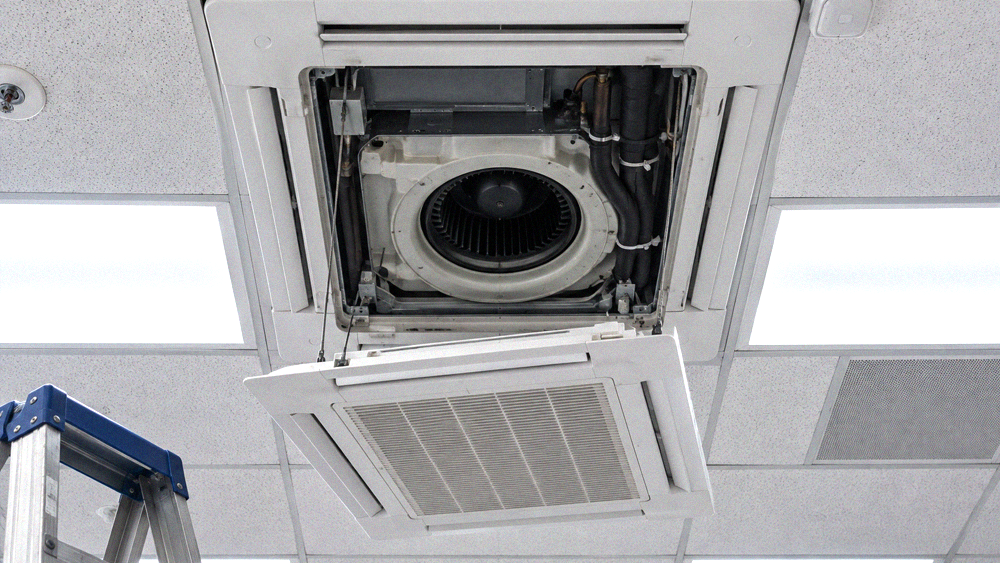
Refrigerant detection with shutdown. A detection system that senses a leak and takes the equipment out of operation. ACHR News, working through misconceptions about A2L refrigerants, notes that leak detection is required on A2L systems, including small ones, and that a compatible detection kit — not a wholesale equipment replacement — is what the requirement calls for.
Forced airflow or dilution ventilation in the served space on a leak signal, which is how a small room can be brought inside the limit.
Shutoff valves that isolate a circuit and limit how much charge can reach a given space.
Two things to get right at design time rather than at commissioning. First, mitigation is a coordinated scope — detection devices, power, controls integration, and in some cases airflow — and it belongs in the electrical and controls packages, not discovered in a submittal review. Second, the mitigation available to you is what the adopted code edition and the equipment’s listing permit, which is a question for the authority having jurisdiction before the layout is fixed.
None of this differentiates the two refrigerants. It differentiates a design team that resolved charge limits in schematic design from one that did not.
Oil, Pressures, and Component Compatibility
Both refrigerants operate in the pressure territory that R410A occupied, which is why both could be brought into equipment platforms derived from R410A designs rather than clean-sheet machines. Honeywell’s guide describes R454B as very close to R410A in pressure drop, and R32’s pressures likewise sit in that range.
On lubricant, both are POE territory in practice, and the operative instruction in the manufacturer literature is the same for both: use what the compressor manufacturer specifies for that machine. That is not a hedge — it is the only correct answer, because the oil is a property of the compressor and the system, not of the refrigerant alone.
For a contractor, the useful takeaway is that neither refrigerant demands a different class of tooling from the other. The A2L-rated recovery machines, vacuum pumps, gauges, and detection that one requires, the other requires too. The ACHR News guide to equipping techs for the shift to A2L describes spark-free recovery equipment with sealed electricals, A2L-capable leak detection, and left-hand-thread recovery cylinders with red stripe identification — and that kit covers both refrigerants. A company tooled for one is tooled for the other.
What Each One Costs You in Service Practice
The design difference is small; the service-life difference is worth a column each.| Consideration | On an R32 platform | On an R454B platform |
|---|---|---|
| Charging discipline | Single component; no fractionation risk from vapor charging | Charge as liquid; standard blend discipline applies |
| Reading pressures and temperatures | One saturation point; simplest case to teach | Minimal glide; familiar to anyone who worked on R410A |
| Tooling required | Full A2L kit | Full A2L kit — the same equipment |
| GWP margin over the life of the system | Under the current limit with less headroom | Meaningfully more headroom against future tightening |
| Operating envelope at extremes | Higher discharge temperature; verify the published map | Wider envelope per the manufacturer arguing for it |
Rows draw on the Honeywell and Trane sources cited above plus the A2L field-practice coverage; treat the last row as a manufacturer’s position rather than an independent finding, and verify against the operating data for the specific equipment.
Nothing in that table justifies overruling a platform choice made on controls, capacity, or service coverage. It does justify asking the service side of your own company which refrigerant they would rather hold on the truck for the next fifteen years — a question that rarely gets asked before a specification is issued, and one Refrigerant Centers hears about later from the people who inherited the answer.
Manufacturer Lock-In Is the Real Decision
Here is the part that most comparison articles skip, and it is the one that will actually shape the project.
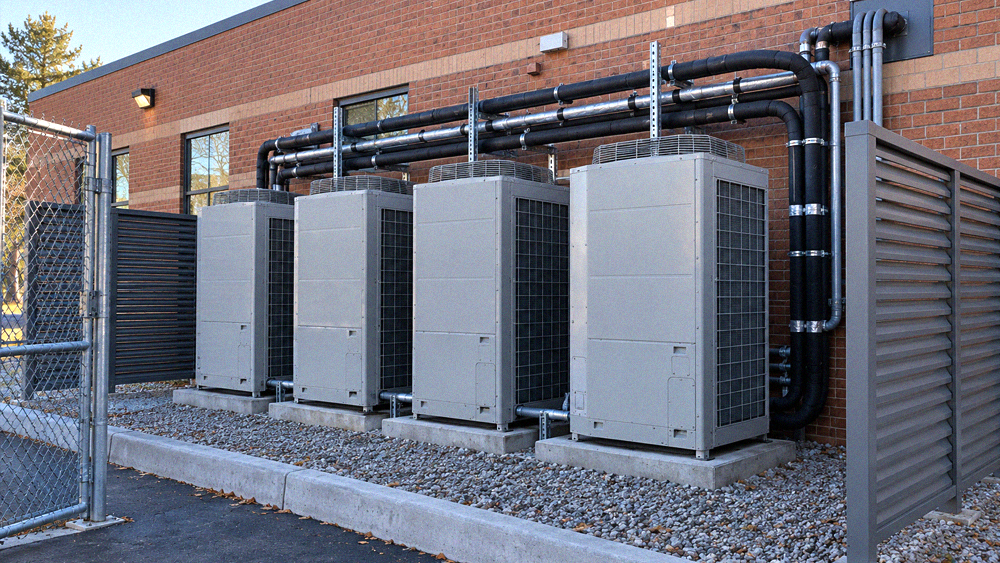
You cannot mix and match. A VRF system is a matched set of outdoor modules, branch controllers, indoor units, piping design rules, and proprietary controls. The refrigerant comes bundled with the platform. Choosing R454B means choosing among the manufacturers who build R454B VRF; choosing R32 means the other set. And that choice carries consequences far larger than the refrigerant:
Controls and integration. VRF controls are proprietary. What integrates with the building automation system, and how well, is a bigger operational fact than 200 points of GWP.
Piping design rules and equivalent-length limits. These differ by manufacturer and directly constrain what layouts are possible in your building.
Local service depth. How many trained technicians for that platform exist within an hour of the building. This is the single most reliable predictor of how the owner will feel about the system in year six.
Parts availability and lead time for that manufacturer in your region.
Commissioning support during startup on a system with dozens of indoor units and proprietary diagnostics.
So the correct sequence is: shortlist platforms on controls, layout feasibility, and service coverage; confirm each shortlisted platform’s charge limits against your smallest served rooms and its operating map against your design conditions; then, if two platforms come out genuinely even, let the GWP margin be the tiebreaker. Leading with the refrigerant inverts that and can eliminate the better system on a difference that will not matter to the building.
Availability and the Longer Term
Both refrigerants are in volume production and both are widely available, which is a change from the early transition years when supply was a legitimate selection factor. Both are the mainstream answers — as NAHB’s explainer on the new refrigerants puts it, R32 and R454B are the two refrigerants to expect in the market, with each manufacturer specifying which it uses.
The longer-term question is what comes after them, and it is worth a moment of honesty with an owner. ACHR News has already taken up what comes after R454B and R32, which tells you the industry is looking past this generation. Meanwhile the HFC phasedown continues on schedule — EPA’s phasedown of hydrofluorocarbons steps allowances from 60 percent of baseline through 2028 down to 30 percent for 2029 through 2033. Both of these refrigerants contain HFC components and both draw on that shrinking allowance pool.
What follows for a 2027 project: neither choice is a permanent answer, and the honest framing for an owner is that R454B’s additional GWP margin buys some insurance against a future limit, at whatever the platform difference costs. That is a judgment the owner should make with the number in front of them, not a technical verdict.
Comparing Two Bids on Different Platforms
When bids arrive on different refrigerants, the comparison is not apples to apples unless you force it to be. Ask for the same five things from both.| Ask for | What it exposes |
|---|---|
| Charge per circuit and the smallest room each circuit serves | Whether the layout actually clears the charge limit, or is relying on mitigation nobody priced |
| Complete mitigation scope, itemized | Detection, controls, and airflow work hidden in one bid and omitted from the other |
| Published operating map against your design conditions | Whether the platform covers your extremes with margin or just barely |
| Part-load performance at the building’s real load profile | Efficiency differences that nominal ratings hide |
| Named local service capability for that platform | Whether the owner can get the system fixed in year six |
The first two rows are where bids most often diverge without anyone noticing. A platform with a slightly tighter charge limit may need more circuits or more mitigation, and if one bidder priced that and the other did not, the cheaper bid is cheaper because it is incomplete.
What to Write Into the Specification
Specifying a refrigerant by name on a VRF project narrows you to one set of manufacturers, which is sometimes intended and often not. Specify the requirement instead:
- refrigerant GWP at or below 700 as determined by the governing regulatory value, with the value and its source stated;
- charge limits demonstrated against the actual smallest served room on each circuit, with the calculation submitted;
- mitigation scope, if required, itemized by discipline and included in the base bid;
- published operating envelope covering the project’s design conditions with stated margin;
- refrigerant detection provided per the equipment listing and the adopted code;
- A2L-rated service equipment and trained technicians for commissioning and warranty work;
- and the refrigerant model, charge by circuit, and detection configuration recorded in the closeout documents.
That last line is small and it repays itself. A service company arriving at the building in four years should be able to learn from the record which refrigerant is in which circuit and how the detection is configured, without opening a unit to find out.
What This Comparison Does Not Decide
Worth stating plainly, because the R32-versus-R454B framing invites more weight than it deserves.
It does not decide whether VRF is the right system for the building. It does not decide zoning, capacity, or whether a heat-recovery configuration is justified. It does not decide the controls integration, which is the thing facility staff will actually interact with daily. And it does not decide whether the piping design will work in the building’s shafts and ceiling cavities.
Every one of those outranks the refrigerant for the owner’s satisfaction with the system. A project that gets the refrigerant “right” and the controls wrong has failed; a project that gets the platform right and takes 200 points of GWP as the cost of doing so has not.
Frequently Asked Questions
R32 vs R454B: which one should I choose for a VRF project?
Choose the platform, not the refrigerant. Both clear the 700 GWP VRF limit, VRF manufacturers offer one or the other rather than both, and controls, charge limits against your room areas, operating map, and local service coverage all outweigh the refrigerant difference.
Do both refrigerants clear the 700 GWP limit for VRF?
Yes. R454B at roughly 466 and R32 at 675 as commonly cited in the United States both fall under it. Confirm against the value in EPA’s regulations, since published figures vary with the assessment report behind them.
Why does European guidance treat R32 less favorably?
Because European rules use AR5-based GWP values, under which R32 is higher than the figure usually cited in the United States, and because some European thresholds differ from the US limit. The framework differs, not the molecule.
Does R454B’s glide complicate service?
Not materially. It is near-azeotropic with minimal glide, and the readings will be familiar to anyone who worked on R410A. Charge it as a liquid, as you would any blend.
What is the minimum room size for an A2L charge?
There is no single number. It comes from the refrigerant’s flammability limit, the room’s area, the adopted code edition, and the equipment listing, applied to your drawings. Calculate it per circuit against the smallest room that circuit serves.
Do R32 and R454B use the same oil?
Both are generally POE territory, but the operative answer is whatever the compressor manufacturer specifies for that machine. The oil is a property of the compressor and system, not of the refrigerant alone.
Do I need different tools for R32 than for R454B?
No. Both are A2Ls and require the same A2L-rated kit: spark-free recovery machines and vacuum pumps, A2L-capable leak detection, gauges set for the refrigerant, and left-hand-thread recovery cylinders.
What comes after R454B and R32?
The industry is already discussing it, and the HFC phasedown continues to tighten through 2029 and beyond. Neither is a permanent endpoint, which is the argument for weighing R454B’s extra GWP margin — and for not overpaying for it.
The One Thing to Do Before Choosing
Take the smallest room on each proposed refrigerant circuit and run the charge-limit calculation against it, on both shortlisted platforms, before anyone writes a refrigerant into the specification. If that check clears on both, the refrigerant is a tiebreaker and the decision belongs to controls, layout, and service coverage. If it clears on only one, you have your answer for a reason that has nothing to do with GWP — and you found it in design rather than in a submittal review.











