
By Refrigerant Centers Editorial Team · Last updated September 21, 2026
Outdoor humidity does not make a compressor work harder, and on a standard air-cooled system it does not meaningfully move head pressure either. What it changes is the load handed to the coil, and therefore how the equipment divides its capacity. On a high-dew-point day a larger share of output goes into condensing water vapor and a smaller share into lowering dry-bulb temperature. Runtime stretches, setpoint recovery slows, and the customer calls because it reads 74°F inside and still feels like a locker room.
That one mechanism explains most summer humidity callbacks. The equipment is usually doing exactly what its performance data says it will do at the entering conditions it has. Your job on that call is to separate three things: the physics the customer has to live with, the design decisions someone made years ago that you can only partly work around, and the real faults — airflow, controls, charge — that you can correct today.
This article works through all three in the order a tech should think about them: what sensible and latent capacity actually are, why dew point rather than relative humidity drives the load, where the moisture is getting in, whether the condenser cares at all, what expanded performance data shows when entering wet bulb moves, and how to run a humidity complaint from the return grille to a recommendation you can put in writing.
Sensible and Latent: Where the Capacity Actually Goes
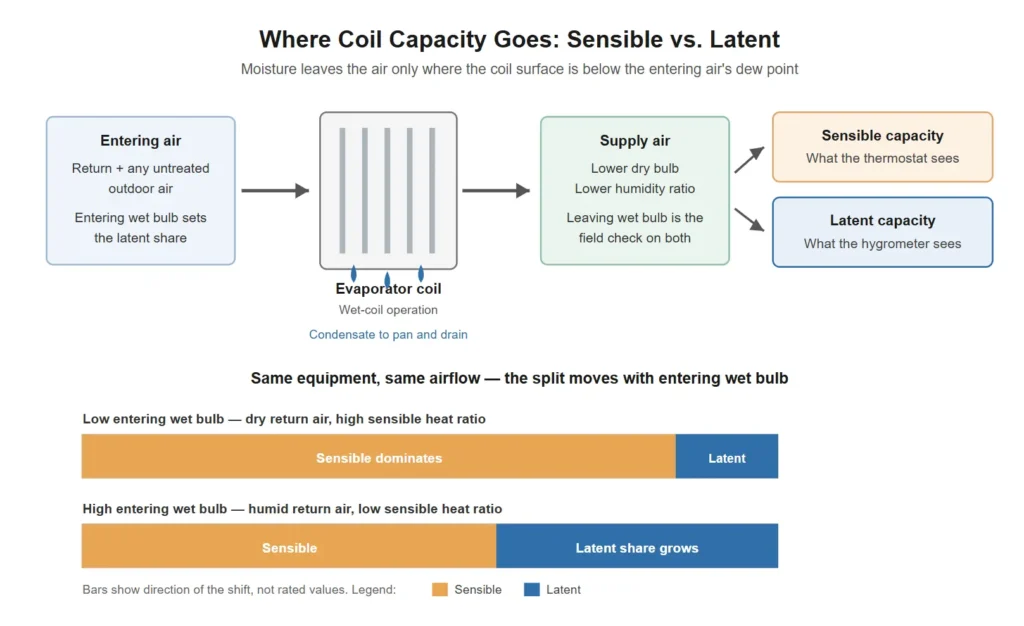
Every wet coil does two jobs at once. Sensible capacity lowers dry-bulb temperature. Latent capacity removes water vapor by holding coil surface below the entering air’s dew point, so vapor condenses on the fins, drains to the pan, and leaves the building. The U.S. Department of Energy treats these as two separate cooling loads precisely because a building can be heavy on one and light on the other, and conventional equipment cannot dial them independently.
The ratio between them is the sensible heat ratio. An SHR of 0.75 means three quarters of the coil’s output is going into temperature. An SHR of 0.95 means the coil is barely dehumidifying.
The part that gets missed in the field: SHR is not a nameplate property. It is a result of the conditions the coil is operating at — chiefly entering wet bulb and face velocity. Hand the same coil wetter air and it does more latent work automatically, because more surface sits below dew point and there is more vapor available to condense. Hand it drier air and latent capacity falls toward zero while sensible capacity rises.
So when outdoor moisture drives indoor humidity ratio up, SHR drops on its own. There is no setting that reverses it. The coil is responding to what the ductwork delivers.
Dew Point Is the Load Number — Relative Humidity Isn’t
Relative humidity is a ratio, not a quantity. It expresses how much vapor the air holds against the maximum it could hold at its current temperature, and as NOAA explains in its reference material on humidity and dew point, warm air holds substantially more vapor than cold air. The same percentage therefore describes completely different absolute loads at different temperatures — 100% RH at 30°F is dry air by mass, while 50% RH at 80°F carries far more water.
Dew point is the absolute measure, and it moves only when actual vapor content changes. For load work it is the number that matters, for three reasons.
It sets the infiltration load. Outdoor air enters at outdoor dew point. The gap between outdoor and indoor dew point determines how many grains each cubic foot of leakage delivers.
It sets whether the coil can dehumidify at all. Coil surface must be colder than entering dew point or nothing condenses. Not adjustable.
It does not fall at night the way dry bulb does. Outdoor dry bulb may drop 20°F after sunset while dew point drops two or three degrees. That is why latent load holds into the early morning after the sensible load is mostly gone — HVAC engineering analysis of dehumidification loads puts the peak latent load near 5 a.m. while peak sensible load lands in late afternoon.
That mismatch is the structural problem. Equipment gets sized for the afternoon sensible peak; the moisture problem shows up at the hour the system barely needs to run, which is exactly when short cycling is worst.
Field reference: what an outdoor dew point implies
Useful for setting expectations on the phone, not for load calculations:
- Below 55°F — latent load is minor; nearly all capacity goes to dry bulb.
- 55–60°F — normal operation holds the space without help.
- 60–65°F — latent load is a real share of total; airflow and cycle length begin to matter.
- 65–70°F — oversizing or high airflow will show up as an indoor complaint.
- Above 70°F — many correctly sized systems still cannot hold the space in range without supplemental dehumidification.
Where the Latent Load Comes From on a Real Job
Outdoor humidity only reaches the coil if something carries it inside. Identifying which path dominates is most of the diagnosis.
Envelope infiltration. Rim joists, top plates, can lights, plumbing penetrations, window frames. Usually the largest path in older stock, scaling with wind and stack effect.
Duct and air-handler leakage in unconditioned space. A leaky return in a vented attic or humid crawlspace pulls air at outdoor conditions straight onto the coil. This single path can create a latent load the equipment was never sized for, and it is the most common thing a tech finds that nobody else had looked for. The same analysis that identified the 5 a.m. latent peak cites NREL research finding that air conditioners in humid climates handle only 50 to 70 percent of the required dehumidification at peak latent conditions, with code-minimum construction performing worst and tight, sealed-duct buildings performing best.
Mechanical ventilation and makeup air. Bath and kitchen exhaust, dedicated outdoor air intakes, and in light commercial any economizer or makeup-air unit delivering untreated outdoor air. An economizer stuck partly open on a 75°F dew point day is a latent load nobody budgeted for.
Door traffic and internal generation. Retail and food service admit a slug of outdoor air on every door cycle. Then there is what the building makes itself: cooking, dishwashing, showers, laundry, occupants, and moisture driving up out of a damp slab or crawlspace.
In a tight building with ducts in conditioned space, internal generation can dominate. In a leaky building on a 74°F dew point day, outdoor air wins by a wide margin. The coil treats both and does not care which one handed it the water.
Does Outdoor Humidity Hurt the Condenser?
This is what most people actually mean by the question, and for standard air-cooled residential and light-commercial equipment the honest answer is: barely.
An air-cooled condenser rejects heat by warming outdoor air. That is sensible heat transfer, driven almost entirely by outdoor dry bulb. Moist air differs slightly in density and specific heat, but at the same dry bulb the effect is small enough that manufacturers index capacity tables to outdoor dry bulb alone. A 95°F day at a 60°F dew point and a 95°F day at a 76°F dew point look nearly identical to that condensing unit.
What genuinely degrades condenser performance — and worsens in the same season, which is why it gets blamed on humidity:
- Loaded coils. Cottonwood, clippings, and dust bind to a coil that has stayed damp, driving condensing pressure up and capacity down.
- Airflow restriction. Shrubs, fences, decks built too close, stacked storage around rooftop units, failing condenser fan motors.
- Recirculation. Discharge air pulled back to the inlet in tight side yards or crowded rooftop arrays.
- Outdoor dry bulb itself. Capacity falls as ambient rises, independent of moisture.
The exception matters on larger buildings. Equipment that rejects heat evaporatively — cooling towers, evaporative condensers, evaporatively pre-cooled condensers — is driven by outdoor wet bulb, because a high wet bulb limits how cold the water or coil surface can get. On that equipment a muggy day is genuinely harder, and rising condensing pressure at flat dry bulb is real. It does not transfer to the air-cooled split system in the side yard, and telling a homeowner otherwise sets up a callback you cannot win.
What AHRI Rating Conditions Assume vs. the Day You’re Standing In
Published capacity and efficiency figures come from one standardized test point. Under ANSI/AHRI Standard 210/240, the full-load cooling test specifies air entering the indoor coil at 80.0°F dry bulb and 67.0°F wet bulb, with outdoor air entering at 95.0°F dry bulb — the conditions given in the performance rating standard for unitary air conditioning and air-source heat pump equipment.
That 67°F entering wet bulb is roughly 51% RH at 80°F: moderately humid indoor air, not the 60%-plus condition a struggling system produces. It is a reasonable average, and it is the single point every published capacity number sits on.
Two consequences for anyone quoting capacity on a job. Nameplate capacity is one point on a surface, not a promise about the building in August. And when actual entering conditions differ from 80/67 — on a humidity callback they always do — both total capacity and its split differ too. That is what expanded performance data exists to tell you, and pulling it up on site is faster than arguing about it.
Reading Expanded Performance Data on a Humidity Callback
Manufacturer expanded performance tables list capacity against entering indoor wet bulb, entering dry bulb, outdoor dry bulb, and airflow. Hold everything constant except entering wet bulb and the effect of moisture shows up directly. Published data for a three-ton split system at 95°F outdoor ambient and 1,200 CFM:| Entering wet bulb | Total capacity (MBh) | Sensible share | What it means on the job |
|---|---|---|---|
| 63°F | 31.1 | 0.82 | Coil nearly dry; little condensate, fast setpoint recovery |
| 67°F (rating point) | 33.7 | 0.62 | Balanced operation; nameplate behavior |
| 71°F | 36.2 | 0.40 | Heavy condensate, long runtime, slow dry-bulb pulldown |
Figures from published expanded performance data for the Goodman VSX13 split system air conditioner; values vary by model, coil match, and airflow — always pull the data for the equipment in front of you.
That table settles most arguments on site. Total capacity rises as entering air gets wetter — condensing latent heat is heat transfer, and the coil has more work available. But the sensible share falls from 0.82 to 0.40. In absolute terms sensible capacity drops from roughly 25.5 MBh to roughly 14.5 MBh across that range.
So a humid day presents as a capacity complaint even though total capacity went up. The thermostat measures dry bulb, and the portion of output aimed at dry bulb just fell by nearly half. Longer runtime, slower recovery, higher kWh — all of it follows from the split, not from a fault.
Oversizing: The Humidity Callback Refrigerant Won’t Fix
The most common root cause of chronic indoor humidity on an otherwise healthy system is equipment too large for the building. Recognize it early, because no amount of charge adjustment addresses it.
Dehumidification is time-dependent. The coil has to get cold, condensate has to form, the film has to grow heavy enough to run off, and it has to reach the drain. That takes sustained runtime. ENERGY STAR’s guidance on right-sized air conditioners notes that efficiency is lowest at startup and improves over roughly the first ten minutes of a cycle, and that short operating times “do not allow the system to effectively remove humidity,” with consequences for comfort and building durability. It puts the efficiency penalty of dropping from a nine-minute cycle to a five-minute cycle at about 17 percent.
An oversized system satisfies the thermostat quickly and shuts down. Each cycle wets the coil and stops before much water leaves the building. Worse, moisture still on the coil re-evaporates into the duct whenever the blower runs on after the compressor stops, putting the water back into the space.
The field signature is unmistakable: brisk cycling, thermostat satisfied, space clammy, drain pan barely producing.
Right-sized equipment moves less air over longer cycles. It feels slower on the hottest afternoon and dramatically better on the muggiest one. Two-stage and variable-capacity equipment split the difference — long low-stage runtime at reduced airflow is close to ideal for a humid climate, and it is the honest recommendation when a replacement quote is already on the table.
Airflow and Fan Control: The Two Settings That Decide Latent Capacity
After sizing, airflow is the biggest lever you actually control, and the one most often set wrong on equipment someone else installed.
Higher face velocity raises sensible capacity and lowers latent capacity. Air spends less time against the fins, coil temperature rises, and less surface sits below dew point. Installers commonly set 400 CFM per ton or more because it maximizes the efficiency number and the felt blast at the register. In a dry climate that is defensible. On the Gulf Coast it is the fault.
For humidity-prone buildings, moving toward roughly 350 CFM per ton drops coil temperature, raises latent capacity, and costs a modest amount of sensible capacity. Most equipment has a blower tap or variable-speed profile for exactly this. Do not go below the manufacturer’s stated minimum — too little air across a cold coil invites freeze-up, liquid floodback, and compressor damage, and you own that outcome.| Condition found | Effect on latent performance | Corrective action |
|---|---|---|
| Fan switch left on ON | Drives air across a wet coil between cycles, re-evaporating condensate into the duct | Switch to AUTO and explain why |
| Long blower-off delay | Same re-evaporation path, running every cycle | Shorten or disable in control settings |
| Airflow at 400+ CFM/ton | Warmer coil, higher SHR, less water removed per hour of runtime | Retap toward 350 CFM/ton within manufacturer limits |
| Deep daytime setback programmed | Moisture builds unchecked, then recovery runs at high SHR and removes little of it | Recommend a 2–3°F setback instead |
| Dirty filter or restricted coil | Low airflow can cold-coil into freeze-up, stopping dehumidification entirely | Restore airflow before touching charge |
The setback row is worth carrying into the customer conversation. Setbacks save energy in dry climates. In humid ones an eight-hour deep setback lets moisture build all day, and the recovery cycle runs at high SHR because the space is hot — it drops dry bulb fast and removes comparatively little of the accumulated water. Many humid-climate buildings are more comfortable and barely more expensive on a shallow setback, and that recommendation costs nothing.
Diagnosing a Humidity Complaint in the Right Order
These calls go sideways when gauges come out first. Charge is the fourth thing to check, because most of what causes a humidity complaint sits upstream of the refrigerant circuit.
Measure before touching anything
Take indoor dry bulb and RH at the return grille, not at the thermostat — thermostats read the wall they are mounted on. Convert to dew point or entering wet bulb. Get outdoor dry bulb and dew point. Now you know the actual entering condition and the gradient driving infiltration, and you can compare against the equipment’s own performance table instead of against a feeling.
Check the drain. A system doing real latent work in humid weather produces continuous condensate. A dry pan at a 70°F outdoor dew point tells you the coil is not staying below dew point long enough, or the system is not running when the moisture arrives.
Confirm runtime, then airflow
Pull runtime from the thermostat or controller if it logs it. Cycles under ten minutes in peak weather point to oversizing or a control problem — and no refrigerant work will change that. Then verify airflow: filter condition, coil cleanliness, static pressure across the air handler, blower tap or ECM profile, and whether the fan is set to ON. Most humidity complaints that a tech can actually fix resolve in this step.
Look for the untreated outdoor air path
Return leakage in an attic or crawlspace, a disconnected boot, an open economizer, a makeup-air unit running with no dehumidification, a bath fan running continuously on a timer nobody remembers setting. Pressure-diagnose if you carry the equipment; otherwise a smoke pencil at accessible return seams on a windy day finds more than people expect.
Only then verify charge and metering
With airflow confirmed, check superheat and subcooling against the manufacturer’s target for the metering device. An undercharged system runs a warmer coil and loses latent capacity first — the temperature complaint may be mild while the humidity complaint is severe. An overcharged system can flood the coil and lose capacity in both directions. A TXV hunting or stuck partly closed produces the same symptom set. Any of this work requires the appropriate EPA Section 608 technician certification, and refrigerant should never be added to chase a humidity symptom before airflow and runtime have been ruled out.
When the Equipment Can’t Get There
Sometimes the diagnosis comes back clean: correct sizing, correct airflow, correct charge, sealed ducts, and the space still runs 60% RH at a 74°F outdoor dew point. That is a design limit, not a fault, and the honest answer is supplemental equipment. Options, in rough order of cost:
Whole-house or zone dehumidifier, ducted. Operates independently of the cooling call, so it handles the 5 a.m. latent peak the air conditioner sleeps through. The most common fix for residential and small commercial spaces and usually the cheapest effective one.
Equipment change to variable capacity. Long low-stage runtime at reduced airflow raises latent capacity substantially. Worth proposing when the existing system is near end of life anyway; hard to justify on its own.
Hot gas reheat. Reheats supply air after the coil, letting the system run for dehumidification without overcooling the space. Standard on many light-commercial rooftop units as an option, and the right answer where a space has a large latent load and a small sensible load.
Dedicated outdoor air system. In light commercial, treating ventilation air at its own coil before it reaches the space removes the largest single latent load from the main equipment. The correct answer when the building’s ventilation requirement is what is breaking the humidity control.
The building-side fixes belong in the same conversation: air sealing, duct sealing, crawlspace encapsulation, and exhaust for the moisture the building generates. EPA guidance on moisture and mold recommends keeping indoor relative humidity below 60 percent and ideally between 30 and 50 percent, which is a useful target to write into a proposal because it is a published health and durability threshold rather than a comfort opinion.
Light-Commercial Specifics
Rooftop equipment adds failure modes a residential system does not have, and they all show up as humidity complaints.
Economizers. A stuck or miscalibrated economizer admitting outdoor air on a high-dew-point day is the single most common cause of an unexplained humidity complaint in light commercial. Differential enthalpy control exists for exactly this reason; a dry-bulb-only changeover will happily bring in 78°F air at a 75°F dew point because it is cooler than return.
Ventilation rates set and forgotten. Minimum outdoor air dampers set for a full occupancy that no longer exists, running against a coil that has to treat every bit of it.
Door traffic. Retail and restaurant infiltration is load nobody calculated. Vestibules and door closers are cheap relative to adding equipment.
Refrigerated fixtures. In food service and grocery, open cases pull latent load out of the space in one place while people complain about humidity in another. Diagnose the space, not just the rooftop unit.
Zoning. A single rooftop unit serving a mixed-load footprint — a hot west office and a cool interior — will overcool the interior while the thermostat zone is satisfied, cycling short and dehumidifying poorly everywhere.
What to Tell the Customer
Humidity calls are as much a communication problem as a technical one, because the customer’s model (“my AC is broken”) and the actual situation (“your AC is working; your building isn’t”) do not match. Give them the finding, the cause, and the cost tier in one pass.| What you found | How to frame it | Scope tier |
|---|---|---|
| Fan on ON, long blower delay | A setting is putting collected water back into the house; changing it is free | Same visit, no parts |
| Airflow too high for the climate | Slightly less air across the coil removes noticeably more moisture | Same visit, labor only |
| Return leakage in attic or crawlspace | The system is pulling in outdoor air it was never sized to dry out | Scheduled repair |
| Oversized equipment, short cycles | It cools faster than it can dry; mitigation now, sizing addressed at replacement | Mitigation now, capital later |
| Correct system, extreme dew point | The equipment is performing to spec; the load exceeds what cooling alone can handle | Supplemental dehumidification proposal |
Put the measured numbers in the invoice — entering conditions, outdoor dew point, runtime, static pressure, superheat and subcooling. When the same customer calls again in three weeks, that record is what keeps the second visit from starting over. If you need order or shipping help on service materials for a scheduled repair, Support@RefrigerantCenters.com can sort out documentation before the truck is loaded.
Frequently Asked Questions
Does outside humidity affect air conditioning?
Indirectly, and substantially. It raises the moisture load entering the building, which shifts the equipment’s capacity from sensible to latent. The machine’s total capacity does not drop — the share available to lower dry-bulb temperature does.
Why is the house humid when the AC is running?
Most often short cycling from oversized equipment, airflow set too high, the fan left on ON, or untreated outdoor air entering through return leakage. Those four account for the large majority of the calls that have a fixable cause.
Does humidity make an air conditioner work harder?
It makes the system run longer, which raises energy use. The compressor is not under higher mechanical stress from outdoor moisture on an air-cooled system; it is simply running more hours because the sensible portion of capacity shrank.
Can an oversized AC cause humidity problems?
Yes, and it is the leading design-side cause. Dehumidification requires sustained runtime for condensate to form and drain. An oversized system hits setpoint and shuts off before that happens, cycle after cycle.
Does high outdoor humidity raise head pressure?
Not on a standard air-cooled condenser, which is driven by outdoor dry bulb. On evaporative condensers and cooling towers it does, because those are driven by outdoor wet bulb.
Will adding refrigerant fix a humidity complaint?
Only if the system is genuinely undercharged, which raises coil temperature and costs latent capacity. Adding refrigerant to a correctly charged system makes things worse and is a certification issue, not a judgment call.
What indoor humidity should I target?
EPA guidance for moisture and mold control is below 60 percent relative humidity, ideally 30 to 50 percent. That range is a defensible number to put in a proposal because it comes from a published health and durability threshold.
Why does the space feel worse in the morning than in the afternoon?
Outdoor dew point barely falls overnight while dry bulb falls sharply, so the latent load stays high while the sensible load nearly disappears. The system runs very little at the hour moisture removal is most needed.
Conclusion
Outdoor humidity is a load problem wearing a performance problem’s clothes. The equipment is usually meeting its published numbers; the numbers just describe a different split than the customer expected. Once you take entering conditions at the return, pull the performance data for that equipment, and work runtime and airflow before charge, most of these calls resolve into one of a few named causes — and the ones that do not resolve are design limits you can quote honestly rather than chase.











