
By Refrigerant Centers Editorial Team
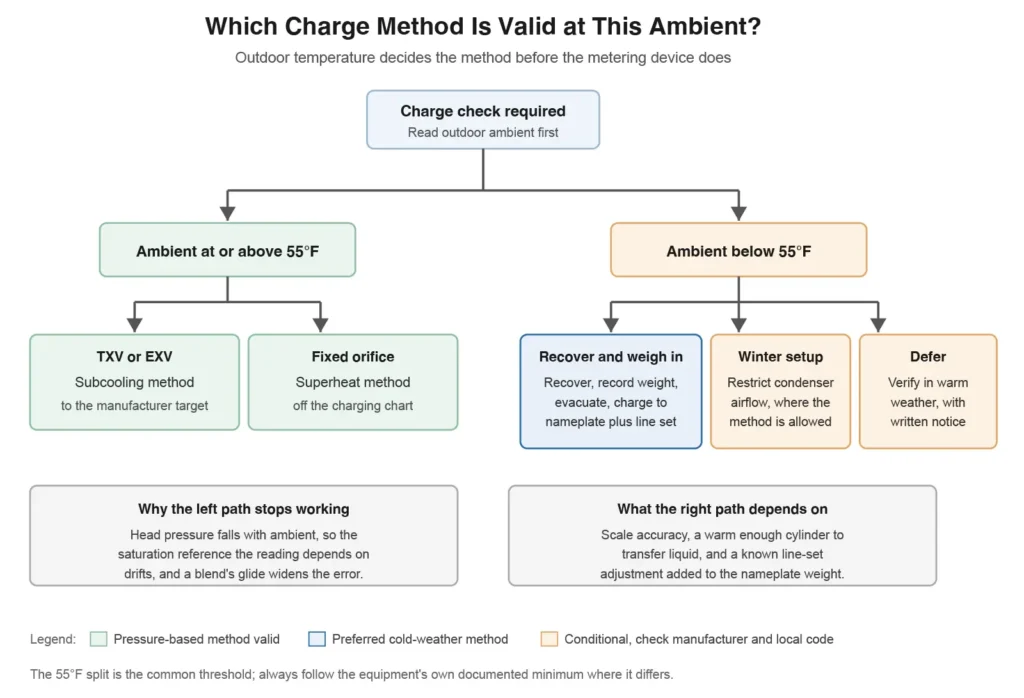
Yes — and not slightly. Below roughly 55°F outdoor ambient, the pressure-based methods most technicians use every day stop producing trustworthy numbers. Subcooling and superheat readings both depend on a saturation reference that moves with condensing pressure, and condensing pressure collapses as ambient falls. The gauge still reads something. It just no longer means what the charging chart says it means.
The practical answer is that in cold weather you stop verifying charge by pressure and start verifying it by weight: recover, record what came out, evacuate, and charge to the nameplate value plus a documented line-set adjustment. California’s Title 24 reference guidance sets the same line, requiring outdoor temperature of at least 55°F for the standard verification procedure and allowing the weigh-in charging procedure or a winter setup method when it is colder, with the option of deferring verification entirely as long as the customer gets written notice.
The rest of this article covers what actually breaks at low ambient, what breaks worse on a glide blend, how cold affects the cylinder and the scale before refrigerant ever reaches the system, how to run a weigh-in that holds up, and what to write on the ticket when the job cannot be verified until spring. Every one of these is a callback-cost question before it is a physics question.
What Actually Goes Wrong Below 55°F
Three separate things degrade at the same time, and they compound.
Condensing pressure falls with ambient. The condenser rejects heat to outdoor air, so as that air gets colder the condensing temperature drops and head pressure drops with it. Subcooling is measured against high-side saturation temperature, so the reference point the whole calculation rests on has moved — and it moves further the colder it gets. A subcooling number taken at 40°F ambient does not correspond to the same charge condition as the same number taken at 90°F.
Metering behavior changes. A TXV will try to hold superheat, but with a collapsed pressure differential across the valve it can lose capacity, hunt, or starve the evaporator. A fixed orifice has no control at all — its flow depends entirely on the pressure difference, which is now much smaller. The charging chart for a fixed-orifice system is indexed to outdoor dry bulb and indoor wet bulb, and most charts simply do not extend below the mid-50s because the manufacturer knows the relationship stops being usable there.
Refrigerant migrates and the system will not stabilize. In cold weather liquid collects in the coldest part of the circuit — usually the outdoor coil and the accumulator. Readings drift while that redistributes, and the time to reach steady state stretches well beyond what a tech budgets for a call.
Any one of these would make a reading questionable. Together they make it noise. The standard trade guidance on refrigerant charging basics notes that a properly running system with indoor and outdoor temperatures above 68°F will show suction saturation above 32°F — below that, you are no longer looking at a normal operating envelope, and additional diagnostics come before any charge adjustment.
Why Glide Blends Make It Worse
If the system is on a zeotropic blend, low ambient stacks a second error source on top of the first. A blend does not have one saturation temperature at a given pressure; it has a bubble point and a dew point, separated by the glide. Subcooling is calculated off the bubble point and superheat off the dew point, and using the wrong one — or a gauge set configured for the wrong one — puts a fixed offset into every reading.
R454B carries roughly 1.5°F of glide between bubble and dew, and the analysis of why subcooling fails below 55°F on R454B notes that calculation error from treating a glide refrigerant as a single-point refrigerant compounds as ambient drops, while A2L systems can take up to 60 minutes to reach steady state in cold weather against 15 to 20 minutes for R410A. An hour of stabilization per reading is not a scheduling problem you solve by reading sooner; it is the reason the weigh-in exists.
The same piece notes that manufacturer service bulletins now point at recover-and-weigh-in for cold-weather A2L work rather than at a corrected subcooling procedure. That is the right conclusion to draw: when the measurement has two independent error sources that both grow with cold, the fix is a different measurement, not a correction factor.| Method | What it depends on | How cold weather breaks it |
|---|---|---|
| Subcooling (TXV, EXV) | Liquid line temperature against high-side saturation | Condensing pressure collapses, so the saturation reference drifts and the target no longer applies |
| Superheat (fixed orifice) | Charging chart indexed to outdoor dry bulb and indoor wet bulb | Most charts do not extend into the low range, and orifice flow falls with the pressure differential |
| Approach (some equipment) | Liquid line temperature minus outdoor ambient | Assumes a normal condensing envelope that low ambient removes |
| Weigh-in | Scale accuracy, nameplate charge, line-set adjustment | Not broken by ambient; affected instead by cylinder temperature and scale handling |
The Cylinder Problem Nobody Budgets Time For
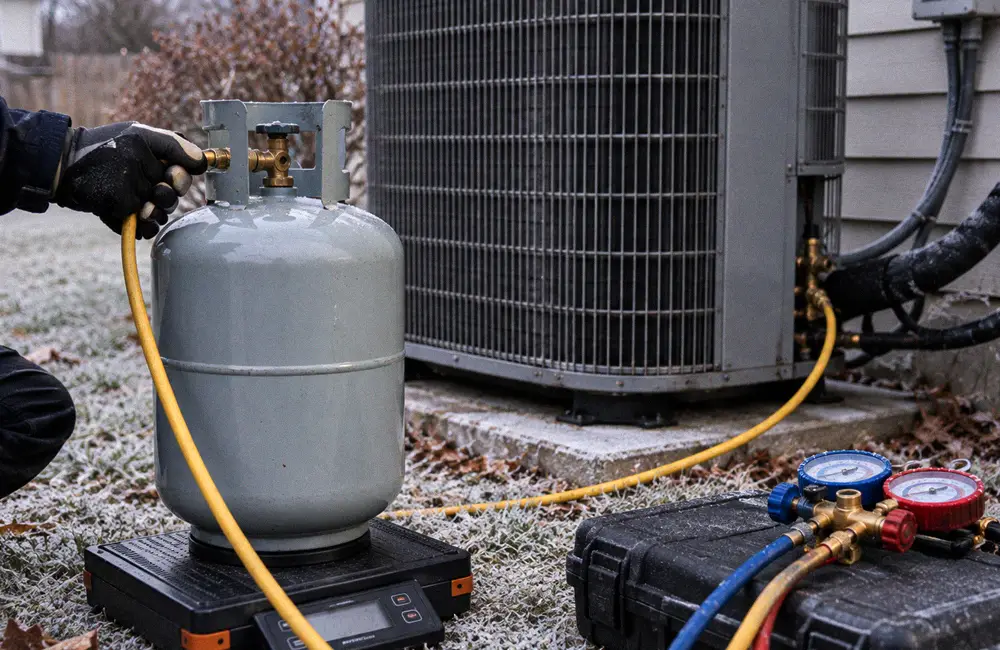
Before any of this reaches the system, cold has already changed the cylinder. Refrigerant pressure in a tank is saturation pressure at the tank’s own temperature. A cylinder that has ridden in an unheated truck bed overnight is sitting at whatever the ambient was, and its pressure is low enough that transfer into the system slows to a crawl or stalls entirely once system pressure approaches it.
Technicians handle this in three ways, in descending order of how much you should like them:
Keep cylinders warm before the job. Storing charging cylinders in the cab or in a heated compartment overnight is the cheap, safe fix and it removes the problem before the truck leaves the shop. This is a stocking and truck-loading decision, not a field technique.
Use a controlled warm-water bath. Warm — not hot — water around the cylinder raises its temperature and therefore its pressure. Never exceed what the cylinder’s own documentation permits, never use an open flame, a torch, a heat gun, or boiling water, and never leave a cylinder unattended in a bath.
Use the system to help. On a recover-and-recharge, charging liquid into the high side while the system is off, then finishing on the low side with the system running, avoids fighting the tank pressure for the bulk of the charge.
There is one more thing cold does to the cylinder that matters for accuracy: the last few ounces come out slowly and unevenly, so the natural temptation is to call it close enough. On a small residential system, being an ounce or two off is inside the tolerance. On a light-commercial unit with a long line set and a small nameplate charge relative to line volume, it is not. Weigh the cylinder before and after and record both numbers.
Charge Every Blend as a Liquid — Especially in Winter
This is standard practice year-round and it becomes more consequential in cold weather, because slow transfer tempts people into vapor charging to move things along.
Pulling vapor off a zeotropic blend removes the more volatile component preferentially, so what stays in the cylinder and what enters the system are both off-composition. The system then runs on a mixture that no longer matches its pressure-temperature chart, and every subsequent reading — including the one taken next spring in good weather — is wrong. The guidance in the trade literature is unambiguous: charge in the liquid phase with the tank inverted, metering it in slowly so the compressor is never slugged.
In practice that means a metering device or a controlled crack of the valve on the low side with the system running, or high-side liquid charging with the system off. It does not mean standing the tank upright because the liquid is coming out slowly. If transfer has stalled, the answer is a warmer cylinder, not a change of phase.
The Weigh-In, Done Properly
The weigh-in is only as good as the number you charge to, and that number is rarely just the nameplate.
Establish the target before you recover
Nameplate charge is the factory charge for the condensing unit with a specified line-set length — commonly 15 or 25 feet, stated on the data plate or in the installation instructions. Anything beyond that gets an addition. Manufacturer long-line guidance gives the rate per foot by line size; the Goodman long line set application guidelines list 0.67 oz per foot for a 3/8-inch liquid line with a 3/4-inch suction line as one example, and also require insulating the liquid line where more than 50 feet of it passes through an area that can run 30°F or more above outdoor ambient. Use the documentation for the equipment in front of you; the rate changes with liquid line diameter and the figures are not transferable between manufacturers.
Measure the line set. Do not estimate it from the outside of the house, and do not trust what the last tech wrote unless it is specific enough to check.
Recover and record
Recover into a weighed cylinder and record the weight recovered. That number is diagnostic in itself: it tells you whether the system was low, correct, or overcharged before you touched it, which is exactly what the customer’s complaint hinges on and exactly what nobody documents. Recovery is also a compliance matter — venting is prohibited under EPA’s stationary refrigeration venting rules, and the work requires the appropriate Section 608 technician certification.
Cold slows recovery too. A cold system holds refrigerant in liquid form in the coldest components, so recovery runs longer and the machine pulls against a lower source pressure. Budget for it rather than stopping short and calling the cylinder weight the system charge.
Evacuate with cold in mind
Two things change. Any moisture in the system is more likely to be frozen, and frozen water does not leave under vacuum until it sublimates, which is slow. And vacuum pump oil thickens in the cold, reducing the pump’s ability to reach and hold a low micron level. Keep the pump warm, use fresh oil, use large-diameter hoses or a core removal tool, and hold the standing vacuum test long enough to prove the system is dry rather than temporarily low. A rising micron reading that plateaus is a leak; one that climbs steadily is moisture.
Charge to the target and verify the weight, not the pressure
Charge liquid to the calculated total, watch the scale, and stop at the number. Then let the system run and record what the pressures and temperatures actually are at that ambient — not to adjust the charge, but to create a baseline for the follow-up visit.| Step | What cold changes | What to do about it |
|---|---|---|
| Recovery | Refrigerant sits as liquid in cold components; source pressure is low | Allow more time; do not stop short and treat the partial pull as the system charge |
| Evacuation | Moisture may be frozen; pump oil thickens | Warm pump, fresh oil, large hoses, longer standing vacuum test |
| Cylinder transfer | Tank pressure is saturation pressure at tank temperature, so transfer stalls | Store cylinders warm; controlled warm-water bath only, never open flame or boiling water |
| Scale reading | Battery output drops and displays respond slowly in the cold | Warm batteries, level the scale, shelter it from wind, zero it on site |
| Final verification | Pressure-based confirmation is not valid at this ambient | Record conditions as a baseline and schedule warm-weather verification |
Your Scale Is a Cold-Weather Variable Too
A weigh-in that replaces a pressure measurement is only better if the scale is trustworthy, and field scales are not immune to winter.
Battery chemistry loses output in the cold, which is the most common cause of a scale that reads erratically or drops out mid-charge. Keep spare batteries in a pocket rather than in the truck. Displays respond more slowly at low temperature, so the number you are watching can lag the refrigerant actually moving — wait for it to settle rather than closing the valve on a trailing reading.
Then there is placement. A scale sitting on frozen, uneven ground, or in wind, or with the hose pulling on the cylinder, reads what those forces tell it. Level the platform, keep the hose slack, block the wind, and zero the scale on site with the cylinder in position rather than trusting a zero from the shop.
None of this is exotic. It is the kind of thing that gets skipped on a cold call and then produces a charge that is three or four ounces off with nothing in the paperwork to explain it.
Heat Pumps in Heating Mode
Winter service on a heat pump raises the obvious question: can you verify charge in heating mode, since that is the mode the system is actually running?
The honest answer is that it depends entirely on the equipment. Some manufacturers publish a heating-mode charging procedure with its own target values and its own valid ambient range. Many do not, and for those the heating-mode readings have no published target to compare against. There is no generic heating-mode subcooling rule to fall back on, and inventing one produces a system that is wrong in both seasons.
So on a heat pump in winter: if the manufacturer publishes a heating-mode procedure and the conditions fall inside its stated range, follow it exactly. If not, weigh in. Recording charge weight, line-set length, and the conditions observed gives the next tech something real to work from, which a heating-mode subcooling number pulled out of habit does not.
Defrost adds a complication worth naming. A system that is cycling through defrost is not at steady state in any useful sense, and readings taken during or immediately after a defrost cycle describe the defrost, not the charge. Let the system complete a cycle and run in steady heating before recording anything.
The Winter Setup Method — and Its Limits
There is a middle path between a pressure check and a full weigh-in: artificially raise the condensing pressure so the system operates in a range where the pressure-based method is valid again. The usual technique is restricting airflow at the condenser fan outlet, which California’s Title 24 reference guidance describes as a winter setup procedure for systems with a TXV or EXV.
It works, within limits, and those limits matter:
- It applies to variable metering devices. A fixed-orifice system has no valve trying to hold superheat, so simulating warm conditions does not make its charging chart valid.
- It is a controlled restriction, not a blocked coil. You are targeting a normal condensing range, not the highest pressure you can produce. Overshooting risks high-pressure trip, compressor stress, and a charge set against the wrong reference in the other direction.
- The manufacturer’s own documentation governs. If the equipment’s literature does not sanction the technique, the weigh-in is the defensible choice.
- It takes time. The system has to stabilize at the simulated condition, and that stabilization is slower in cold weather for exactly the reasons already covered.
For a single changeout where the customer is standing there, the winter setup can save a return trip. For a fleet of shoulder-season installs, a weigh-in standard is faster to train, faster to audit, and does not depend on a technician’s judgment about how much restriction is enough.
What to Put on the Ticket
A cold-weather charge job that is not documented is a warranty argument waiting to happen, because the next tech has no way to tell a correct weigh-in from a guess.
Record, at minimum: outdoor ambient and indoor conditions at the time of work; the weight recovered; the nameplate charge and the source you read it from; the measured line-set length and the adjustment rate applied; the total charged; the pressures and temperatures observed after charging, labeled as a cold-ambient baseline rather than a verification; and the scheduled follow-up. If verification was deferred, the customer gets that in writing — the Title 24 guidance treats written notice as the condition for deferring, and it is good practice regardless of whether your jurisdiction requires it.
That paperwork does two things. It protects the technician who did the work correctly, and it tells whoever returns in April what they are checking against. Refrigerant Centers sees the downstream version of this constantly: a spring no-cool call on a system charged in February where nobody can say what went in, so the second visit starts with a recovery it should not have needed.
If a job needs order paperwork or cylinder documentation sorted out before a scheduled changeout, Support@RefrigerantCenters.com can handle that side ahead of the truck being loaded.
Frequently Asked Questions
Is it too cold outside to run my AC for a charge check?
For a pressure-based check, yes, below about 55°F outdoor ambient. The system may run, but the readings no longer map to the charging chart. The equipment’s own documented minimum governs where it differs from that general threshold.
Can you check subcooling below 55 degrees outdoor ambient?
You can take the reading; you cannot rely on it. Condensing pressure has fallen far enough that the saturation reference the calculation depends on no longer corresponds to the target value, and on a glide blend the error grows further.
How do you charge in cold weather without gauges?
By weight. Recover the existing charge and record it, evacuate, then charge to the nameplate value plus the documented line-set adjustment, using a scale. Gauges still come out — to record a baseline, not to set the charge.
Does refrigerant cylinder temperature affect how much goes in?
It affects how fast and how completely it transfers, not how much the system needs. A cold cylinder has low saturation pressure and will stall as system pressure rises, which is why partial charges and “close enough” ounces show up on winter tickets.
Can I warm a refrigerant cylinder to speed up charging?
Only with a controlled warm-water bath within the limits the cylinder’s documentation allows, and never unattended. No open flame, torch, heat gun, or boiling water. Storing cylinders warm before the job avoids the problem entirely.
Does cold weather affect evacuation as well as charging?
Yes. Moisture may be frozen and will not leave under vacuum until it sublimates, and vacuum pump oil thickens, reducing the pump’s ability to hold a low micron level. Expect longer pull-downs and a longer standing vacuum test.
Can I verify a heat pump’s charge in heating mode in winter?
Only if the manufacturer publishes a heating-mode procedure and the conditions are inside its stated range. There is no generic heating-mode target, and readings taken during or right after defrost describe the defrost cycle rather than the charge.
Should I come back in warm weather to verify?
On any cold-weather weigh-in where a pressure-based check could not be run, yes — and say so in writing at the time of the work. The return visit is short if the paperwork from the first one is complete.
Conclusion
Read ambient before you read a gauge. Above the equipment’s documented minimum, run the normal method for the metering device in front of you. Below it, the reading is not evidence — weigh in, keep the cylinder warm enough to transfer liquid, treat the scale as an instrument rather than a bathroom scale, and write down enough that the spring visit is a confirmation instead of an investigation.











