
Yes—an air conditioner can appear to cool normally with slightly low refrigerant, particularly when cooling demand is modest. It may produce cold air, reach the thermostat setting, and keep occupants comfortable while its refrigerant charge is below the equipment manufacturer’s specification.
However, normal comfort is not the same as a verified correct charge. It tells you that the system is meeting the building’s current needs, not necessarily that it is delivering its intended capacity or efficiency.
The reverse matters, too: a system should not receive more refrigerant simply because someone describes a pressure reading as “a little low.” A genuine undercharge needs to be distinguished from changing operating conditions, measurement error, and other equipment problems.

Why Slightly Low Refrigerant Can Go Unnoticed
Cooling performance is not simply an on-or-off condition. A system can continue removing heat even when its charge is imperfect.
The building may need less cooling than the system can still provide
Consider a small office on a mild morning. The windows are shaded, few people have arrived, and indoor equipment is generating little heat. An AC with some lost cooling capacity may still satisfy that relatively small load.
Later, sunlight, warmer outdoor conditions, and increased occupancy may raise demand enough to reveal a problem.
This is a capacity-versus-load explanation, not a diagnostic test: if available cooling remains greater than the current load, the room can stay comfortable. It does not establish how much refrigerant is missing—or whether refrigerant is the problem at all.
The metering device can make early symptoms less obvious
A thermostatic expansion valve, or TXV, regulates refrigerant flow in response to evaporator outlet conditions. Within its operating range, that regulation can make some readings look relatively normal despite changes elsewhere in the system.
The Fieldpiece ASX14 operating manual explains that TXV systems regulate superheat, which is why subcooling is an important charge indicator on those systems.
A reasonable implication is that acceptable superheat alone cannot rule out a mild undercharge. The valve cannot replace missing refrigerant, and its ability to regulate flow has limits.
Fixed-orifice systems behave differently. Their charge assessment commonly involves manufacturer-specified superheat procedures rather than treating a TXV charging method as universal.
Small changes can be difficult to notice
Most occupants do not keep a weather-adjusted record of cooling cycles or indoor humidity. A gradual change may blend into ordinary variations in weather and building use.
“It still feels fine” is useful information for the technician. It just answers a different question from “Is the charge correct?”
What Does “Slightly Low” Actually Mean?
“Slightly low” is often an impression rather than a complete diagnosis.
It might mean that:
- A measured charging value is outside the manufacturer’s target.
- An installer suspects an initial charge adjustment was missed.
- A previous service record shows refrigerant loss.
- Someone has interpreted a single pressure reading without enough supporting measurements.
Those situations should not be treated as equivalent.
The amount missing also needs context. The same refrigerant mass represents a different share of the total charge in a small system than in a larger one. Equipment design, piping configuration, and manufacturer tolerances matter.
There is no universal percentage that every AC can safely lose while remaining “normal.” Nor should a value within an approved operating tolerance automatically be labeled an undercharge.
A useful question to ask is:
“Which measurement shows the charge is low, and what manufacturer target are you comparing it with?”
That invites an evidence-based explanation without assuming the diagnosis is either right or wrong.
What Normal-Looking Behavior Can—and Cannot—Tell You
| Observation | What It Suggests | What It Does Not Prove |
|---|---|---|
| The thermostat reaches its setting. | Cooling is sufficient for the present load. | Full capacity or correct charge under all conditions. |
| Supply air feels cold. | The system is producing a noticeable cooling effect. | Adequate airflow or total heat removal. |
| One pressure reading looks normal. | That measurement is plausible for the observed conditions. | The correct refrigerant quantity. |
| There is no visible ice. | No icing is visible at the inspected locations. | A leak-free or correctly charged system. |
These distinctions follow the whole-system diagnostic approach described in the Department of Energy’s air-conditioner diagnostics guide, which explains that interacting faults can produce misleading charge indications.
Why cold air is not a complete performance test
The temperature of the air leaving a register is only part of the picture. Cooling performance also involves how much air is delivered and how the system handles moisture.
A brief hand check cannot separate those factors. Neither can one generic supply-to-return temperature difference establish the charge on every installation.
For an owner or facility manager, observations are most useful when they describe a pattern: which rooms are affected, when discomfort occurs, and whether performance has changed under similar conditions.
When a Hidden Problem May Become Noticeable
A system that seems satisfactory under light demand may become less convincing during hotter weather or after the building has warmed up.
Possible changes include longer recovery after a thermostat setback, difficulty maintaining the setting, or cooling that gradually deteriorates. These are reasons to investigate, not proof of low refrigerant.
Carrier’s home AC recharge guidance identifies poor cooling, extended operation without adequate cooling, and icing as possible warning signs. Similar symptoms can also come from unrelated faults.
Avoid judging the system from one unusually hot afternoon. Compare conditions where possible:
- Was the thermostat setting the same?
- Were doors and windows closed?
- Had occupancy or equipment use increased?
- Was the filter condition similar?
- Did the change begin after installation or service?
Those details help distinguish a developing equipment problem from a change in demand.
How a Technician Confirms a Mild Undercharge
The goal is to verify the diagnosis before changing the charge.
Start with airflow and operating conditions
A refrigerant assessment should account for filter restriction, blower operation, coil condition, and airflow. Testing conditions also need to fall within the equipment manufacturer’s permitted range.
Fieldpiece’s whole-system troubleshooting guidance recommends checking airflow before refrigerant charge because airflow problems can affect the readings used to evaluate charge.
A frozen coil, unstable operation, or unsuitable test conditions may need to be addressed before a charging conclusion is meaningful.
Use the equipment’s specified method
Depending on the system, the procedure may involve measured superheat, subcooling, weighed charge, piping allowances, or a dedicated service mode.
The technician should identify the applicable method rather than chase a generic pressure value. Useful service documentation includes the target, actual readings, test conditions, and any adjustment made.
You do not need to interpret every technical value yourself. Ask for an explanation that connects the measurements to the recommendation:
“Airflow was checked, this is the specified target, and these readings show why a correction is necessary.”
That is more informative than “It needed a little gas.”
If the Charge Is Low, Find Out Why
A sealed AC system circulates refrigerant; it does not normally consume it. A confirmed shortage may reflect leakage, an incorrect original charge, or refrigerant lost during previous work.
The service history helps distinguish these possibilities. A newly installed system that was never properly commissioned raises different questions from a previously verified system that has lost charge.
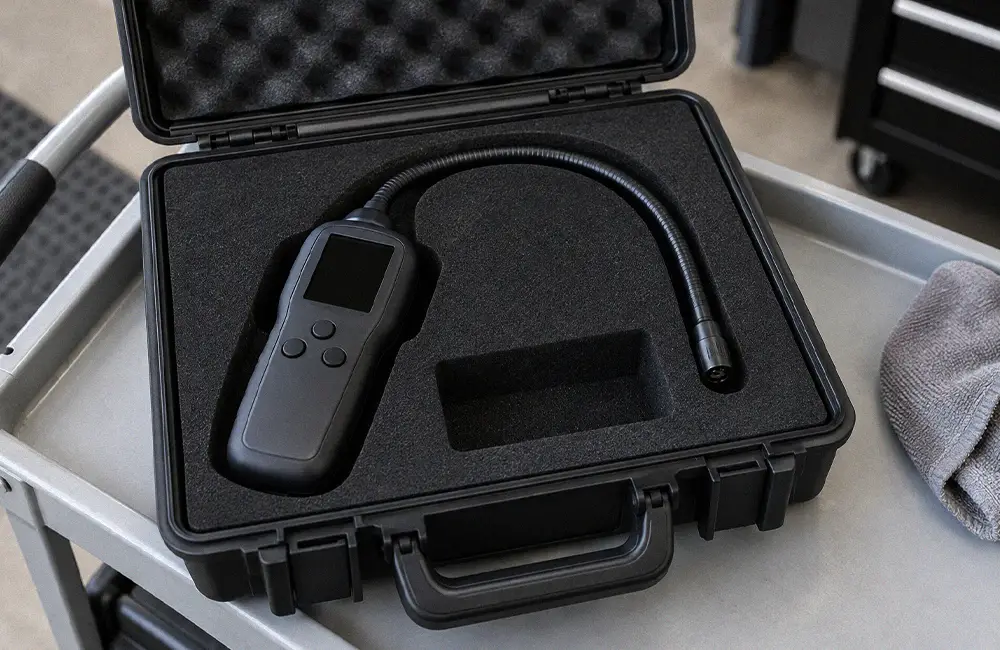
There does not need to be a visible puddle or obvious hole. Electronic instruments can help locate refrigerant escaping from a circuit; INFICON’s leak-detector documentation describes both area searching and pinpoint leak detection.
A detected leak and an undercharge are related findings, but they are not identical measurements. Finding a leak does not, by itself, quantify the amount missing.
If leakage is confirmed, agree on a repair and verification plan. Repeated additions without resolving the cause can leave the underlying problem active.
Should You Keep Running the AC?
Do not treat “still cooling” as permission to ignore a confirmed fault.
Arrange prompt service when an undercharge or leak has been established. Ask the technician whether operation should stop based on the actual equipment condition.
If the system develops ice, abnormal mechanical noise, repeated protective shutdowns, or a serious loss of cooling, stop cooling operation and have it assessed. Do not repeatedly restart it to see whether the problem disappears.
There is no reliable countdown from “slightly low” to equipment damage. Our guide to how long an AC can run with low refrigerant explains why runtime depends on more than the amount missing.
Leave refrigerant handling to a qualified professional. The EPA’s Section 608 certification requirements cover technicians performing relevant service activities, including attaching gauges and adding or removing refrigerant from covered stationary equipment.
Choosing Service Refrigerant After Diagnosis
Material selection comes after confirming the equipment requirements and the repair plan.
For an existing system specified for R410A, qualified service professionals can review R410A refrigerant in a 25 lb cylinder. The cylinder’s net contents are a purchasing quantity—not the amount to add to an individual AC. The required charge remains equipment-specific.
Refrigerant Centers also organizes products by air-conditioning and heat-pump applications. Contractors sourcing materials for different jobs can check the complete refrigerant selection after identifying each system’s specified refrigerant.
These pages support material selection, not diagnosis or substitution. Do not choose a different refrigerant because its name, operating pressure, or price appears similar.
Frequently Asked Questions
Can low refrigerant exist without warm air from the vents?
Yes. An undercharged system can still produce cool air. Vent temperature alone cannot establish the charge or show whether full cooling performance is available.
Does reaching the thermostat setting rule out a leak?
No. It shows that the system met the current temperature demand. A small leak may exist before occupants notice a clear comfort problem.
Should an AC receive refrigerant during every tune-up?
No. Refrigerant addition should address a verified need, not be an automatic seasonal maintenance step. If repeated additions are proposed, ask what is causing the shortage.
Can a small refrigerant addition make performance worse?
Yes, if the diagnosis is wrong or the addition exceeds the specified charge. “Just a little more” is not a substitute for a valid charging procedure.
Does slightly low refrigerant mean the compressor is already damaged?
Not necessarily. A confirmed undercharge warrants attention, but it does not establish that damage has occurred. Compressor condition requires its own assessment.
Conclusion
An AC can feel normal with slightly low refrigerant because present cooling demand may be modest and the early effects may be difficult to notice.
The right response is neither to ignore a verified shortage nor to add refrigerant based on guesswork. Confirm the diagnosis, investigate the cause, and follow the equipment manufacturer’s charging procedure.
For Refrigerant Centers readers, the key distinction is simple: comfortable today does not prove correctly charged—but suspected undercharge is not a diagnosis until the measurements support it.











