Published August 31, 2026
R134a remains a capable automotive air-conditioning refrigerant when it is used in a vehicle designed for it. A healthy R134a system can deliver fast cabin cooldown, stable highway performance, and effective humidity removal. Its biggest limitation is not basic cooling ability—it is a high global warming potential that has moved new vehicle production toward lower-GWP alternatives.
That distinction matters. R134a is still widely relevant for servicing the existing vehicle fleet, but it should never be treated as a universal replacement for R1234yf, R12, or an unidentified refrigerant.
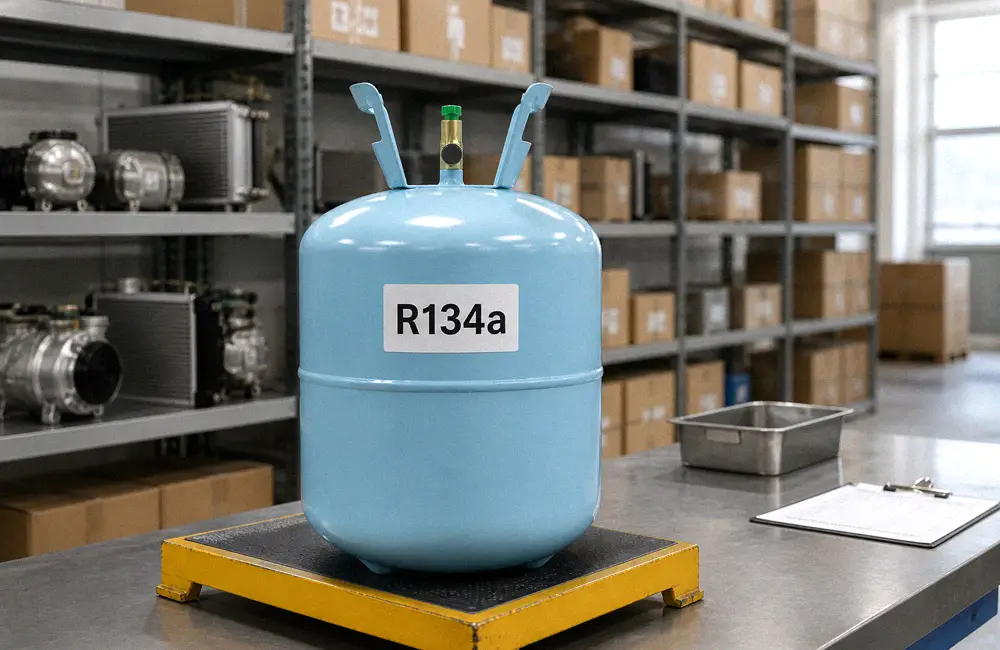
The Bottom Line
R134a is a strong choice for technicians, repair shops, and fleet operators servicing vehicles whose underhood labels specify R134a. It offers predictable operation, established service procedures, broad equipment familiarity, and good real-world cooling when the entire AC system is functioning correctly.
It is not the right choice for:
- Vehicles factory-filled with R1234yf
- Systems containing an unidentified or contaminated refrigerant
- R12 vehicles that have not received a documented retrofit
- New equipment designed around a different refrigerant
- Repairs intended to mask a leak or mechanical fault with repeated top-offs
In short, R134a remains useful because millions of compatible vehicles are still in service—not because it can be installed in every automotive AC system.
R134a at a Glance
R134a is a single-component hydrofluorocarbon refrigerant. Unlike older R12, it contains no chlorine and has zero ozone depletion potential. It is also classified as A1 under the ASHRAE safety system, indicating lower toxicity and no flame propagation under the classification test conditions.| Property | R134a | Practical Meaning |
|---|---|---|
| Refrigerant type | Single-component HFC | No blend fractionation during normal charging |
| ASHRAE safety class | A1 | Lower toxicity and no flame propagation under classification conditions |
| Normal boiling point | −14.9°F (−26.1°C) | Allows heat absorption at low evaporator temperatures |
| Ozone depletion potential | 0 | Does not directly deplete stratospheric ozone |
| 100-year GWP | 1,430 | Releases have a substantial climate impact |
| Primary automotive role | Servicing compatible existing vehicles | Check the vehicle label before connecting equipment |
Technical data source: Arkema’s Forane R134a specifications and the EPA refrigerant comparison.
How R134a Produces Cabin Cooling
R134a does not create cold directly. It moves heat from the passenger compartment to the outside air through a vapor-compression cycle.
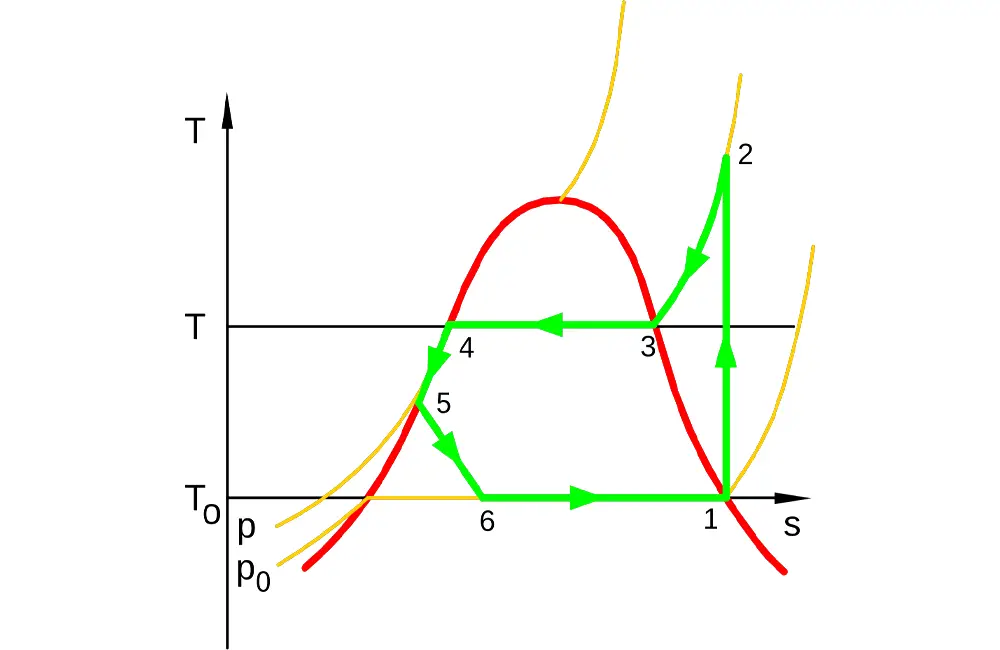
The compressor circulates refrigerant vapor and raises its pressure. The condenser then releases heat to outside air, allowing the refrigerant to become a high-pressure liquid. After passing through an expansion device, its pressure and temperature fall. Inside the evaporator, the refrigerant absorbs heat from cabin air before returning to the compressor.
That cycle also removes moisture. As warm, humid air crosses the cold evaporator, water condenses on its surface and drains away. This is why properly operating automotive AC can make the cabin feel more comfortable even before it reaches its lowest temperature.
What Cooling Performance Feels Like on the Road
A correctly charged R134a system can cool a hot cabin quickly, but refrigerant type is only one part of the result. Real-world performance depends on ambient temperature, humidity, engine speed, condenser airflow, blower operation, cabin volume, solar load, recirculation settings, and the condition of the system.
Drivers may notice three different phases:
- Initial pull-down: The system must remove heat from seats, trim, glass, and hot cabin air. Vent temperature alone does not describe this entire load.
- Stabilization: Once interior surfaces cool, the system can maintain a more comfortable cabin temperature with less demand.
- Low-speed or idle operation: Cooling may weaken if condenser airflow is poor, a cooling fan is malfunctioning, or the compressor cannot maintain the required capacity.
A system that cools while driving but warms at idle may have an airflow or control problem rather than a refrigerant problem. Likewise, weak cooling can result from a leaking compressor seal, restricted expansion device, contaminated condenser, failing clutch, sensor fault, damaged fan, or incorrect refrigerant charge.
The refrigerant charge must match the vehicle specification. Both undercharging and overcharging can reduce performance. Excessive refrigerant can increase high-side pressure and reduce condenser capacity, while too little refrigerant can starve the evaporator and interfere with oil circulation. Sanden’s automotive compressor service guide emphasizes correct refrigerant and lubricant handling because inadequate lubrication and improper charging practices can damage a compressor.
Where R134a Still Belongs
The correct refrigerant should be determined from the vehicle’s underhood AC label, service information, and—when contamination is possible—a refrigerant identifier.| Vehicle or System | Use R134a? | Required Approach |
|---|---|---|
| Vehicle labeled for R134a | Yes | Follow the specified charge amount, oil type, and service procedure |
| Vehicle labeled for R1234yf | No | Use R1234yf-compatible equipment and procedures |
| Original R12 system | Only after a compliant retrofit | Recover the original refrigerant and install required fittings and labeling |
| Unknown or contaminated system | Not until identified | Test the refrigerant and isolate contaminated material |
Compatibility guidance source: EPA information on handling contaminated automotive refrigerants and retrofitting R12 systems.
There is no universal “drop-in” refrigerant for automotive AC. Different refrigerants may require different service fittings, labels, lubricants, recovery equipment, charge procedures, and system components.
R134a vs R1234yf
The comparison between R134a and R1234yf is often framed as a contest over which refrigerant feels colder. In practice, complete system design matters more than comparing refrigerants in isolation.
R134a has a long service history and is classified A1. R1234yf has a much lower GWP—approximately 4 compared with 1,430 for R134a—but carries an A2L classification, indicating mild flammability. Vehicles designed for R1234yf incorporate the refrigerant’s properties into their components, controls, service ports, labels, and prescribed procedures.
Neither refrigerant should be substituted based on cost, availability, or a belief that one will produce colder vent air. Installing the wrong refrigerant can contaminate service equipment, create unexpected pressure and lubricant behavior, and leave the vehicle out of compliance with its intended configuration.
Environmental and Regulatory Reality
R134a replaced ozone-depleting R12 in new US passenger vehicles during the 1990s. Its zero ozone depletion potential was a major environmental improvement, but its high GWP later became a concern.
EPA restrictions now apply to refrigerants with a GWP of 150 or greater in newly manufactured or imported light-duty passenger vehicles beginning with model year 2025, subject to the rule’s implementation date. That restriction does not require compatible vehicles already on the road to stop using R134a. The EPA explicitly states that existing vehicles may continue to be serviced with it in the United States. See the agency’s current acceptable MVAC refrigerants and impacts guidance.
Responsible handling is therefore central to R134a service. Preventing leaks, recovering refrigerant, repairing faults, and avoiding unnecessary releases preserve both the system’s performance and the environmental benefit of proper refrigerant management.
Service Quality Determines the Result
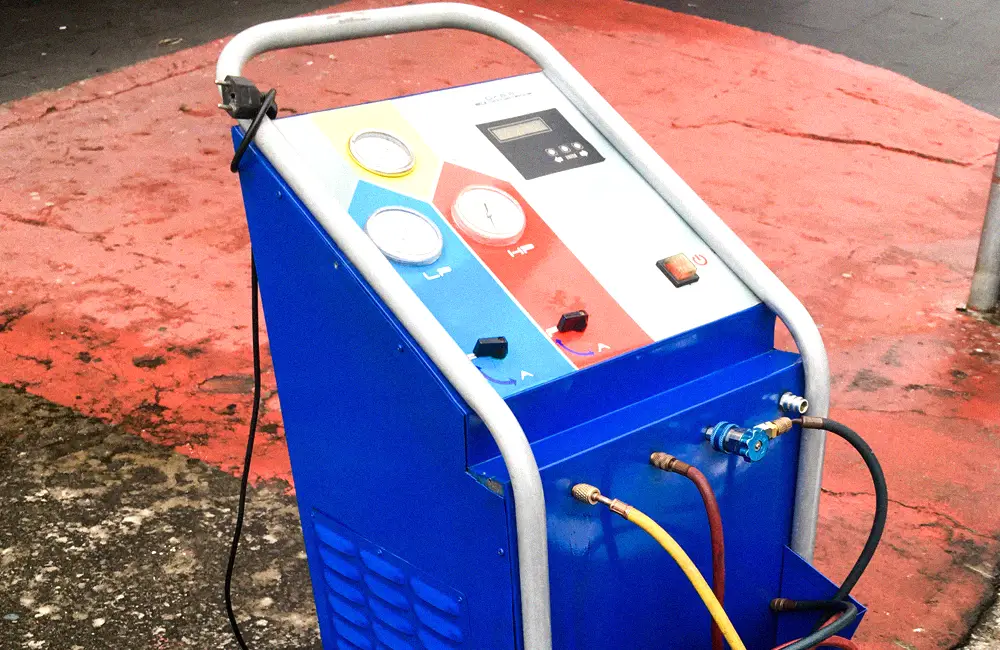
Professional R134a service involves more than attaching a charging hose. A proper workflow may include identifying the refrigerant, recovering the existing charge, measuring the recovered quantity, leak testing, repairing failed components, evacuating air and moisture, checking oil requirements, and charging the specified refrigerant mass.
Under EPA requirements, technicians who receive compensation for servicing motor vehicle air conditioners must have Section 609 certification and use approved equipment. Intentionally venting refrigerant is prohibited, and recovered refrigerant must be recycled or reclaimed before reuse. The EPA’s MVAC servicing requirements also address equipment certification, recovery practices, and refrigerant-specific fittings.
Adapters should not be used to defeat unique service fittings. Those fittings are part of the protection against accidental refrigerant mixing. If the system’s contents are uncertain, a refrigerant identifier should be used before connecting it to recovery equipment.
Who Should Buy a 30 lb R134a Cylinder?
A larger cylinder is primarily suited to professional repair facilities, certified mobile AC technicians, dealerships, agricultural or equipment service operations, and fleet maintenance departments that regularly service documented R134a systems.
Before purchasing, the user should verify:
- The vehicles or equipment are labeled for R134a
- Applicable technician certification requirements are satisfied
- Recovery and charging equipment is approved and compatible
- The operation can store the cylinder securely
- The expected service volume justifies a larger container
- Procedures are in place for leak repair and refrigerant recovery
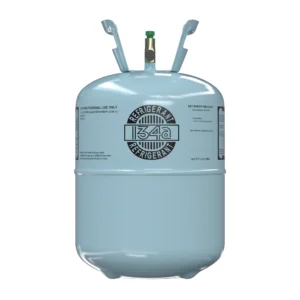
For qualified operations with recurring demand, Refrigerant Centers offers a 30 lb virgin R134a refrigerant cylinder. Purchasers should review applicable federal and local requirements before ordering or using refrigerant; additional purchasing guidance is available in the EPA refrigerant sales restrictions.
Frequently Asked Questions
Is R134a still legal for automotive AC service?
Yes. Although its use is restricted in newly manufactured or imported light-duty vehicles under current EPA transition rules, existing compatible vehicles may continue to be serviced with R134a.
Does R134a cool better than R1234yf?
Not as a universal rule. Cabin cooling depends on the entire AC system, including the compressor, condenser, evaporator, controls, airflow, charge accuracy, ambient conditions, and vehicle design.
Can R134a be mixed with R1234yf?
No. The refrigerants have different properties, safety classifications, service fittings, equipment requirements, and system designs. Mixing them contaminates the refrigerant charge and may contaminate recovery equipment.
Can R134a be added whenever cooling becomes weak?
Weak cooling should be diagnosed first. Refrigerant does not disappear through normal consumption; a low charge usually indicates leakage. Adding refrigerant without measuring the charge or repairing the fault can lead to continued leakage or overcharging.
Can an R12 vehicle be filled with R134a?
Only after a documented retrofit that meets applicable requirements. The original refrigerant must be properly recovered, and the system may require component, lubricant, fitting, and labeling changes. R134a should not simply be added to an operating R12 system.
Does the A1 classification make R134a harmless?
No. A1 is a safety classification, not permission for careless handling. Liquid refrigerant can cause frostbite, vapor can displace oxygen in confined spaces, pressurized containers require proper storage, and intentional venting is prohibited.
Final Verdict
R134a remains an effective refrigerant for the automotive systems designed around it. Its cooling performance is proven, its service behavior is familiar, and its large installed base ensures continued relevance for repair shops and fleet maintenance operations.
Its role, however, is now firmly tied to servicing existing compatible equipment. R134a’s high GWP makes leak prevention, recovery, and accurate charging especially important, while the transition to R1234yf means technicians must identify each vehicle’s refrigerant instead of relying on age or appearance.
Used in the correct system and handled by properly equipped personnel, R134a can continue delivering reliable cabin cooling for years. Used as an improvised substitute or repeated top-off, it can create poor performance, contaminated equipment, unnecessary emissions, and expensive repairs.