
A commercial ice machine with low production needs two separate checks: whether it is making the amount of ice expected for its exact model and operating conditions, and whether that amount reaches the business when demand peaks. A nearly empty bin does not prove a refrigeration fault. Record output, available storage, actual withdrawals and the conditions around the machine before approving a refrigerant service, a larger head or a bigger bin. Repair restores lost performance; resizing addresses a capacity shortfall; storage addresses the timing of supply.
This guide is for restaurant, bar, hotel and facilities managers arranging service or planning equipment expenditure. It covers commercial ice used for food and beverages, with modular cube machines as the main example. Flake, nugget, dispenser and specialized healthcare applications have different equipment and sanitation requirements. The goal is a defensible operating decision, not a staff charging procedure or a universal ice-machine troubleshooting chart.
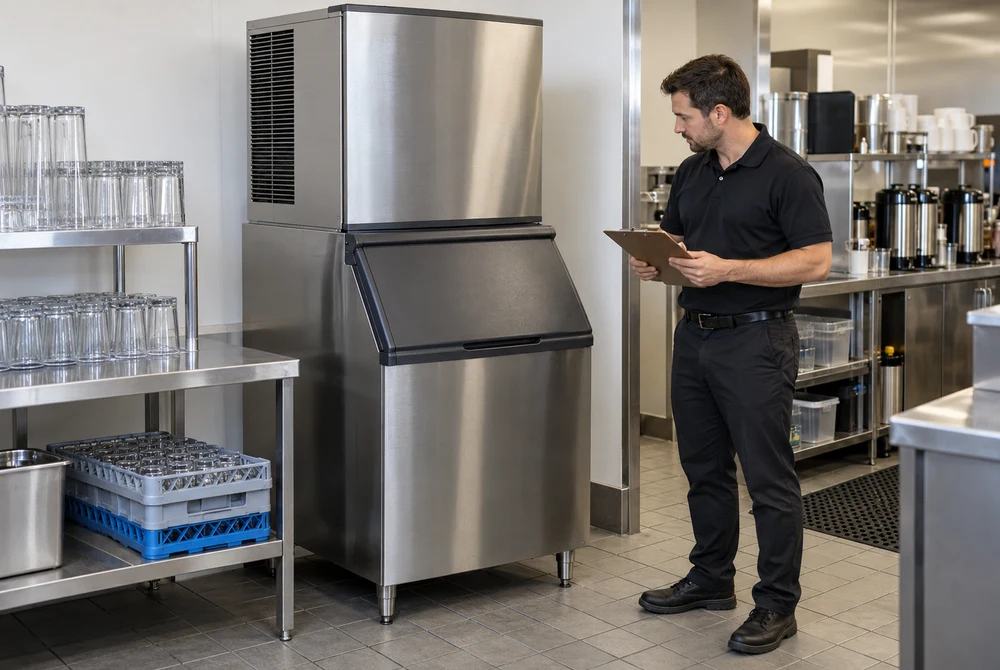
Start by identifying which shortage you have
Three situations can produce the same complaint: the bar runs out of ice before the end of service. The machine may have lost output compared with its own documented baseline. It may be working normally in a hotter installation but producing less than a favorable-condition advertising figure. Or it may make enough over a day while the available bin cannot carry the business through a short, heavy rush. These situations need different spending decisions.
Describe the complaint in time and quantity. “We had no usable ice at 8 p.m. on Friday” is a starting observation. Add the starting stock, approximate use during the shift, purchases of emergency ice, production interruptions and whether the bin recovered overnight. Do not convert a busy-shift impression into a precise pounds-per-day figure. If the records are incomplete, label them as estimates and plan the next observation.
| Pattern | Evidence to obtain | Likely decision path |
|---|---|---|
| Output fell under comparable conditions | Measured output and qualified diagnosis | Restore performance |
| Expected output; higher daily demand | Production conditions and total daily use | Review capacity and installation |
| Enough daily output; rush-hour shortage | Starting usable stock and peak withdrawals | Review storage and distribution |
| Ice piles near control; production stops | Approved bin/head arrangement and control assessment | Verify installation and operation |
The table organizes the investigation; it cannot diagnose the machine from a symptom. More than one problem may exist. A scaled machine can also serve a business that has outgrown its capacity. A larger bin can mask a slow production problem for part of a shift. Establish the current performance before judging whether an expansion would solve the remaining shortage.
Get the complete equipment identity
Find the full model, serial number, installed condenser arrangement and storage-bin model in the equipment file or on a safely accessible nameplate. Record the suffix, not just the brand or a rounded capacity class. An air-cooled model, a water-cooled variant and a remote-condenser version can share a family name while needing different installation conditions. A manual found for a similar-looking machine is not sufficient.
Keep the machine head and bin as separate assets in the record. Note whether there is a dispenser, adapter, chute or other approved interface between them. The head determines production; the installed storage and distribution arrangement determines how much ice staff can draw at a particular moment. A larger-looking enclosure is not proof of usable storage, and a model number on the bin does not identify the refrigeration system.
Collect the current manufacturer documents for the installed variant. The Hoshizaki KM-660MAJ product page, for example, identifies an air-cooled modular crescent machine and separately lists compatible bins. That illustrates why a headline production rating and a storage-bin designation should not be treated as the same specification. It is an identification example, not a recommendation to replace an unrelated machine with that model.
If the nameplate is missing or the history includes modifications, ask the service company to establish the equipment identity before selecting parts or refrigerant. Do not reconstruct a charge specification from cabinet size, the appearance of a cylinder left on site or a previous informal note. Preserve uncertainty in the work order so it is resolved rather than passed to the purchasing team as a fact.
Compare production at the conditions that actually matter
A rated daily output belongs to stated test conditions. The same machine can behave differently beside a cooking line, in a poorly ventilated service area or with warmer incoming water. The relevant comparison is the performance information for the exact installed model at the conditions observed during the shortage. A room thermostat elsewhere in the building may not describe the air entering the condenser.
Record the conditions when the complaint occurs, using safe observation or measurements arranged by the contractor. Include intake-area temperature, incoming-water temperature, the condenser arrangement, operating interruptions and whether nearby equipment or stored supplies affect the installation. Put measurement location and time beside each value. A morning reading taken before kitchen equipment starts cannot automatically explain an evening shortage.
Manitowoc’s January 25, 2021 sizing guidance explains that ambient air, supply-water temperature and the installation environment affect production, and discusses both larger storage and capacity changes. Apply that principle through the actual model documents. Do not transfer a percentage loss or a numerical example from one machine to another.
Distinguish an allowed operating range from a production guarantee. A machine may be permitted to run at a particular ambient temperature without achieving its highest advertised output there. Ask the supplier which performance table supports the proposed capacity at your demanding conditions, and which assumptions remain unverified. Where the published table does not cover the installation, obtain manufacturer or authorized supplier guidance rather than extrapolating a confident figure.
Measure output without confusing it with withdrawals
The change in bin inventory during a busy shift is not the machine’s production. If staff remove ice while the machine makes it, the end-of-shift stock reflects both movements. Melt, spills, transferred ice and emergency deliveries add further uncertainty. Before measuring, agree with the service company on a practical method that preserves food safety and normal controls and states exactly what the result represents.
For an operator record, separate starting usable stock, ice drawn for each use, outside ice added and ending usable stock. Estimates can help plan service, but they should not be presented as a certified performance test. A contractor may use model-specific batch measurements and cycle observations to assess production. That technical method should identify the relevant start-up period, stable operation and conditions rather than treating one unusually fast or slow cycle as representative.
Use clean, suitable containers and the operation’s approved handling process for any weighed ice. Establish the empty-container weight and the measurement units before starting. Record elapsed time, who collected the information and whether the machine stopped because the bin was full. Do not defeat the bin control or keep equipment running in an unapproved configuration to obtain a longer test. A measurement plan that requires that intervention belongs back with the qualified contractor.
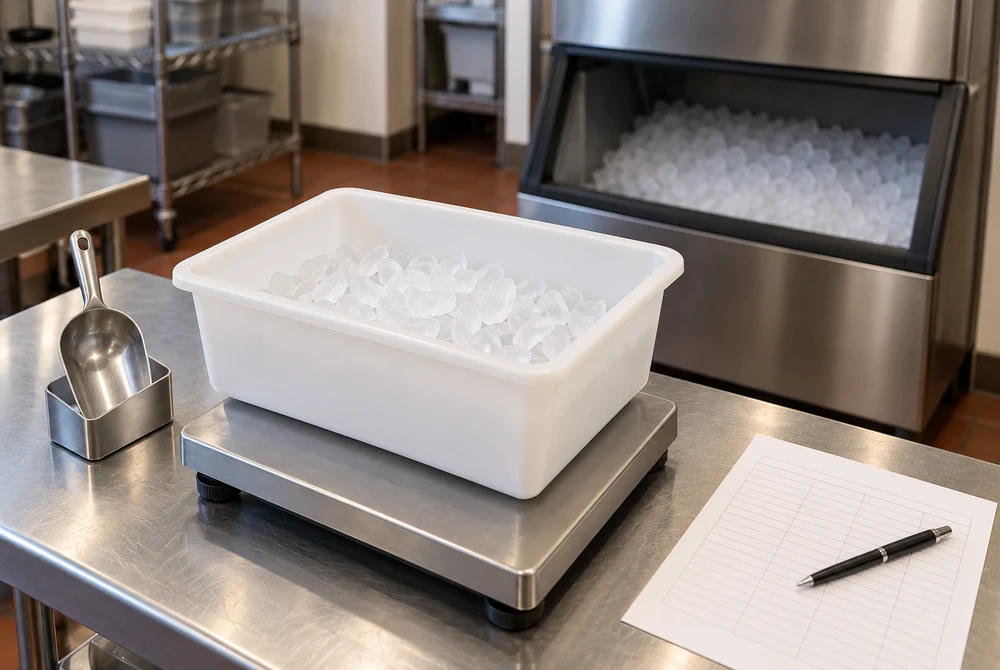
Report a limited observation honestly. If you measured a batch, call it a batch measurement. If you estimated stock by a container count, call it a stock estimate. Extending a short interval to a full day assumes that conditions, controls and operating time remain comparable; those assumptions may fail during service. A clear limited result is more useful than a precise-looking daily total built on unknowns.
Map when the business uses ice
List all uses, not only drinks sold. Include beverage service, preparation, displays where applicable, replenishment of satellite stations and other authorized uses. Identify the ice type required for each. A change in menu, delivery format or service pattern can alter demand even if the customer count remains similar. The machine may still be working as before while the business asks more of it.
Break the busiest representative shift into practical intervals. Record which station draws ice, when the largest withdrawals occur and whether staff have to make repeated trips to the main bin. The aim is to find the interval in which accessible supply falls behind use. Daily averages can hide a two-hour shortage. A bin that starts the rush partly empty has less ability to bridge that interval than the same bin starting with its normal usable stock.
Separate ordinary peak demand from an exceptional event. A banquet, equipment failure elsewhere or a one-time catering order may justify a temporary supply plan rather than a permanent replacement. Recurring Friday shortages deserve a design review based on recurring Friday conditions. Use a documented business assumption for planned growth, with the person approving that assumption named in the project record.
Include the recovery period between peaks. Storage is useful only if the machine can rebuild the required supply before the next draw. A larger bin does not increase the head’s production rate. If the business consumes more ice than the machine can make across successive days, adding storage alone postpones the shortage. If total production is adequate and the timing is the problem, storage or distribution may be the more relevant investment.
Check accessible installation changes before authorizing work
Work through a peak-period example
Consider an illustrative restaurant that starts its busiest interval with 80 pounds of usable ice. During the next two hours, measured additions from the machine total 30 pounds while recorded withdrawals total 100 pounds. Ignoring melt and other losses for this simplified example, the remaining stock is 10 pounds: 80 plus 30 minus 100. That calculation describes the stock balance for the interval. It does not establish the machine’s rated capacity or identify a fault.
If the business needs a larger reserve at the end of that interval, management must establish where the additional supply can come from. More starting stock may help if the machine can build it before service and the approved storage can hold it. More production during the interval may help if the existing head is genuinely undersized. Reduced avoidable losses or improved distribution may help if the recorded withdrawals include inefficient handling. Those options should be tested against the actual operation, not chosen from the arithmetic alone.
Now imagine the same restaurant reports that starting stock used to be adequate but the head recently takes much longer to replenish it. That adds a performance question before a storage purchase. Conversely, if verified output remains comparable and an expanded beverage menu substantially increases recurring use, the capacity question becomes stronger. Keep both histories in the assessment. The example numbers are invented to explain the method and are not a model rating, industry benchmark or recommended reserve.
Ask what changed shortly before the shortage began. Supplies may have been moved near air openings; nearby equipment may now reject more heat; a water-filter change may coincide with altered water delivery; or operating hours may have expanded. Record the sequence without declaring the most recent change guilty. A useful history narrows the contractor’s investigation while leaving the diagnosis open.
Staff can document visible conditions and keep approved access routes clear. They should not remove panels, reach into moving machinery, alter plumbing, bypass controls or change hidden settings. Water around powered equipment, damaged wiring, unusual odors or a suspected refrigerant release requires the site’s appropriate immediate response, not an extended production experiment. Keep an urgent safety issue separate from the longer capacity study.
Have the contractor compare the installation with the exact manufacturer’s clearance, water, drainage and utility requirements. Those requirements vary. Do not accept a universal clearance distance copied from another brand or a water-pressure value for a different variant. A proposed relocation should include the resulting utilities, access, sanitation and maintenance implications rather than only the available floor space.
Treat cleaning and sanitation as distinct work
A cleaning entry on an invoice needs enough detail to establish what was done. Descaling, cleaning food-contact surfaces, sanitizing and condenser maintenance are different tasks. A statement that the machine was “cleaned” may leave several of them unknown. Request the applicable procedure, areas addressed, completion date and instructions for returning the machine to service.
The current manufacturer-linked Hoshizaki instruction manual issued June 10, 2022 provides model-specific cleaning and sanitizing instructions and chemical-handling warnings. Use the manual matching the installed machine, approved chemicals and its required sequence. Do not borrow concentrations, cleaning positions or disassembly steps from a forum or another model.
The FDA Food Code 2022 and published supplement provide U.S. model guidance; the local authority’s adopted requirements and the establishment’s procedures govern the operation. A production test does not establish that ice is hygienically acceptable. If contamination is suspected, manage affected ice and service through the food-safety process before evaluating capacity.
For budgeting, ask whether water conditions require a different maintenance plan, and what evidence supports it. Filter choice and replacement interval should fit the machine and actual water conditions. Avoid assuming that a newly fitted filter proves adequate flow or that recurring scale proves a refrigeration defect. The service report should distinguish an observed condition, its correction and the production result afterward.
Write a service request that can produce an answer
Give the contractor the complete asset identity, shortage timeline, observed production pattern, conditions, maintenance history and known control changes. Include photographs of accessible equipment and records without personal customer information. Specify the operating question: has output fallen below the expected model performance, or does the installation need more capacity or storage? That question is more useful than requesting a predetermined part replacement.
Ask for the cause of lost production and the evidence behind the proposed repair. The manufacturer-linked Hoshizaki service manual separates low-production investigation into operating sequences and possible causes. It does not make slow ice production synonymous with low refrigerant. The qualified technician must use the installed model’s procedures and observations.
Request separate findings for water delivery, heat rejection, freeze and harvest behavior, controls and refrigeration where relevant. You do not need to tell the technician how to perform each test. You do need a report that explains which findings justify the expenditure. If previous settings were changed, ask the contractor to verify the correct documented configuration instead of asking staff to copy settings from the internet.
Agree on the follow-up observation before the visit ends. If the complaint appears after several busy shifts, a brief morning demonstration may not close it. Define what can be verified on the visit, what needs an operating-period observation, who records it and when a return call is due. Keep unresolved findings visible rather than treating a paid invoice as complete acceptance.
Keep refrigerant purchasing behind a verified diagnosis
Ice-machine refrigerant identity is model-specific. For the KM-660MAJ example, the current manufacturer page identifies R404A. That does not establish the refrigerant in a different model, revised variant or modified machine. The technician should reconcile the nameplate, service history and applicable documentation before ordering a material or approving any system change. Low output alone cannot determine the charge, a leak or the correct service quantity.
When a qualified technician has confirmed that an existing system requires R404A service, the Refrigerant Centers R404A product page provides the verified same-site supply reference. Confirm the required material, cylinder size and purchase eligibility before ordering. This link is a service-material next step, not permission to mix refrigerants or retrofit the machine. The cylinder quantity is not the machine’s charge.
EPA’s refrigerant sales guidance, updated March 23, 2026, distinguishes purchase eligibility for stationary equipment from motor-vehicle servicing. Arrange stationary refrigeration work with appropriately certified personnel and document eligibility as applicable. Do not treat possession of an automotive service credential or a small container as a general authorization for commercial ice-machine work.
For a confirmed service specification, the refrigerant catalog can support availability and product-document review. It cannot establish interchangeability. Our related explanation of why pressure alone does not establish the correct refrigerant charge is useful background when assessing an unexplained top-off proposal. Require the equipment-specific diagnosis and service plan first.
Decide when repair is enough
A repair is a reasonable route when the fault is established, the equipment can be restored to suitable performance, parts and service support are available, and the restored capacity fits the business. Ask the contractor to identify the expected result and the limits of the repair. Replacing a failed component does not promise favorable-condition rated production in a hotter kitchen.
Compare the repair quote with the cost of continued interruptions, emergency ice, service access and planned downtime. Use actual invoices and local quotes; do not apply an invented universal replacement percentage. Keep recoverable performance separate from capacity growth. A repair may be necessary to measure the existing machine fairly even if the business later chooses expansion.
If the quotation leaves diagnosis uncertain, ask what additional assessment would resolve that uncertainty and whether the proposed work is exploratory. That is different from a confirmed corrective repair. Record the approval basis so management understands what has been purchased. A sensible service relationship can tolerate uncertainty when it is stated clearly and has a defined next step.
Decide whether a larger bin would solve the peak
Consider storage when production across the relevant period can cover demand but available stock runs out during a concentrated draw. Establish the amount that can be prebuilt, the actual usable stock before the rush and the recovery before the next rush. Include the way staff reach the ice. A nominal storage figure does not guarantee that every pound is conveniently available at the point of use.
Confirm manufacturer-approved compatibility for the head, bin, adapter and any dispenser. Include support, access, sanitation, drainage and control behavior in the installation review. Do not assume that a head can be moved to any larger bin of similar width. The supplier should identify the supported combination and the installation requirements in writing.
Compare a storage change with better distribution where that is practical and approved. A satellite station may be short even while the main bin holds ice; repeated trips may be an access problem rather than a production shortfall. Any transfer process must preserve hygienic handling. The expansion brief should identify whether it is solving reserve quantity, staff access or both.
Decide when to resize or replace the machine
Review capacity when verified production under the demanding installation conditions remains below recurring daily demand, or when supported repair cannot restore dependable service. Describe the future operating pattern before comparing machines. Include ice type, busiest demand intervals, storage, seasonal conditions, utilities, noise, maintenance access and the planned service arrangement.
Ask each supplier to state the production basis used in the proposal and whether the existing location can support it. A remote-condenser option, water-cooled variant or higher-output head introduces installation choices that need professional evaluation. Do not assume one arrangement is automatically cheaper or suitable for every building. Include building approvals, water use where relevant, roof or exterior access where relevant, and the cost of ongoing service.
Compare complete installed systems rather than head prices alone. Include the approved bin or dispenser, adapters, utilities, water treatment, commissioning, maintenance and contingency supply during the changeover. If two proposals use different ice types or rating conditions, flag that difference before comparing their output. A purchasing table should reveal those assumptions instead of making unlike figures look equivalent.
Accept the result under a representative operating pattern
For a repair, retain the diagnosis, corrective work, documented configuration and post-service observation. For an expansion, retain the approved head/bin combination, installation checks and commissioning results. In either case, compare the demonstrated result with the agreed objective. A full bin after an idle night is different evidence from adequate supply during the business’s normal peak.
Set a short operational follow-up with a named owner. Record starting stock, significant withdrawals, interruptions, conditions and whether emergency supply was needed. Use the same definitions as the original assessment so the before-and-after comparison remains meaningful. If the follow-up differs from the acceptance conditions, state that limitation and agree on the next check.
Bring the findings into the maintenance plan. Our commercial refrigeration maintenance guide explains the broader division between staff observations and technical service. Use the ice machine’s own manual for its tasks and intervals. A maintenance record should preserve the condition and corrective action, not just repeat a generic refrigeration checklist.
Frequently asked questions
Does an empty ice bin mean the machine is broken?
No. The bin can empty because demand exceeds replenishment during a peak, production has fallen, the installation is hotter than the rating conditions, or the machine has stopped for a control or other reason. Compare measured output, controls, starting stock and withdrawals. The shortage time is useful evidence, but it does not identify the fault by itself.
Can I divide the daily rating by 24 to predict rush-hour supply?
That gives a simplified average under the rating assumptions, not a promise of available ice each hour. The machine works through operating cycles and may stop when storage is satisfied. Conditions and interruptions can change. Use the exact model data, representative measured performance and starting usable stock when planning a peak-demand interval.
Will a larger bin increase ice production?
It adds storage rather than the head’s production capacity. It may help bridge a short peak if enough ice can be built beforehand and replenished afterward. It will not solve a sustained daily deficit. Confirm an approved head/bin combination and the installation, handling and control requirements before selecting storage.
Should staff reset alarms or change settings to speed up ice making?
Follow the installed manufacturer’s authorized operator instructions and the service provider’s direction. Record the alarm and the circumstances before any permitted action. Repeated resets or undocumented setting changes can remove useful evidence and leave operation uncertain. Internal controls, safety functions and technical adjustments belong with qualified service personnel.
How do I know whether cleaning fixed low production?
Record which cleaning, descaling and sanitizing tasks were completed, then compare production under documented comparable conditions. Sanitation acceptance is a separate requirement. A cleaner appearance does not establish restored output, and increased output does not establish safe ice. Keep both results in the service record.
Is low refrigerant the usual answer to slow production?
The symptom does not establish a refrigerant diagnosis. Water, heat rejection, scale, controls and operating sequence may require assessment. Ask the technician to explain the verified cause and applicable service procedure. Refrigerant purchasing follows confirmed equipment identity and diagnosis, not an assumption based on an empty bin.
What should a replacement quote include?
It should identify the exact head and approved storage or dispenser arrangement, ice type, production basis, installation conditions, utilities, commissioning and maintenance support. Include the business demand assumptions and any unresolved site requirements. Compare the total installed proposal and its supported operating result, not just the highest advertised daily output.
Turn the shortage into a defined decision
The useful outcome is a record showing whether the machine lost performance, the operation needs more sustained production, or available storage cannot bridge its peak. That distinction lets Refrigerant Centers readers approve the appropriate next step with a clear basis. Preserve the evidence, verify the exact equipment and judge the result during representative service. Dependable ice supply comes from matching production, storage and demand while keeping qualified service and hygienic handling central to the plan.











