
After a walk-in cooler loses power, keep product decisions separate from equipment recovery. Preserve the outage timeline, limit unnecessary door openings, place affected stock under a controlled hold and follow the establishment's emergency plan and regulatory authority's instructions. Restored power, a running fan or a cold display does not establish the safety of food or prove the refrigeration system is ready for normal service.
For managers, the useful sequence is records, product hold, qualified equipment assessment and authorized release. Each step has its own evidence and responsible person. A refrigeration contractor can assess equipment; the establishment's person in charge and regulatory authority govern food and operating decisions under the applicable local rules. Do not let one contractor observation replace all those decisions.
This guide addresses U.S. retail-food and food-service walk-in coolers. It does not cover pharmaceutical storage or prescribe a universal food-discard chart. Manufacturer and FDA materials were checked on October 3, 2026. The FDA Food Code is a model for adoption; the edition and provisions adopted by the local jurisdiction must be confirmed. A household refrigerator's familiar four-hour guidance is not a commercial walk-in clearance rule.
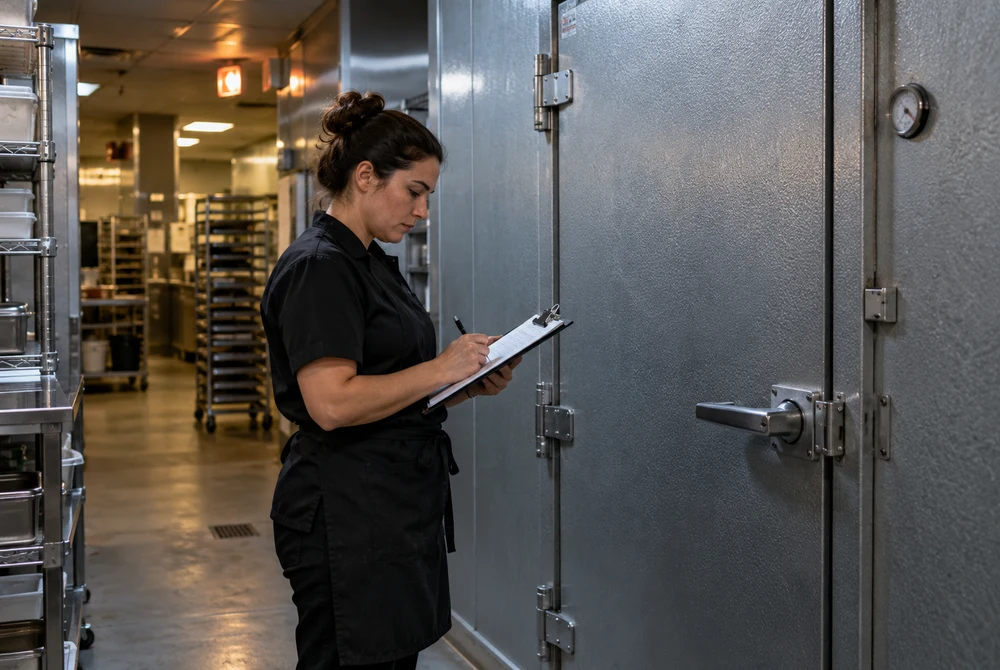
Assign an incident lead before information becomes fragmented
Name the person responsible for the incident record and the person authorized to make operational decisions. They may be the same person, but the responsibility should be explicit. Staff should know where to report observations and who can authorize stock movement, service access or changes to normal operations.
Keep maintenance, kitchen and management information in one incident file. A contractor may know when the compressor restarted while a kitchen employee knows when a delivery arrived. Both facts can matter. If they remain in separate conversations, the final timeline can look more complete than it actually is.
Use role-based contact information and share only what is needed for the event. The record does not need unrelated employee or customer data. A concise incident process should make it easy for staff to preserve facts without improvising their own food-safety decisions or assuming someone else has already notified the appropriate authority.
Record the last known normal condition and the first known interruption
Start with the last documented normal reading and the first confirmed loss of power or refrigeration. These may not be the same moment. A monitoring alert can be delayed, a staff observation can occur after the outage began and a device may stop communicating when the building loses electricity.
Record the source of each timestamp. Utility information, a controller log, a monitoring platform and a handwritten observation can differ in time zone or clock accuracy. Preserve those differences until they can be reconciled. Do not silently shift times to create a continuous record.
If the beginning is unknown, mark an interval rather than invent an exact start. “Normal at the last recorded check; interruption discovered at the next check” is a useful statement. It makes the uncertainty visible to the person evaluating the product history and prevents the discovered time from being mistaken for the beginning of exposure.
Keep the door closed where practical and control access
Limit unnecessary openings while the cooler is affected. Assign any necessary entry to the people carrying out the emergency plan, stock transfer or qualified assessment. Record openings that materially affect the event rather than sending several employees into the cooler to independently inspect the same stock.
Keep the access route clear and account for lighting, water and other site hazards. A power interruption can affect more than refrigeration. Staff should not enter dark mechanical areas or electrical equipment spaces to restore a cooler. Use qualified personnel and the establishment's safe work process for those conditions.
Door management supports the incident response but does not establish food safety. A statement that the door remained closed is useful context alongside temperature and time evidence. It cannot replace the actual product history or the local authority's decision. Similarly, an opening does not establish an exact product temperature without the relevant measurements.
The FDA model and the locally adopted rules have different roles
The current FDA Food Code information describes a model offered for adoption by governmental jurisdictions. It is not automatically a single federal operating rule for every restaurant. Establish which edition, amendments and emergency procedures apply where the business operates.
In the 2026 Food Code, section 3-501.16 generally addresses cold holding of time/temperature control for safety food at 41°F or below, with specified exceptions. Section 3-501.19 concerns planned use of time as a public-health control with its required procedures; it is not a clock that can be created retrospectively to rescue an undocumented outage.
Keep those model references separate from the local decision. A manager should use the adopted code, approved emergency plan and regulatory instructions for affected stock. When the plan does not cover the actual situation or records are incomplete, contact the responsible authority rather than choosing a convenient household guideline or informal online answer.
Contact the authority when the emergency requires it
The model Food Code's sections 8-404.11 and 8-404.12 address imminent health hazards, interruption of operations and resumption approval. The applicability and any approved emergency-plan provisions depend on the adopted requirements and event. Confirm the local notification and reopening process rather than assuming that restored electricity cancels the reporting duty.
For jurisdiction-specific examples, North Carolina's restaurant emergency operations resources address written emergency plans. Oregon's power-outage guidance, revised September 9, 2022, provides a state-specific example of temperature records, transfers and inspector coordination. These examples do not replace another jurisdiction's rules.
Record who was contacted, when and what instructions were received. If a decision depends on information still being collected, keep that condition in the record. The contractor's statement that the cooler is functioning and the authority's permission to resume affected operations are distinct conclusions, even if both are eventually obtained.
Air temperature now does not reconstruct product temperature history
A room display describes a measurement at a particular sensor and time. It does not automatically establish the temperature of every product or the history of an unrecorded period. A cooler that becomes cold again can display a reassuring value while the earlier stock history remains unresolved.
Use the instruments and measurement procedure required by the establishment's plan and applicable instructions. Identify whether the reading is room air, a buffered monitoring channel, a controller input or a measured product temperature. Those values answer different questions and should not be placed in the same column without labels.
Keep missing intervals visible. If monitoring stopped with the power, a graph that resumes afterward is not proof that the unrecorded period stayed within the required conditions. Restoring communications may recover stored readings on some systems, but verify that function and its timestamps. Do not assume a later display has reconstructed data that were never recorded.
Put affected stock under a controlled hold
Use the establishment's hold procedure so affected lots cannot be used or sold while their status is unresolved. Identify the cooler, products and lot or batch information needed for the decision. Keep held stock distinguishable from cleared stock, using the method authorized by the business's plan.
Avoid a vague instruction that “everything is probably fine” or “use the older items first.” Staff need a concrete release status and responsible person. A product hold is a control while evidence is assessed; it is not a substitute for the eventual disposition decision.
Document any movement while the hold is active. A transfer to another location does not erase the preceding exposure history. Preserve the origin, timing, destination and relevant measurements so the decision-maker can assess the whole event. If the records cannot support a decision, state that limitation rather than using the destination's current temperature to fill the gap.
Do not reset the exposure clock after power returns
Restored cooling changes the current environment. It does not undo an earlier period outside the required conditions or make unknown history known. Keep the event's timeline continuous through restoration, transfers and recovery. The release decision must consider the applicable requirements and recorded history.
Do not use smell, appearance or tasting as a clearance test. Those observations cannot establish that time/temperature control was adequate. Follow the person in charge and regulatory authority's instructions for the affected food, with product-specific information where required.
Similarly, do not create a retrospective time-control plan after an outage merely because a familiar number of hours appears in a general guide. Planned time as a public-health control has defined procedures and conditions. An emergency with missing records requires the actual emergency process, rather than a newly invented clock chosen after the event.
Use a worksheet that distinguishes facts from decisions
The worksheet below is an editorial incident-management aid. It is not a claim that every listed field is a universal legal requirement. Adapt it to the approved plan and regulatory instructions, keeping the relevant measurements and decisions traceable.
| Record item | Entry | Responsible role |
|---|---|---|
| Equipment and location | Cooler ID; model | Manager |
| Timeline | Known times; unknown intervals | Incident lead |
| Affected stock | Products; lot or batch | Person in charge |
| Measurements | Type; time; instrument | Assigned staff |
| Transfer | Origin; destination; times | Assigned staff |
| Equipment status | Findings; checks; limitations | Qualified contractor |
| Product disposition | Hold; release or disposal basis | Authorized decision-maker |
| Operating approval | Authority; conditions; time | Permit holder |
Do not combine the last three rows into one “ready” checkbox. Each answers a different question. A repaired cooler can still contain unresolved stock, and cleared stock may need a suitable storage location while equipment checks continue. Separate fields make those dependencies visible to the next shift.
Preserve readings with their measurement context
Record the time, measurement type, location and instrument. If a reading is taken from a controller display, identify it as such. If an authorized product measurement is made, record the method and product identity required by the plan. Retain relevant instrument status or verification information when it affects interpretation.
Avoid rounding a set of variable observations into one favorable average. A reading from one shelf does not describe every location. A product checked after transfer may not establish its earlier temperature. The record should reflect which information was actually collected and the limits of its representativeness.
If two instruments disagree, preserve both readings and investigate the reason under the applicable procedure. Do not select whichever reading would allow normal operations to resume. Differences in location, measurement type, timing or instrument condition can explain a disagreement, but that explanation must be assessed rather than assumed.
Record transfers as part of the incident, not a fresh beginning
When the emergency plan authorizes a transfer, identify where the stock will go and how that location's suitability will be established. Record the movement and any required receiving measurements. Keep the held status and disposition responsibility attached to the stock throughout the transfer.
Avoid overloading the destination or introducing products without considering its intended use and storage requirements. Transfer logistics should be coordinated with the person in charge and the responsible facility staff. The receiving cooler's normal operation cannot independently establish the acceptability of the transferred food.
Maintain traceability for items that later move back. The final record should connect the original outage, temporary storage and authorized release. If a lot was divided among destinations, make those movements clear enough that the business can account for the affected stock without relying on staff memory after several shifts.
Restored building power is only the first equipment observation
Note when building power returned and when the cooler's controls, fans and refrigeration operation were actually observed. These times can differ. An illuminated display or a running evaporator fan does not establish that the compressor is operating or that cooling capacity has been restored.
Record displayed alerts and visible behavior from normal operator access. Preserve the information before any authorized reset. If the controller is inaccessible or its indication is unclear, leave it for the contractor. Staff should not open electrical panels or bypass safety devices to make the machine start.
Use the equipment's owner's or operator instructions for permitted actions. A restart sequence from an unrelated controller can be inappropriate. The incident record should say what the operator actually observed and what the qualified technician later established, rather than combining both into the unsupported statement that “the cooler came back on.”
Controller delays can be legitimate, but they are model-specific
Some controls include compressor off-time or restart delays. The correct explanation depends on the installed controller and configuration. A delay should be assessed against its manual, not against a universal online countdown. Likewise, an expected delay does not rule out a separate overload, power-supply or equipment fault.
The Heatcraft QRC manual describes a four-minute holdoff on power return for that controller. It is a specific example, not a rule for every walk-in. The Heatcraft intelliGen instructions cover their own settings, alerts and operating behavior.
Record the controller identity and the explanation the technician gives for the observed sequence. If a delay is expected, note the document used. If the equipment does not follow that sequence, preserve the fault information and continue diagnosis. Do not force operation by overriding a delay or protective function simply because held inventory creates pressure to resume service.
Give the contractor a useful equipment complaint
Tell the contractor what lost power, when restoration was observed and what the equipment did afterward. Include accessible model information, alerts and the temperature trend, clearly identifying each measurement type. State whether there were known problems before the outage and whether staff performed any authorized intervention.
Keep food decisions separate from the requested mechanical assessment. The contractor needs to know the business impact and access constraints, but a service call should not ask them to certify all stock from a single room-air reading. Ask for the equipment findings, required repairs and return-to-service limitations.
If several systems were affected, identify each one rather than describing a site-wide result as if it applied to every cooler. One unit may recover while another remains off. The final incident record should allow managers to coordinate equipment and stock decisions by location, with the correct status carried into each handover.
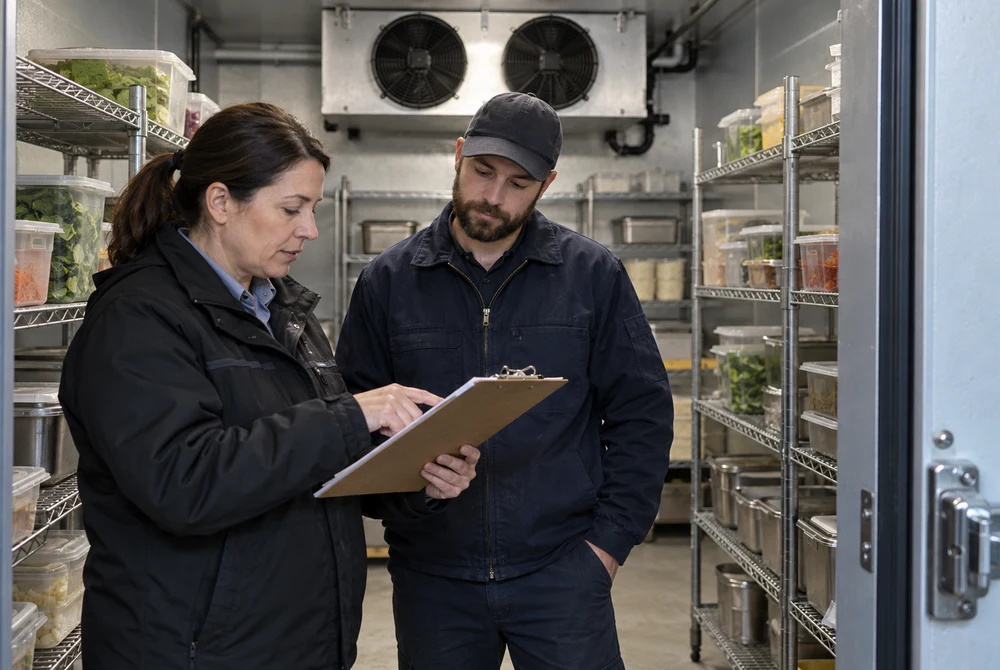
Keep mechanical diagnosis with qualified personnel
A technician may need to establish the power supply, controller status, protective trips and refrigeration operation using the applicable service procedure. Managers should request the findings and scope rather than perform electrical or sealed-circuit checks themselves. A power interruption is not evidence that the refrigerant charge suddenly needs topping off.
If refrigerant work is proposed, ask what confirmed condition supports it and what repair or verification accompanies the service. The sound of a compressor, a warm room or a changed display alone does not establish charge quantity. The technician should connect the recommendation to the equipment diagnosis.
Record what was repaired and what was only inspected. If the unit restarts without a confirmed fault, the report should say that instead of inventing a failed component. If a fault remains intermittent, request the next step and operating guidance. Mechanical uncertainty should stay visible while the business coordinates its own operational decisions.
Evaluate the recovery trend without promising a universal time
Agree with the contractor on the conditions under which recovery will be assessed. Equipment load, stock condition, door use and operating sequence can differ between events. There is no single recovery duration that proves every walk-in is healthy. A clock alone cannot establish that the required refrigeration duty has been restored.
Record the trend with the relevant conditions. Note whether the cooler is empty, lightly loaded or returning to its normal load, and whether authorized transfers or repeated entries occurred. A change in load can alter the observed trend without proving that the refrigerant or compressor changed performance.
Ask what acceptance checks establish normal mechanical service and what follow-up is required. If the initial assessment covers only limited conditions, document that boundary. Do not present an empty-room recovery check as a guarantee of performance during a full delivery or peak door traffic unless the contractor's assessment supports that claim.
Separate equipment acceptance, food release and reopening
Use three distinct decisions: whether the refrigeration equipment is ready for its intended duty, whether affected food can be released under the applicable instructions and whether operations can resume where regulatory approval is required. Each decision should have an identified basis and responsible person.
| Decision | Evidence | Sign-off |
|---|---|---|
| Equipment ready | Contractor checks and limitations | Qualified service provider |
| Affected stock resolved | Product history and applicable instructions | Authorized food decision-maker |
| Operations resume | Required authority approval and conditions | Permit holder |
The table is a coordination aid, not a universal legal signature form. It helps prevent the common problem of one “all clear” being interpreted too broadly. Keep any conditions attached to the relevant decision. If equipment is ready but a stock decision is pending, the stock remains controlled; if operating approval is required, follow that process before resuming affected operations.
Restock in the sequence the recovery plan supports
Coordinate restocking with the person in charge and contractor. Identify what stock has been cleared, which cooler is suitable and what conditions the equipment assessment covered. Avoid moving unresolved stock back simply because the display has reached its setpoint.
Keep normal storage practices and airflow arrangements in the plan. Record loading that changes the recovery assessment, and follow any applicable equipment limitations. If the business needs to restore service rapidly, make the responsibility for checking the next stage explicit rather than assuming the first load proves readiness for every later load.
Maintain the link between the incident record and the restored inventory. Staff on the next shift should know which stock was released, which remained held and which was removed under the applicable decision. A physical return to the cooler should not silently become an authorization to use the product.
Close the incident with the unresolved items visible
Compile the timeline, measurements, stock movements, contractor report and decision records. Identify unknown intervals and any remaining follow-up. A completed incident file should show what was established, not conceal missing information behind the fact that the business is operating again.
Retain the existing commercial refrigeration maintenance guide for routine inspection planning. Monitoring design and routine maintenance have different roles from this event-response record. Use their procedures to address identified weaknesses after the outage rather than rewriting the event as a maintenance checklist.
Review whether staff knew the contacts, whether alarms reached the responsible person and whether the backup plan matched the actual interruption. Assign concrete actions where a gap was found. An incident can produce useful improvement without claiming that a particular tool or refrigerant would have prevented every outage consequence.
Prepare the next outage plan from actual gaps
Use the record to identify which information was hardest to obtain. If the outage start was uncertain, review the monitoring and notification process. If product movements were hard to trace, improve the transfer worksheet. If staff did not know who could release a hold, clarify decision authority in the written plan.
Assess monitoring power and communication dependencies separately. A sensor can keep measuring while a notification channel fails, or communication can return without recovering the missing history. Verify the actual system behavior rather than assuming that a cloud dashboard provides continuity during every interruption.
Any new equipment or procedure should answer a documented need. Avoid replacing the whole monitoring program because one alert was missed without understanding the failure. Similarly, avoid treating a repaired electrical fault as proof that the food-safety process was adequate. Mechanical prevention and incident response are related but distinct parts of the business's readiness.
Make the shift handover explicit while recovery continues
If the incident crosses a shift change, identify who now owns the record and which decisions are still pending. Hand over held-stock status, cooler status, contractor findings and authority instructions separately. A verbal statement that the power is back can easily be mistaken for permission to resume all normal operations.
Use the latest verified record rather than asking the next shift to reconstruct the event from messages. Identify the next expected check, responsible person and contact if the condition changes. If a contractor will return later, state what the earlier visit established and what remains for that visit. Keep any equipment operating restrictions visible to staff who use the space.
The receiving shift should acknowledge the operational instructions through the establishment's normal process. The purpose is continuity of the existing response, not a new decision based on a single fresh display reading. Held items remain held until the designated decision is recorded, and required approval conditions remain attached to the affected operations.
Preserve vendor and contractor records without broadening their claims
Keep service reports, monitoring exports and transfer documents with the incident file. Label what each record establishes. A monitoring export can support its recorded readings; it does not automatically certify every product. A contractor's successful mechanical test can support the stated equipment assessment; it does not authorize an unrelated food-release decision.
When a vendor makes a recovery or monitoring claim, ask whether it applies to the installed configuration. An advertised feature may require backup power, local storage or a particular communications arrangement. Verify the actual condition before recording that the feature protected the event. If the claim remains unverified, keep it as a question for follow-up rather than a finding in the incident closeout.
Frequently asked questions
Can I reopen as soon as the walk-in display is cold again?
Not on that evidence alone. The display does not reconstruct affected product history or establish every required equipment check. Follow the adopted code, approved plan and regulatory instructions. Where operations were discontinued under applicable imminent-hazard provisions or law, obtain the required resumption approval. Keep mechanical acceptance, product disposition and operating authorization separate.
Does the household four-hour refrigerator rule apply to a commercial walk-in?
Do not use it as a universal commercial clearance rule. Walk-in equipment, stock and local food-service requirements differ. Use the establishment's applicable emergency plan and regulatory instructions, supported by the event's actual records. Do not transfer residential search advice or household guidance into a commercial product-release decision.
Does cooling the food again make the earlier outage irrelevant?
No. Current cooling does not undo an earlier exposure or fill an unknown time interval. Preserve the continuous history through the interruption, transfers and recovery. The authorized decision-maker should assess the affected stock using the applicable instructions. Do not reset a clock after restoration or use smell and taste as evidence of safety.
The fans are running. Does that prove refrigeration is restored?
No. Fans, controller power and compressor operation are different observations. Record what is visible from normal operator access and request a qualified equipment assessment. A running fan or illuminated display cannot establish refrigerant condition, cooling capacity or completion of the return-to-service checks.
Is a four-minute restart delay normal for every cooler?
No. Heatcraft QRC describes a specific power-return holdoff for that controller. Other controls and configurations can differ. Identify the installed controller and use its manual. Preserve alarms and obtain service when the observed sequence is unexplained. Do not override a protective delay to force the unit to operate.
Who should decide whether held stock can be used?
Use the establishment's designated food-safety decision process and the regulatory authority's instructions. The refrigeration technician supplies mechanical findings within their scope. Those findings do not automatically authorize release of affected food. Record the decision, basis and responsible person so the next shift knows the stock's actual status.
What if monitoring records are missing for part of the outage?
Mark the gap explicitly and retain the last known normal and first confirmed abnormal information. Check whether the monitoring system actually stored recoverable readings. Do not invent a continuous trend or assume that later communications reconstructed the missing period. Contact the appropriate decision-maker or authority under the applicable emergency procedure.
Should a cooler that failed after an outage receive refrigerant immediately?
Only a qualified diagnosis can establish the need for refrigerant work. A power interruption can involve controls, electrical supply or protective responses without proving low charge. Ask the contractor to identify the confirmed condition, proposed repair and verification. Do not approve a top-off solely because the room is warm after restoration.











