
By Refrigerant Centers Editorial Team
New chillers for comfort cooling have been held to a 700 GWP ceiling since January 1, 2025, and EPA’s Technology Transitions restrictions by sector put industrial process refrigeration chillers under the same 700 limit with later dates — January 1, 2026 for units with an exit temperature above −22°F, and January 1, 2028 for the −58°F to −22°F band. That takes R134a and R410A off the table for new machines, which is the whole of the problem most specifiers are now solving.
What clears the limit falls into two useful groups. There are A1 options — nonflammable, and therefore cheap in code terms: R513A at a GWP of 631, R450A at 601, R515B at 293, R1233zd(E) at about 4.5 for low-pressure machines. And there are A2L options with far lower GWP but real building consequences: R1234ze(E), R1234yf, R454B, R32. The refrigerant you can live with is usually decided by the machinery room, not by the chiller.
That is the argument of this article. The GWP number is the easy constraint to satisfy; the expensive one is what an A2L charge does to ventilation, detection, and the plant-room scope on a replacement job. ASHRAE 15’s A2L provisions can push the required machinery-room exhaust for a given tonnage several times higher than the same machine on an A1 refrigerant, which is a mechanical and electrical scope item, not a footnote. Sections below cover the category limits, the candidate refrigerants by pressure class, the A1 versus A2L trade, where retrofit is genuinely available, and how to sequence the decision so it does not arrive as a change order.
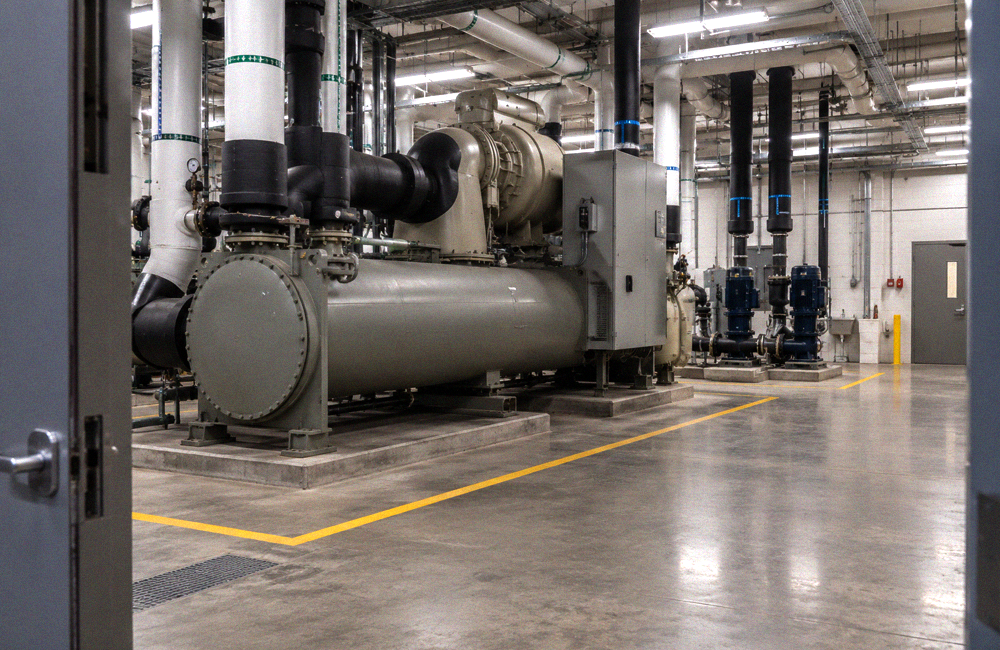
Which Chiller Category Your Project Falls In
Chillers are not one subsector. Before comparing refrigerants, confirm which line the project sits on, because the dates differ by years and the application definition — comfort cooling versus process — decides it.| Chiller category | GWP limit | Compliance date |
|---|---|---|
| Chillers for comfort cooling | 700 | January 1, 2025 |
| Ice rink chillers | 700 | January 1, 2025 |
| Industrial process chillers, exit temperature above −22°F | 700 | January 1, 2026 |
| Industrial process chillers, −58°F to −22°F exit temperature | 700 | January 1, 2028 |
| Semiconductor manufacturing, 100 lb charge or less | 700 | January 1, 2030 |
Limits and dates from EPA’s Technology Transitions restrictions-by-sector listing; verify the current entry for your exact category before specifying, since these have been amended more than once.
Two notes that decide real projects. The 2026 reconsideration rule extended some dates rather than moving the GWP targets — the Holland & Knight summary of the changes to the Technology Transitions provisions records the semiconductor industrial-process date moving to January 1, 2030 and the residential installation deadline being removed, while the underlying limits stayed. So do not assume a general loosening; check the specific line.
And a chiller serving a process load is not automatically in the process category. Where a machine serves both, the classification follows the application as the rule defines it, and getting it wrong in the submittal is a problem that surfaces at closeout. Document the basis of the classification in the design narrative.
The Candidates, Grouped by Pressure Class
Chiller refrigerants do not substitute across pressure classes. A low-pressure centrifugal machine and a high-pressure screw chiller are shopping in different aisles, and the candidate list only makes sense grouped that way.| Refrigerant | GWP | Safety class | Where it fits |
|---|---|---|---|
| R1233zd(E) | 4.5 | A1 | New low-pressure machines |
| R514A | 7 | B1 | New low-pressure machines and R123 retrofits |
| R515B | 293 | A1 | New medium-pressure machines |
| R513A | 631 | A1 | New medium-pressure machines and R134a retrofits |
| R450A | 601 | A1 | Medium-pressure, new and retrofit per EPA listing |
| R1234ze(E) | 7 | A2L | New medium-pressure machines only, not a retrofit |
| R1234yf | 4 | A2L | New medium-pressure machines |
| R454B | 466 | A2L | New high-pressure scroll and screw machines |
| R32 | 675 | A2L | New high-pressure machines, more redesign than R454B |
GWP and safety-class figures as published in the Cooling Post review of refrigerant choice in HVAC chillers, except R450A, whose GWP of 601 is the value shown in EPA’s own listing. Published GWPs differ slightly between sources depending on which assessment report they draw from; for compliance, the governing value is the one in EPA’s regulations, so confirm there before relying on a figure near the 700 line.
Three things fall out of that table.
R513A and R450A are the interesting rows for owners who cannot accept a flammable refrigerant. Both are A1, both land under 700, and both are only modestly under it. That last point matters: a refrigerant at 631 satisfies today’s limit with sixty-nine points of headroom, and anyone specifying on a twenty-year equipment life should ask the owner how they feel about that margin.
R515B is the A1 answer with real headroom at 293, at the cost of being a new-equipment refrigerant rather than a retrofit path.
The very low numbers are all A2L or B1. If the goal is a GWP in single digits, the project is taking on either flammability provisions or the toxicity classification of a B1 refrigerant, and the machinery room has to be designed for it.
The A1 Versus A2L Decision Is a Building Decision
The temptation on a replacement is to treat refrigerant as a line in the equipment schedule. On a chiller it is closer to a structural decision, because the flammability class drives plant-room scope across three disciplines.
Choosing A1 keeps the machinery room broadly in the territory the existing plant was designed for. Choosing A2L brings in ASHRAE 15’s provisions for flammable refrigerants: refrigerant detection tied to emergency shutdown, larger mechanical exhaust, non-sparking components in the airstream path, and interlocks to the building automation system. Every one of those is a cost and a coordination item, and several of them are physical — you cannot add exhaust capacity that the shaft space will not carry.
The practical consequence is a sequencing rule: the refrigerant class has to be settled during schematic design, not during submittal review. The ACHR News treatment of ASHRAE Standard 15-2022’s role in the refrigerant transition makes the same point from the design side, noting that late-stage changes from an A1 to an A2L refrigerant are expensive because they ripple through space constraints, equipment specification, and electrical scope across all the MEP disciplines.
For a contractor bidding design-build, this is where the money is won or lost. A bid that assumes A1 and gets held to an A2L machine has absorbed a plant-room scope it did not price.
What ASHRAE 15 Changes in the Machinery Room
The single most useful thing to show an owner who is weighing GWP against cost is the ventilation consequence, because it is concrete and it is large.| Requirement | A1 refrigerant plant room | A2L refrigerant plant room |
|---|---|---|
| Machinery-room exhaust, 250-ton example | About 3,162 CFM on R134a | About 19,000 CFM on R1234ze |
| Detection and shutdown | Detection per the standard’s general provisions | Emergency shutdown at 25% of the lower flammability limit, with self-testing and an exterior manual control |
| Exhaust equipment construction | Conventional | Fan motors out of the airstream; nonferrous or non-sparking components |
| Intake placement | Per general ventilation design | Within about a foot of the expected refrigerant concentration elevation |
| Controls integration | Typically local | Building automation system interlocks |
Requirements and the 250-ton ventilation comparison as reported in ACHR News’s coverage of ASHRAE Standard 15-2022; the governing numbers for a specific project come from the standard’s own tables applied to the largest circuit charge, and the adopted code edition in your jurisdiction controls. ASHRAE publishes the standard’s addenda separately, so confirm which version your authority having jurisdiction has adopted.
Read the first row twice. A roughly sixfold increase in machinery-room exhaust for the same tonnage is not a fan upgrade — it is louvers, shaft space, structural penetrations, electrical service, and in retrofit plant rooms it is sometimes simply not available. That is why an existing basement plant room with a single small exhaust path frequently decides the refrigerant before anyone opens a catalog.
None of which is an argument against A2L. It is an argument for pricing it honestly and early, and for recognizing that an owner’s lowest-GWP preference may cost more in the building than in the machine.
Retrofit or Replace: What Actually Decides It
“Can I retrofit instead of replacing?” is the first question most owners ask, and the answer is narrower than they hope.
Retrofit is genuinely available on some paths. EPA’s listing of substitutes in centrifugal chillers shows R450A as acceptable for both new and retrofit use, alongside R514A as a newer low-GWP option and several older blends; R513A is the common retrofit route out of R134a. Retrofit is not available for others — R1234ze(E) is a new-equipment refrigerant rather than a drop-in for an R134a machine, and the A2L options generally arrive with equipment designed around them.
There is also a regulatory point that changes the shape of the conversation. The GWP limits restrict new products and newly installed systems. They do not force the removal of an operating chiller, and the same EPA listing carries an important caveat in the other direction: many substitutes acceptable under SNAP may still be restricted under the Technology Transitions program, so SNAP approval alone is not a compliance answer. Check both.
What actually decides retrofit versus replacement on a specific machine:
- Capacity and efficiency after the swap. A retrofit refrigerant rarely matches the original exactly, and a machine that loses capacity at design conditions has created a plant problem rather than solved a compliance one. Get the manufacturer’s performance data for that model on that refrigerant, not a generic comparison.
- Machine age and remaining life. Money spent retrofitting a machine with five years left is money spent twice.
- Oil and materials compatibility. Manufacturer-specific, and the manufacturer’s documentation governs. Do not generalize from another model.
- Tube and vessel condition. If the bundle is at end of life, the refrigerant decision is academic.
- Whether the retrofit path clears the limit with margin. A retrofit into a refrigerant just under 700 may be a short reprieve on a long-lived machine.

For anything beyond a like-for-like retrofit, treat replacement and retrofit as two priced options in the owner’s package rather than as a default and an alternate. The comparison usually settles itself once the plant-room scope for each is on the same page.
Low-Pressure Machines and Legacy Fleets
Large centrifugal plants running R123 are a distinct situation, and the low-pressure candidates were developed for exactly it. R514A is listed for both new machines and R123 retrofits, and R1233zd(E) serves new low-pressure equipment with a GWP around 4.5 and an A1 classification.
The catch on R514A is the B1 designation. B-class toxicity brings its own machinery-room provisions, and while an owner used to R123 is already operating under a similar framework, a design team that has only worked with A1 refrigerants should not assume the plant room is unaffected.
Where a low-pressure fleet is staying in service, the practical planning question is component and refrigerant supply over the machine’s remaining life rather than compliance. The limits do not stop the machine running, but supply for a shrinking installed base tightens over time, which belongs in the owner’s capital plan as a schedule input.
The R134a Replacement Question on Medium-Pressure Machines
This is the most common conversation, because R134a water-cooled screw and centrifugal chillers are everywhere and R134a’s GWP of 1430 is well above the ceiling for new equipment.
Three realistic answers, in the order owners usually rank them:
Stay A1 and accept a moderate GWP. R513A at 631 or R450A at 601. The machinery room stays broadly as designed, the retrofit path exists on some machines, and the compliance margin is thin but real. This is the low-friction choice and often the right one for a plant room with no room to grow.
Stay A1 and get headroom. R515B at 293, on new equipment. More margin against future tightening, no flammability scope, but no retrofit route.
Go A2L for a very low GWP. R1234ze(E) or R1234yf, on new equipment designed for them, with the ASHRAE 15 scope that comes with it. Choose this when the plant room can carry it or when the owner’s carbon commitments make it worth carrying.
What not to do is treat the three as interchangeable in the schedule and let the equipment vendor’s proposal decide. They have different capacity behavior, different plant-room implications, and different service pictures, and the owner should see all three priced.
High-Pressure Scroll and Screw Machines
Air-cooled scroll and screw chillers on R410A — GWP 2088 — are in the same position as the rest of the R410A equipment world, and the options are the ones the broader market moved to.
R454B at 466 is the closer operating match to R410A and is the more common path in new equipment. R32 at 675 is also below the limit and is used, but it demands more redesign relative to an R410A platform, and its GWP sits uncomfortably close to the ceiling for a machine expected to run two decades.
Both are A2L, which is the whole point for air-cooled chillers: because these machines usually sit outdoors on a roof or a pad rather than in a machinery room, the ASHRAE 15 plant-room burden that shapes the water-cooled decision often does not apply the same way. That makes the A2L choice much easier on air-cooled projects than on indoor ones — and it is worth saying explicitly to an owner who has heard that A2L equipment is expensive to accommodate. Where the equipment is outdoors, the accommodation is mostly about service practice and local code for the piping route into the building, not about a new exhaust system.
Efficiency and Capacity Are Part of the Refrigerant Choice
A refrigerant swap changes the thermodynamic cycle, so it changes capacity and efficiency at the same conditions. This gets lost when the conversation is framed entirely around GWP.
Two rules keep it honest. First, compare selections at the project’s actual design conditions and at the part-load profile the plant really runs, not at nominal rating conditions — a chiller plant spends most of its hours well away from design. Second, insist on manufacturer selection data for the specific machine and refrigerant rather than a general statement that performance is “comparable.” The manufacturer’s own data is the only source that speaks to a particular compressor, heat exchanger, and control package.
Where a retrofit is on the table, ask specifically what happens to capacity at the worst design hour. A plant that meets load in April and falls short in August has not been retrofitted; it has been derated.
Servicing the Fleet You Already Have
The limits are prospective. An existing chiller above 700 GWP keeps operating, and it keeps being serviceable — nothing in the Technology Transitions program requires tearing out a working machine or converting it.
What changes is the supply environment, gradually, as the phasedown reduces HFC production and the installed base for high-GWP components shrinks. For a facility engineer with several R134a machines, that translates into three planning items rather than a compliance deadline: leak performance on the existing fleet, because a machine with a leak history becomes an expensive machine in a tightening refrigerant market; recovered and reclaimed refrigerant as a service supply for the remaining life; and a replacement sequence that spreads capital across years rather than stacking it.
Refrigerant Centers fields the downstream version of this regularly — a plant where two of four machines were replaced on a low-GWP standard and the other two were left without a written plan, so each service call becomes an ad hoc decision. Write the sequence down, even if the dates are soft.
Sequencing the Decision So It Lands Before Design
The order below is the one that keeps the refrigerant choice from becoming a change order.
Confirm the category and date first. Comfort cooling or process, and which exit-temperature band. This sets the applicable limit and whether there is any time.
Survey the machinery room before shortlisting equipment. Available exhaust path and shaft space, louver capacity, electrical capacity, detection infrastructure, egress, and whether the room can accept A2L provisions at all. This survey, not the equipment catalog, is what narrows the refrigerant list on an indoor project.
Establish the owner’s flammability position in writing. Some institutional owners have standards that effectively exclude A2L in occupied buildings. Finding that out after equipment selection is a wasted design cycle.
Price A1 and A2L options as complete scopes. Equipment plus plant-room work plus controls plus commissioning. A comparison that prices only the chillers will always make A2L look cheaper than it is on an indoor project, and will make A1 look worse than it is.
Check the adopted code edition with the authority having jurisdiction. ASHRAE 15 has been amended repeatedly and jurisdictions adopt on their own schedule. The edition in force governs the design.
Then select equipment. By this point the refrigerant is largely determined, which is the intended outcome.
What Belongs in the Owner’s Decision Package
Owners approve capital based on documents, so the document is part of the engineering. A package that actually supports a decision contains:
- the applicable limit and compliance date, with the category basis stated;
- the shortlisted refrigerants with GWP and safety classification, and the compliance margin each one carries against 700;
- the machinery-room scope implied by each option, separated from equipment cost;
- capacity and efficiency at design and at the plant’s real part-load profile, from manufacturer selection data;
- the retrofit option where one exists, priced honestly, with its remaining-life assumption stated;
- the service picture over the equipment life — refrigerant supply, technician handling requirements, and what a leak repair looks like on each option;
- and the sequence for any machines not being replaced in this project.
That last item is the one most often missing and the one owners ask about six months later.
Frequently Asked Questions
Do I have to replace my existing chiller because of the 700 GWP limit?
No. The limits apply to new products and newly installed systems. An operating chiller above 700 GWP may keep running and keep being serviced; what tightens over time is refrigerant and component supply, which is a planning matter.
Can I retrofit my existing chiller instead of replacing it?
Sometimes. R450A is listed as acceptable for both new and retrofit use in centrifugal chillers, and R513A is a common route out of R134a. Whether it is right for a specific machine depends on manufacturer data, remaining life, and post-retrofit capacity.
What replaces R134a in chillers?
On new medium-pressure equipment: R513A or R450A if the project needs A1, R515B for an A1 option with more GWP headroom, or R1234ze(E) and R1234yf for very low GWP with A2L provisions.
Which options under 700 GWP are nonflammable?
R1233zd(E), R515B, R513A, and R450A are A1. R514A is B1 — nonflammable but with a toxicity classification that carries its own machinery-room requirements.
Does an A2L chiller really need that much more machinery-room ventilation?
For an indoor machine, yes, materially more. Published comparison figures for a 250-ton chiller put R1234ze machinery-room exhaust in the range of 19,000 CFM against about 3,162 CFM for R134a. Your project’s number comes from the standard’s tables applied to the largest circuit charge.
Are the chiller GWP limits the same for process cooling as for comfort cooling?
The limit is 700 in both, but the compliance dates differ — January 1, 2025 for comfort cooling, and January 1, 2026 or January 1, 2028 for industrial process chillers depending on exit temperature.
Did the 2026 EPA rule change the chiller limits?
It adjusted dates in several subsectors — including moving the semiconductor industrial-process date to January 1, 2030 — rather than changing the GWP targets themselves. Confirm the current entry for your category rather than assuming general relief.
Is R32 or R454B the better choice for an air-cooled chiller?
R454B at 466 is the closer operating match to R410A and generally the less disruptive platform change; R32 at 675 is also compliant but demands more redesign and leaves less margin against any future tightening.
Where to Start Tomorrow
If a chiller replacement is in planning, the first hour is better spent in the machinery room than in a catalog. Measure the exhaust path, find out what the electrical service will carry, and get the owner’s position on flammable refrigerants on paper. With those three facts, the refrigerant shortlist writes itself and the equipment selection follows — and the compliance margin against 700 becomes a deliberate choice rather than whatever the low bidder proposed.











