
Refrigerant pressure can fluctuate every few minutes because the compressor, fans, expansion device, or capacity controls are responding to changing system conditions. Some movement is normal. For example, pressures will change when a compressor starts, stops, changes speed, or switches stages.
Repeated large swings during an otherwise steady cooling demand may indicate compressor short cycling, TXV hunting, intermittent airflow, evaporator icing, condenser fan cycling, a refrigerant restriction, or a control problem. The important question is not simply whether pressure moves, but which pressure moves, how far it moves, and what equipment event occurs at the same time.
Refrigerant Pressure Is Not Supposed to Be Perfectly Constant
A running refrigeration circuit is a dynamic system. Suction pressure is influenced by evaporator temperature, indoor airflow, heat load, refrigerant feed, and compressor capacity. Discharge pressure responds to outdoor temperature, condenser airflow, refrigerant mass flow, and heat rejection.
If any of those conditions change, pressure changes too.
Variable-speed, digital, and staged systems deliberately adjust compressor capacity to match the load. Copeland’s control documentation describes variable-capacity compressors responding to relatively small suction-pressure or temperature variations, so modest periodic movement can be part of normal operation rather than a fault. (Copeland E2 Enhanced User Manual)
Normal causes can include:
- A single-stage compressor completing a thermostat cycle
- A two-stage compressor changing capacity
- A variable-speed compressor increasing or decreasing speed
- A condenser fan cycling to regulate head pressure
- A TXV or electronic expansion valve adjusting refrigerant flow
- Refrigerated cases entering or leaving defrost
- Doors opening or the heat load changing
- Multiple evaporators or solenoid valves cycling on one system
Pressure movement becomes more concerning when the swings are large, frequent, unrelated to a known control action, or accompanied by frost, noise, weak cooling, nuisance shutdowns, or unusually high compressor current.
What Different Pressure Patterns Can Mean
The diagnostic value comes from matching the pressure pattern to temperatures, airflow, electrical readings, and component operation.| Observed pattern | Possible explanation | What to correlate with it |
|---|---|---|
| Both pressures rise and fall as the compressor starts and stops | Normal cycling or abnormal short cycling | Thermostat call, safety controls, compressor current, and cycle duration |
| Suction pressure repeatedly rises and falls while discharge pressure is steadier | TXV hunting, unstable evaporator load, or intermittent airflow | Superheat, sensing-bulb temperature, blower operation, and coil condition |
| Head pressure changes sharply when a fan switches | Condenser fan or head-pressure control cycling | Fan command, outdoor temperature, condenser cleanliness, and fan speed |
| Suction pressure falls as frost develops, then rebounds | Low airflow, evaporator icing, or a defrost event | Filter condition, blower speed, return-air temperature, and frost pattern |
| Low suction pressure with low subcooling and high superheat | Possible undercharge or inadequate liquid supply | Leak inspection, weighed charge, line temperatures, and manufacturer specifications |
| A localized temperature drop appears before the metering device | Restriction or flash gas in the liquid line | Filter drier temperature difference and subcooling at multiple locations |
| Displayed pressure jumps without corresponding temperature or current changes | Gauge, hose, sensor, transducer, or control-input problem | A second calibrated instrument and inspection of sensor wiring and mounting |
Technical source note: Pattern interpretation should follow a complete system diagnosis. See the Danfoss TXV troubleshooting guide, Parker Sporlan Bulletin 10-11, and Copeland’s guidance on compressor short cycling.
TXV Hunting Can Create Repeating Suction-Pressure Swings
A thermostatic expansion valve regulates refrigerant flow by responding to evaporator outlet superheat. If it feeds too much refrigerant, superheat falls. The valve then closes, refrigerant flow decreases, and superheat rises. If the response repeatedly overshoots in both directions, the valve is “hunting.”
A slight movement is not automatically abnormal. Danfoss notes that a 1 K superheat variation is not generally considered hunting. Its service guidance also identifies improper superheat adjustment, excessive valve capacity, and inadequate liquid supply as conditions that can produce unstable operation. (Danfoss Fitters Notes: Thermostatic Expansion Valves)
Persistent hunting may result from:
- An oversized valve or oversized replaceable orifice
- An improperly mounted or poorly insulated sensing bulb
- A bulb installed near a suction-line trap
- Uneven refrigerant or air distribution through the evaporator
- Rapidly changing evaporator load
- Flash gas arriving at the valve
- Moisture intermittently freezing at the valve
- An incorrect superheat adjustment
- A valve or power element that is sticking or failing
Parker Sporlan specifically identifies oversized valves, poor bulb location, uneven distribution, and moisture-related freezing among the conditions that can aggravate or imitate hunting. (Parker Sporlan Bulletin 10-11)
Replacing or adjusting the valve before checking airflow, refrigerant supply, and bulb installation can therefore leave the original problem unresolved.
Compressor Short Cycling Causes Larger Pressure Changes
When the compressor stops, the low side rises and the high side falls toward equalization. When it restarts, suction pressure drops and discharge pressure rises again. If that sequence occurs every few minutes, the gauge readings may look dramatic even though the pressure change is only a consequence of repeated start-stop operation.
Possible causes of short cycling include:
- A thermostat or temperature controller with a narrow differential
- An oversized system satisfying the thermostat too quickly
- Low-pressure or high-pressure safety-control trips
- Evaporator freeze protection
- A dirty condenser or failed condenser fan
- An intermittent indoor blower
- Compressor overload protection
- A defective pressure sensor or transducer
- Control-board, contactor, or wiring faults
The timing matters. Copeland notes that a suction-pressure sensor located where it is exposed to pressure spikes can contribute to unstable control behavior, while an excessively close control differential can increase cycling. (Copeland: Is Short Cycling Driving You Crazy?)
A compressor that runs for only a short period, stops, and restarts repeatedly should be diagnosed rather than treated as a refrigerant-charge problem by default.
Airflow Problems and Evaporator Icing
An evaporator depends on a steady supply of warm air. A clogged filter, dirty blower wheel, blocked return, slipping belt, failing fan motor, or incorrect fan-speed setting can reduce the heat entering the refrigerant.
As evaporator load falls, suction pressure generally falls. If the coil begins freezing, airflow can decline further. Pressure may then drift downward until a freeze control stops the compressor or the ice partially melts, after which pressure rises again.
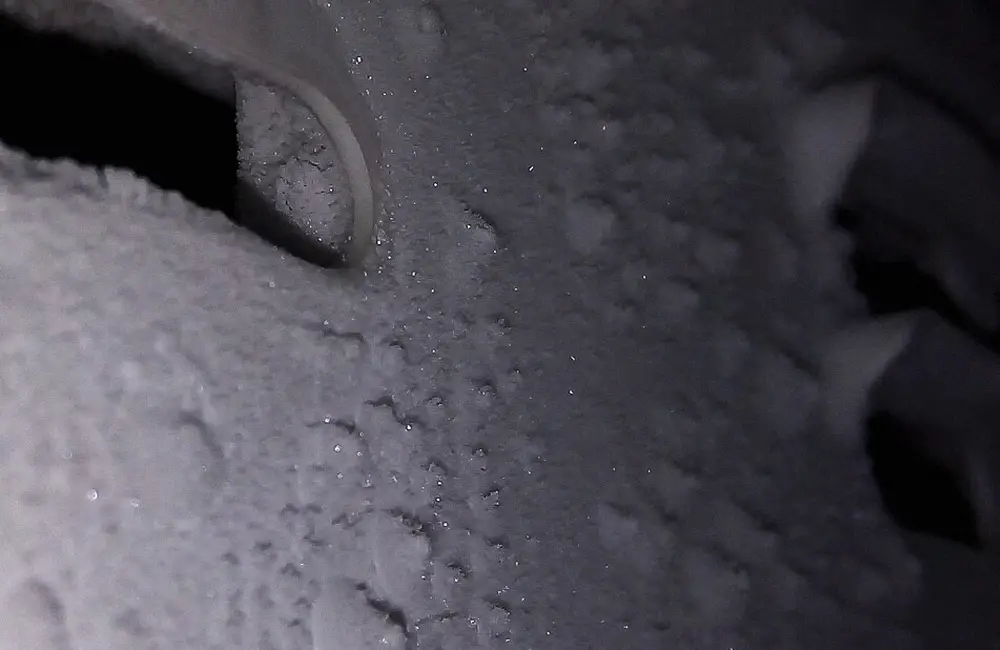
The frost photograph is illustrative: visible ice does not prove that an air conditioner is low on refrigerant. The frost pattern, blower operation, air temperature, superheat, and control history all need to be considered.
Low Charge, Restrictions, and Flash Gas
Low refrigerant can contribute to unstable operation, especially if suction pressure falls far enough to open a low-pressure control. The compressor stops, pressures recover, the control closes, and the compressor starts again. This can repeat every few minutes.
However, pressure alone cannot confirm an undercharge. Danfoss explains that low charge commonly produces higher superheat, lower subcooling, and lower evaporator pressure. It also warns that an upstream obstruction can create flash gas at the expansion valve even when the system contains the correct amount of refrigerant. (Danfoss TXV Troubleshooting)
A technician should therefore distinguish among:
- An actual refrigerant shortage
- A restricted filter drier or liquid-line component
- Inadequate condenser subcooling
- Flash gas caused by pressure loss
- A receiver or liquid-line feeding problem
- Contamination or moisture
- An incorrectly adjusted or selected metering device
If testing supports a low-charge diagnosis, the next step is to find the source of the loss—not simply add refrigerant. See Can an Air Conditioner Lose Refrigerant Without a Visible Leak? and How Long Can an AC Run With Low Refrigerant? for related guidance.
Pressure Changes After Shutdown Are a Different Condition
Pressure movement immediately after shutdown is expected. Refrigerant continues absorbing and releasing heat, liquid continues boiling or condensing, and the high and low sides gradually move toward equilibrium.
That off-cycle pressure should not be compared directly with the stabilized suction and discharge readings of a running system. Static pressure primarily reflects refrigerant temperature and composition; it cannot establish whether the system has the correct total charge.
For a fuller explanation, read Why Refrigerant Pressure Rises After the AC Shuts Off.
How a Technician Should Diagnose the Fluctuation
A useful diagnosis requires a time-based record rather than one gauge reading.
- Confirm the equipment and refrigerant. Check the nameplate, service documentation, metering device, compressor controls, and required charging method.
- Verify the instruments. Compare suspicious electronic readings with a calibrated test instrument and inspect hoses, fittings, transducers, and sensor wiring.
- Stabilize the operating conditions. Restore normal airflow, close doors and windows, confirm fan operation, and allow the equipment to run under a meaningful load.
- Record synchronized readings. At regular intervals, log suction pressure, discharge pressure, suction-line temperature, liquid-line temperature, supply and return air temperatures, outdoor temperature, compressor current, fan status, and control signals.
- Calculate superheat and subcooling. These measurements help separate refrigerant-feed problems from charge, load, and airflow problems.
- Match each pressure change to an event. Determine whether the change begins when a compressor stage changes, a fan switches, a valve moves, frost forms, or a safety opens.
- Check the whole system before changing the charge. The U.S. Department of Energy’s air-conditioning diagnostic guidance emphasizes that faults and environmental conditions can interact, creating misleading charge symptoms unless testing is systematic. (DOE Air-Conditioning Diagnostics Guide)
What a Homeowner or Facility Operator Can Check
Without opening the refrigerant circuit, the operator can document:
- How long the compressor runs before stopping
- Whether indoor and outdoor fans keep running
- Whether the thermostat display changes or resets
- Whether airflow becomes weaker over time
- Whether ice appears on accessible tubing or the indoor coil
- Whether the outdoor coil is visibly obstructed
- Whether the air filter needs replacement
- Whether unusual clicking, hissing, or surging occurs
- The time and outdoor conditions when the problem appears
Do not release refrigerant, adjust a TXV, or add refrigerant based on an internet pressure chart. EPA guidance treats attaching or disconnecting gauges and adding or removing refrigerant as activities requiring the appropriate Section 608 technician certification for stationary equipment. (EPA Section 608 Technician Certification) Intentional venting of regulated refrigerants is also prohibited except for limited regulatory exceptions. (EPA Prohibition on Venting Refrigerants)
After the defect has been repaired and the nameplate refrigerant confirmed, technicians and equipment owners can review the applicable air-conditioning and heat-pump refrigerant category or browse all refrigerants available from Refrigerant Centers. The replacement refrigerant must match the equipment, service procedure, oil, components, and applicable regulations.
Frequently Asked Questions
Is it normal for suction pressure to move every few minutes?
Small changes can be normal when load, compressor capacity, or expansion-valve position changes. Large repetitive swings under steady conditions deserve further diagnosis.
Does fluctuating pressure always mean the TXV is bad?
No. Low airflow, an oversized valve, poor sensing-bulb installation, flash gas, refrigerant shortage, restrictions, changing load, and control cycling can all resemble TXV failure.
Can low refrigerant make the compressor cycle on and off?
Yes. If suction pressure drops far enough to open a low-pressure control, the compressor may stop and restart after pressure recovers. Other electrical, airflow, and control faults can produce the same pattern.
Why does head pressure rise and fall while the compressor keeps running?
A cycling condenser fan, variable-speed fan, changing outdoor airflow, staged condenser control, or changing compressor capacity may be responsible. Dirty coils and unstable fan controls should also be checked.
Can a bad pressure sensor cause apparent fluctuations?
Yes. Loose wiring, electrical noise, poor sensor placement, calibration errors, and pressure pulsations can make a control or display report unstable values that are not confirmed by temperature or current changes.
Can static pressure determine whether the charge is correct?
No. Static pressure mainly follows refrigerant temperature and composition. A partly charged and fully charged system can show similar static pressure when liquid and vapor are both present.
Should refrigerant be added to stabilize the pressure?
Not until the system has been tested. Adding refrigerant to a restricted, overcharged, low-airflow, or incorrectly controlled system can make the fault worse.
Conclusion
Refrigerant pressure that changes every few minutes is not automatically a sign of low charge or a failed expansion valve. It may reflect normal compressor modulation, fan cycling, load changes, or valve response. It may also reveal short cycling, evaporator icing, a restriction, unstable liquid supply, or a faulty sensor.
The reliable approach is to record both sides of the system along with line temperatures, airflow, electrical data, and control events. Once the repeating pressure change is matched to a specific event, the technician can correct the cause instead of guessing from a single gauge reading.











